Tuesday, March 27, 2018

finally some clear weather

More than a month since my last post; we've had consistently cloudy weather since then.  Last night was the first clear night since then, though transparency was a poor 2/5 with a haze blowing in from the ocean.  Seeing was decent 6-7/10, so I had a satisfying night observing the waxing gibbous moon.

It was a good session mainly because of the 21st Century Atlas of the Moon, which I bought a couple weeks ago.  I have probably 10 books and atlases of the moon, but none of them are convenient to use at the telescope.  This atlas his made of water-resistant paper, and has a spiral binding so it can lay flat in my chart holder.  Best of all, the image scale is well matched to 553x through my 12.5-inch scope, so what I see on the chart matches the eyepiece view.  The photos are based on the LRO and have more detail than I can see, but at least there is enough detail there for me to try to strive to see more.  And, finally, I can identify what I can see, and even crater hop to different targets.  The atlas highlights interesting features on the facing pages of each section, giving me some specific things to look for.  I'm very happy with it.

I spent most of my night around Plato, plate 19.  After a couple of minutes searching, I could see the four main craterlets on Plato.  It wasn't just waiting for the seeing to still, but remembering where they should be and what they should look like.  The Plato Rilles were highlighted in the Atlas as a special feature, so I was able to see two of them, east of the crater especially one long sinuous one.   Next I panned to the Teneriffe Mountains, the peaks of which rise above the Mare Imbrium plain, and the twin peaks of Mt. Pico.  Further away was the tall Mt. Piton, and identical looking craters Piazzi Smyth and Kirch. 

Next I came back to the Straight Ridge and then searched for the Maupertuis Rilles.  I remember seeing many forked and short rilles flowing down to the Mare when I looked at the atlas earlier with a magnifying glass.  Now I saw just one prominent rille.  Maupertus crater was rough edged, and four interior peaks were lit in the shadow-filled crater, and looked like a "chicken foot."  There seemed to be many fractures and ridges running in straight lines from the crater toward the area where the rilles were.

Promontorium Laplace was interesting for the long sharp cone shadow it cast beyond a group of four small hills to its west.  Three of these were lit peaks in shadow, but one of them cast another long pointed shadow next to the one from Laplace, forming a sharp double tip to the shadow and strangely terminating at the same "length."

 Helicon and Le Verrier were also highlighted.  They looked identical except Le Verrier is supposed to have a lot of ejecta rubble around it; I did not see that clearly, but did notice some softening around it.  I may not have had the right light angle.

I looked for rays around Anaxagoras, but could only see a rimmed crater.  Philolaus was shadowed in, but had a very rough and thick comma shaped mountain ridge trailing away from it.

After resetting my equatorial platform, I looked around Copernicus, plate 22, and immediately noticed domes -- something I did not see before.  These were the Hortensius Domes, and I could see all six including the summit pits on five of them -- old volcanos.  I noticed another, larger dome nearby, Milichius Dome Pi -- much wider and it seemed taller, but with a not very prominent summit pit.  There were some smaller, flatter domes nearby.  North of there I noticed another "face" in the moon: it was a hill feature near a sweeping curve hill, which made it look like an old woman in a hood, with a very short arm pointed toward the Pi dome.  In the below photo it is labeled as a megadome and she is facing up. 

Image result for milichius dome


I don't know why I keep seeing faces, animals, etc. in the features on the moon, I suppose it is natural. 

So, more of this.  It was really great to get out and try to forget the usual stresses of life with time well spent outside.

Saturday, February 24, 2018

LDS doubles

Last night had a short window of clear skies, with some decent seeing.  I've had my 20-inch set-up in the back yard to debug the ServoCAT install, but tore it down a few days ago due to some rain.  So I used Big Blue instead.  I started out around Orion to re-align my finders.  The E & F stars in the Trapezium were easy.  I poked around in Taurus and while in the Hyades found three new to me designations, LDS, which if this sampling is any guide, are very wide separated pairs, good binocular splits and probably never considered pairs due to their large separations.

STF 774 / Alnitak: 270x viewed while aligning finders.  AC is a very faint star widely separated outside of the main star's glare.  AB also seen, about 2" and 1.5 delta mag.  Surprised seeing as good as it is for the start of a session.
05H 40M 45.52S -01° 56' 33.3" P.A. 166.8 SEP 2.18 MAG 1.88,3.70 SP O9.5IBE DIST. 225.73 PC (736.33 L.Y.)

37 Tau: Orange star with 2x fainter wide pair; nice airy disks. [AB seen; AC is STG 4, 12th mag and super wide]
04H 04M 41.71S +22° 04' 54.9" P.A. 193 SEP 134.3 MAG 4.46,10.01 SP K0III DIST. 57.37 PC (187.14 L.Y.)

STF 479: 2+1 system?  AB is wide but closer than the AC; about half a delta mag.  C 2x fainter and much wider. [indeed triple]
04H 00M 56.81S +23° 12' 05.4" P.A. 127 SEP 7.5 MAG 6.92,7.76 SP B9V DIST. 328.95 PC (1073.03 L.Y.)

BUP 55: Yellow-orange, suspect a brightening very wide, but uncertain.  [AB 0.5" but 5 delta mag, not seen; AC very wide and 13th mag, not possible.
04H 22M 56.03S +17° 32' 33.3" P.A. 336 SEP 111.8 MAG 3.76,13.21 SP K0III DIST. 47.71 PC (155.63 L.Y.)

Ho 328: Olive shape.  Light yellow-orange star, no clean split but clearly elongated. [! not bad for 0.4" separation]
04H 17M 01.22S +19° 40' 32.6" P.A. 355.8 SEP 0.4 MAG 7.38,9.06 SP F5V DIST. 84.53 PC (275.74 L.Y.)

STF 520: Faint elongated / overlapping disks.  Two more stars wide with averted vision, maybe a system? [binary only, 0.63"!]
04H 18M 14.55S +22° 48' 24.6" P.A. 83.6 SEP 0.63 MAG 8.26,8.45 SP F5 DIST. 153.37 PC (500.29 L.Y.)

LDS 5535 / Omega Tau: Nothing close; may be the very wide finder split, 2 delta mag?
04H 17M 15.69S +20° 34' 43.5" P.A. 118 SEP 179.3 MAG 4.95,9.63 SP A3 DIST. 28.94 PC (94.4 L.Y.)

Ho 328: Tentative.  Very faint, very close ~0.8", emerges with seeing, hair split -- but could be flaring, not quite solid.  [Probably not seen, could not have split a 0.4"]
04H 17M 01.22S +19° 40' 32.6" P.A. 355.8 SEP 0.4 MAG 7.38,9.06 SP F5V DIST. 84.53 PC (275.74 L.Y.)

BU 87: Orange star with 1.5" blue 3 delta mag pair.  Definite disks, well split, round with seeing.
04H 22M 22.74S +20° 49' 16.4" P.A. 167 SEP 1.9 MAG 6.21,8.60 SP B3V+K3II DIST. 714.29 PC (2330.01 L.Y.)

STF 545: Wide, white, 1.5 delta mag. 
04H 27M 04.85S +18° 12' 27.1" P.A. 58 SEP 18.5 MAG 6.92,8.78 SP A0V DIST. 106.5 PC (347.4 L.Y.)

Bgh 2: Another new designation.  White, wide, 1 delta mag.
04H 29M 30.35S +17° 51' 47.4" P.A. 9 SEP 109.5 MAG 6.95,9.06 SP G5 DIST. 46.4 PC (151.36 L.Y.)

LDS 2246: A star is white, bright, perfect disk with nothing nearby, so the pair must be a very wide, 2 delta mag?
04H 30M 33.63S +16° 11' 38.5" P.A. 130 SEP 254 MAG 4.78,6.54 SP A6IV DIST. 43.2 PC (140.92 L.Y.)

Aldebaran: Marked as a double so had a look.  Very bright orange with a lot of glare, but there is a steady faint star halfway to the field stop riding it out.  [Likely STFB 2, AC; though there are a few other much fainter stars, 6 visible, which would be fun to go after in the 20-inch]
04H 35M 55.24S +16° 30' 33.5" P.A. 32 SEP 134.7 MAG 0.85,11.30 SP K5III DIST. 20.43 PC (66.64 L.Y.)

LDS 2266: Orange, with a very wide 2 delta mag pair. [AB seen; there is a BC pair with C as 18th magnitude!]
04H 42M 51.64S +18° 43' 14.4" P.A. 102 SEP 141.2 MAG 7.18,10.20 SP G5+K3 DIST. 43.5 PC (141.9 L.Y.)

The quarter moon was moving through open cluster NGC 1647, so I swung over there to look for any occulting stars.  Not finding any (by this time there was haze blowing in, transparency was dropping) I used an orange filter at 553x and paned around various features.  Four Plato craterlets seen easily, etc.  It grew very cold by 10pm and feeling tired I packed up.

Sunday, February 11, 2018

willow springs midweek


Thursday night I arranged to observe from Willow Springs with Steve.  I really couldn't afford the time away from work, but I very much wanted to get out.  Steve had plans at Lake Sonoma but changed them for a chance of darker skies.

I brought my 20-inch, first time out in quite a while.  I finished doing the mechanical install of the ServoCAT but had not yet turned anything on, so I content myself with manual star hopping for the session.  I was already tired from a long day of work, and my note-taking suffered from lack of focus.

Before I began Steve showed me a finder chart for the Eridanus Loop, a second supernova remnant overlapping with Barnard's Loop.  I tried my 2x42 Vixens with various filters, and I thought I saw a N-S streak of something where it was supposed to be.  I could easily see Barnard's Loop, and the Rosette Nebula showed as a bright puffy glow.  Steve pulled Eridanus Loop Arc A up in his 24-inch, and we could see a brownish / muddy discoloration in the sky; best seen offset along its edge.  We were able to trace it for 2-3 degrees, including a kink in the stream.
Image result for eridanus loop

I started out from Algol, intending to star hop up to IC 275:

NGC 1198: Small, fairly faint, brighter core with averted vision.  Two pairs of stars in the NE halo.  Very diffuse halo, 3:1 NW-SE, maybe spiral?  [E-S0, 12.5v]


IC 284: Bright foreground star at core, bright core, 4:1 fairly bright halo N-S, moderately large.  A non-stellar brightening to the W edge of the core [which turns out to be another galaxy, PGC 11646].  11.5v.


NGC 1177 & 1175: NGC 1175 is faint, moderately large, diffuse, brightens with averted vision.  3:1 NW-SE, with a brighter core.  Non-stellar glow to north of it, is NGC 1177, small, round, fairly faint, likely a pair [in fact these two are on the edge of AGC 426, with several more NGCs in the immediate area].


NGC 1164: Small, very faint, round haze, averted vision needed.  SBab, 13.1v


NGC 1193: Unresolved milky white oval shape, NW-SE, with a dozen stars resolved across face.  To NW is a pretty blue and orange pair of stars.


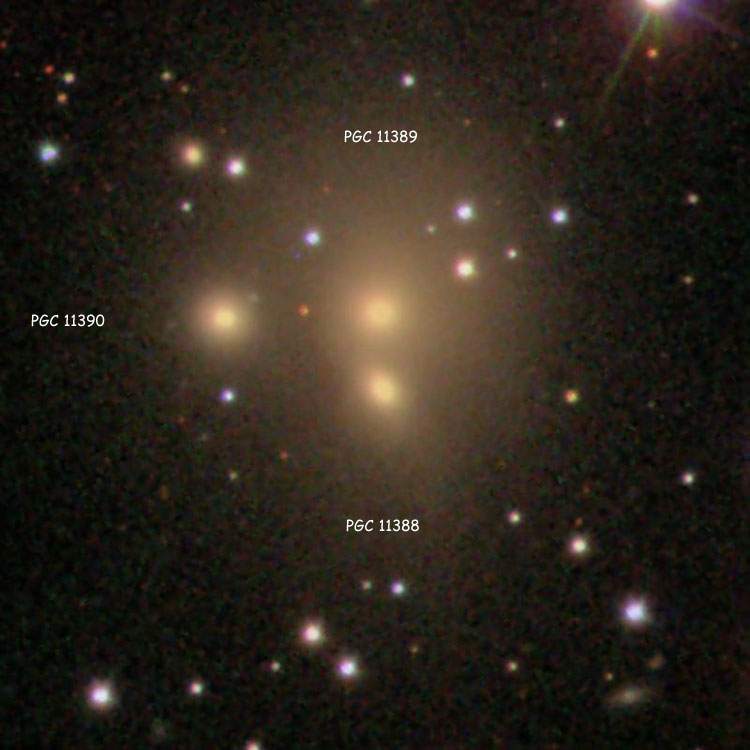
IC 275: Used 205x at first then 333x to try to see details. Largish mass of faint halo glow, with two brightenings near the center. I see another, smaller haze to the east, and another near an arc of stars [these are not galaxies, likely unresolved faint stars]. This is a group of three galaxies, PGC 11388 = A magnitude 16.5 elliptical galaxy (type E1?); PGC 11389 = A magnitude 16.3 elliptical galaxy (type E1 pec?); and PGC 11390 = A magnitude 15.6 elliptical galaxy (type E0?). I resolved the two brightest, but the third, PGC 11389, was not separated; its glow was likely combined with the other two.  ~460 mly distant.
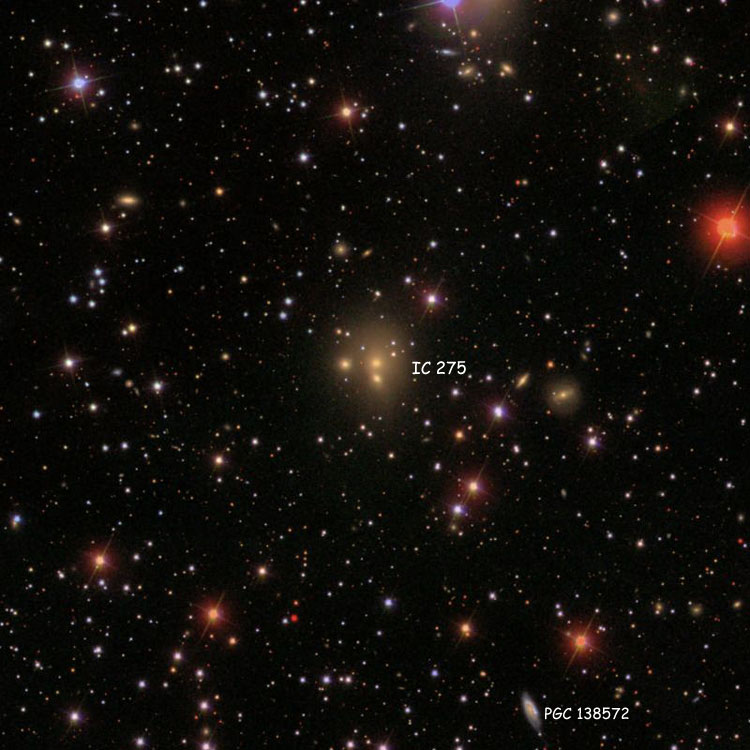
SDSS image of region near the elliptical galaxies that comprise IC 275, also showing PGC 138752, a possible candidate for the otherwise lost or nonexistent IC 274

SDSS image of elliptical galaxies PGC 11388, 11389 and 11390, which comprise IC 275


NGC 1160 & 1161: Striking field.  NGC 1161 is smaller but brighter, irregular 2:1 N-S; looks like a reflection nebula shining by the light of two stars nearby to the west [S0, 11.0v].  NGC 1160 is a 3:1 NE-SW with gradually brightening core and diffuse halo, likely a spiral [Scd, 12.8v].


NGC 2438: PN in M46: Fat ring shape, ragged nebulosity inside the ring.  Two stars inside the ring.  Both OIII and UHC enhance the view.  It's a foreground object to the open cluster, and adds drama to the view.  Good in all powers.
Image result for ngc 2438

CLR 5237: Calabash Nebula / "Rotten Egg" planetary nebula (since it is giving off sulfur).  This was plotted in Interstellarum, and so I supposed it could be visible.  Wrong.  I printed some finder charts and read one online reference that it was once seen as a "dim streak."  After much searching and confirming the star field (which is very close to NGC 2438), I noted an "excessively faint grey roundish glow a little east of the AAVSO finder chart position.  No central star unless the field star is it.  UHC seemed the best."  After getting home I realized what I saw was a roundish vacancy of stars to the east of where I was looking.  The nebula itself is extremely small, and when I search for Calabash nebula I find one positive observation in Jimi Lowrey's 48-inch telescope.  So why is this plotted in Interstellarum?  In this image, CLR 5237 is in the lower right corner, slightly bow shaped; note the round vacancy of stars just to its left; that's what I saw...
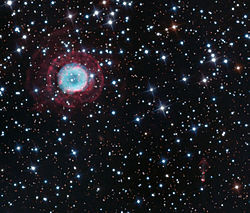
Image result for calabash nebula


SaSt 2-3: Planetary nebula.  At 333x, appears as a faint star nearby to the SW of a brighter one.  Remains stellar with OIII.


Next I went up to Hydra's head and just looked for objects plotted on Interstellarum:

NGC 2644: Faint with a brighter mottled core, 3:1 N-S, with a faint extension / spiral arm looping up to the north then east. [Sc, 12.4].


IC 2420: Small bright core with a mass of halo sweeping up to the east, which could be the brighter part of a spiral arm.  [This is actually a round lenticular galaxy; the "spiral arm" I thought I saw may just be the unresolved faint star.]


BU 335: Close, ~1", 2 delta mag.  [Way off on the separation estimate; I found seeing / collimation may have been a problem with doubles during this session.]
08H 48M 12.24S +02° 34' 48.4" P.A. 266 SEP 2.7 MAG 7.46,9.41 SP F5 DIST. 153.37 PC (500.29 L.Y.)


NGC 2713 & 2716: NGC 2713 has a just stellar nucleus, compact round core, and a bright, surprisingly long halo, ~6:1 NW-SE, tapering slowly.  NGC 2716 to the NE in the view is small, round, but mottled -- maybe spiral arm to the north?  Bright core but not stellar nucleus.


NGC 2723: Galaxy is small, fairly faint, round but mottled, seems to have arms east and west sides.  Stellar nucleus with a foreground stars east and west of halo. [S0, 13.2; arm on west side may be unresolved stars.]


NGC 2729: Small, generally round, fairly faint, mottled, may be spiral.  Bright round core with a foreground star just east of core.  [S0, 13.4]


NGC 2718: Fairly bright, bright core elongated NW-SE, stellar nucleus, and oval halo [it is a barred spiral SBab 11.8v].  UGC 4703 is a extremely faint, very small non-stellar round glow 5' to the NW.


Per 1: double star: Tried a number of magnifications, but no split.  It's an orange-yellow star, suspected very faint star to the north but it's too far and intermittent with seeing.  Should have brought my off-axis mask!
08H 51M 13.71S +08° 20' 18.6" P.A. 354 SEP 0.8 MAG 8.30,9.59 SP K0

Leo I and IC 591: Leo I was very large greying of darker sky background, saw the round outline while panning around the field and with Regulus out of the field.  IC 591 is small, fairly faint, has a bright core and fainter halo, elongated 3:1 N-S; it is on the western rim of Leo I.


NGC 3130: In field with 31 Leo; can see the galaxy with the bright star in the field but view improves when keeping it out.  Bright core, just stellar nucleus, 3:1 NNE-SSW, some mottling in the core and halo.


IC 595: Small, extremely faint, round.  Averted vision brightens the core and small bright nucleus; diffuse halo.


NGC 3070 & NGC 3069: NGC 3070 is small, round, fairly faint, with a bright core, stellar nucleus, larger halo.  NGC 3069 is very small and very faint but has a long 5:1 N-S halo, bright core appears offset to south of halo.


NGC 3226 & 3227: Striking scene.  NGS 3227 is large, bright, with stellar nucleus and elongated core with faint tapering halo, 3:1 NW-SE.  NGC 3226 is a round to oval elliptical mass bordering the NE tip of NGC 3227, with a bright core & quasi-stellar nucleus, elongated 3:2 NNE-SSW.  Two galaxies either side.  I see two more galaxies on either side of 3227 [which according to the DSS image seem to be wispy ends of spiral arms of 3227! It is a SABa Seifert 1 11.79v]  3226 z=0.00423, 3227 z=0.00365, so maybe they are not interacting?  However the area is referred to as the NGC 3227 Group...


2M1134-2103: Quadruple-lensed quasar: I noticed this item in a post on Deep Sky Forum.  This and another lensed quasar were discovered in the last few months (pre-print published in January 2018 https://arxiv.org/pdf/1711.02674.pdf ).  One was ~19th magnitude, but 2M1134-2103 was around 16th, so I prepared some finder charts and gave it a try.  I found the field with low power then increased to 333x, and the star field matched the finder.  The quaser was very faint, stellar, not resolved to any components, and part of a trio of stars of similar magnitude.  I don't find any redshift value given for this one yet.

NGC 3763: Small, faint, bean shaped / irregular, 3-2 N-S, no core but a mottled haze.  5th magnitude Theta Crateris is very near to the NE and must be kept out of view. [SBc, 11.8v].  MCG-1-30-12 is on the opposite (north) side of Theta Crateris, in different field, and is a small, faint elliptical with a bright core.


Crater Globular Cluster, aka Laevens 1: This was plotted in Interstellarum, so I gave it a go.  I did not have a detailed finder chart, just a rough estimation from the atlas.  After a while staring at 333x I felt a "lucida" or brightening which reminded me of some Palomar globulars, within a triangle of stars.  I made a sketch of it and the surrounding star field.  Checking it on Aladin at home, I did sketch a string of stars very near to the globular, but the "lucida" I took for it was really an "over-density" of faint stars about 6' too far east.  This globular was discovered in 2014 and is likely the furthest away from the Milky Way center, some 470,000 light years (17x farther from the galactic center than earth).  It is thought not to be from the Milky Way, since it is too young (7b years).  It is thought to be a capture from the Small Magellanic Cloud, since its stars share spectral properties with SMC globular Lindsay 38, and it is found within the SMC debris stream.  It might also be leftover from an anonymous dwarf galaxy eaten by the MW.  In any case, why would Interstellarum plot such a no-see-um, except to have a "complete" list of all known MW globulars?


Friday, February 9, 2018

double stars around pleiades . M45

Big Blue, 553x most of the time. Seeing 6-7, Transparency 4/5. Viewed mostly around M45, tried to make a small project of viewing double stars around the Pleiades

STF 435: Wide orange and blue, 2 delta mag. Nice big orange finder split 1 degree to the north from here; one of which has a faint wide pair when viewed through the telescope.
03H 43M 06.52S +25° 40' 52.9" P.A. 3 SEP 13.5 MAG 7.20,8.87 SP F3V

STF 427
= V1268: Wide near equal orange in finder, loses color in the scope.
03H 40M 38.77S +28° 46' 24.0" P.A. 207 SEP 7 MAG 7.41,7.84 SP A1V+A2V DIST. 113.12 PC (369 L.Y.)

STF 401: Wide near equal. [SHY 445, 4 delta mag and 999” separation!?]
03H 31M 20.76S +27° 34' 18.5" P.A. 269 SEP 11.4 MAG 6.58,6.93 SP A2V DIST. 97.47 PC (317.95 L.Y.)

EI 7: Pretty finder split.

Tok 13: Orange-yellow with very wide 2x fainter B
03H 26M 35.36S +28° 42' 55.2" P.A. 129 SEP 96.4 MAG 6.59,10.00 SP G5IV-V DIST. 51.63 PC (168.42 L.Y.)

A 1830: Wide separation, 2 delta mag. [AC = GRV 195 3 delta mag super wide, likely what was seen. Aitken is 0.1” separation
03H 51M 20.24S +26° 21' 13.6" P.A. 166.9 SEP 0.12 MAG 8.02,8.00 SP F8

HU 813
: B not seen, too faint.
03H 40M 21.58S +21° 24' 20.6" P.A. 294 SEP 3.7 MAG 7.18,14.70 SP A5 DIST. 81.97 PC (267.39 L.Y.)

HJL 1024: Very wide faint companion, ~3 delta mag
03H 43M 41.53S +23° 38' 56.9" P.A. 175 SEP 196.8 MAG 7.96,9.61 SP A9V DIST. 131.93 PC (430.36 L.Y.)

HJL 1026: Two faint stars near two brighter stars. Pretty wide, 1 delta mag. View disrupted by the brighter stars, the finder not at enough scale to separate them. [Multiple system, seems the brighter stars are part of the system.]
03H 45M 54.47S +24° 33' 16.2" P.A. 130 SEP 149.6 MAG 5.75,6.42 SP B8V DIST. 114.03 PC (371.97 L.Y.)

BU 536: Large pair split in the finder. In scope it is a 2+1, but there are two fainter stars seen, one 5” from its star. Can not find a 0.9” pair which is supposed to be there. [6 stars in system, so it’s a little confusing…]
03H 46M 16.00S +24° 11' 23.5" P.A. 179 SEP 1.03 MAG 8.13,9.39 SP A7V

BU 537: Seeing too unsteady; suddenly it is very poor.
03H 47M 03.55S +24° 49' 11.7" P.A. 219 SEP 0.6 MAG 8.70,10.70 SP A9V

STF 450: Easy yellow-blue 5” 1.5 delta mag. [AB seen. AC = HL 21 and is 6.65 delta mag and very wide separation.]
03H 47M 24.41S +23° 54' 52.8" P.A. 261 SEP 6.2 MAG 7.29,9.40 SP A2V

STF 449: B comes to view with seeing and averted vision. Wide ~7”, 2 delta mag. [Not sure what I saw, my separation too close; 6 stars in system.]
04H 10M 04.99S +24° 06' 53.8" P.A. 281 SEP 31 MAG 10.36,11.12 SP G0 DIST. 166.67 PC (543.68 L.Y.)

STF 457
: Messy elongation but not split. [0.9”, should have been doable, if seeing was better.]
03H 50M 19.66S +22° 40' 41.6" P.A. 91 SEP 0.9 MAG 9.31,9.44 SP F5

sunday doubles

A Sunday night session with Big Blue, through clouds which were not in the forecast! Was able to see E & F in the Trapezium. The seeing was Pickering 6, not great (it was forecasted to be better).

Eta Orionis: Bright white, 1 delta mag, hazy but split (maybe scattered light).

Bvd 51: Picked out a wide, 2 delta mag pair right away using 8mm, but felt the slightly reddish A might be a very close pair. Used barlow though seeing did not support it. Did not split but suspected elongation. [The wide pair is it.]
05H 15M 23.69S -03° 21' 57.4" P.A. 317 SEP 44.5 MAG 7.76,9.56 SP F7V+G1V DIST. 83.26 PC (271.59 L.Y.)

BU 189: Took a while but was able to get a solid observation. Seeing needed to still (and cloud pass out of field of view) then a 3x fainter point comes to view with averted vision, can barely hold it. ~5”. [HDS 702 is the A star, 0.5” separation, not seen!]
05H 20M 26.41S -05° 22' 03.1" P.A. 285 SEP 4.6 MAG 6.41,9.80 SP B8III DIST. 281.69 PC (918.87 L.Y.)

STF 667: Pretty orange A and 2x fainter B, which is a little blue-orange. 5”
05H 14M 41.31S -07° 04' 18.1" P.A. 316 SEP 4.2 MAG 7.15,8.78 SP K2 DIST. 297.62 PC (970.84 L.Y.)

Bvd 52: Another one from this new designation! Passed RX Lepus on the way down, a medium deep orange. Bvd 52 seems a system of stars, all pretty wide. The closest two of similar magnitude, the other stars are fainter. How do they know / notice they are binary? [It’s a single pair, not sure which one.]
05H 18M 08.86S -16° 11' 13.4" P.A. 227 SEP 89.7 MAG 7.72,9.05 SP G/KIV+G3V DIST. 56.85 PC (185.44 L.Y.)

STF 661: Surprisingly large delta mag for a Struve, ~3-4 delta mag! But B star is brighter than a typical Burnham. 1.5-2”, B in A’s diffraction.
05H 13M 13.87S -12° 56' 26.4" P.A. 357 SEP 2.2 MAG 4.43,6.77 SP B9V DIST. 223.21 PC (728.11 L.Y.)

Iota Lepus: Bright but more widely separated B than STF 661. 3 delta mag, ~4”. RX Lep in finder, red-orange. [HUB 6 is a 0.4” 2.44 delta mag to A]
05H 12M 17.89S -11° 52' 08.9" P.A. 337 SEP 12 MAG 4.47,9.92 SP B8V DIST. 71.07 PC (231.83 L.Y.)

STF 701: White and ruddy / rusty. ~6”, 1 delta mag.
05H 23M 18.50S -08° 24' 55.9" P.A. 139 SEP 6.3 MAG 6.13,8.09 SP B8III DIST. 122.7 PC (400.25 L.Y.)

STF 982: Bright orange and slightly red star, 2-3 delta mag. [AB seen; AC and AD fainter and wider]
06H 54M 38.63S +13° 10' 40.1" P.A. 142.5 SEP 7.32 MAG 4.75,7.80 SP F0VP DIST. 25.63 PC (83.61 L.Y.)

Ho 342: Split when seeing stills; orange A and yellowing B, 1.5-2”
07H 02M 50.54S +13° 05' 21.7" P.A. 87 SEP 1.1 MAG 7.99,8.71 SP F5 DIST. 212.31 PC (692.56 L.Y.)

STF 1007: Pretty equal white finder split; one star with one companion seen through eyepiece? [AC and AD pairs]
07H 00M 37.12S +12° 43' 24.2" P.A. 300 SEP 14.9 MAG 7.43,11.40 SP A2V DIST. 280.11 PC (913.72 L.Y.)

Eng 28: Pretty, wide equal finder split, white, nice field. [BUP 96 3.5 delta mag very wide BC]
07H 08M 00.24S +15° 31' 42.9" P.A. 99 SEP 171.9 MAG 7.86,7.74 SP G0V DIST. 46.75 PC (152.5 L.Y.)

Wei 14: Right triangle. B fainter, almost need averted vision. Third more steady and wide.

Ho 346: Orange and much fainter blue B, ~10” 3 delta mag. Nice! [WAL 51 is AC, 6.25 delta mag!]
07H 25M 54.13S +18° 08' 51.0" P.A. 58 SEP 13.5 MAG 7.04,11.70 SP G5 DIST. 324.68 PC (1059.11 L.Y.)

STF 1090: Pretty finder split, equal white. Is a 2+1 with 2x fainter. [AC, BC wider and fainter.]
07H 26M 27.33S +18° 31' 00.8" P.A. 98 SEP 60.7 MAG 7.27,8.17 SP F2V DIST. 112.23 PC (366.09 L.Y.)

STF 1083: Equal wide, white.
07H 25M 35.30S +20° 29' 42.6" P.A. 46 SEP 6.8 MAG 7.32,8.13 SP A5 DIST. 132.45 PC (432.05 L.Y.)

NGC 2392, Eskimo Nebula: Bright central star, inner ring with lots of mottling; green larger round, diffuse halo with soft edges. With OIII, central star is gone, but nebula is a little more apparent, with same features.

Wednesday, January 31, 2018

lunar eclipse

This morning was a "super blue blood moon" or something like that.  Super because the moon is closer to earth than usual, blue because it's the second full moon an January (a little arbitrary since humans made up the calendar), and blood because it's a lunar eclipse and would show in sunset colors from sunlight refracting through earth's atmosphere along its whole circumference.   "Peak" was to be at 5:30am

I set my alarm for 5am but woke on my own a few minutes before.  I was surprised that it was clear since we've had nothing but clouds for more than a month.  The moon was in between some yew trees on the west border of our yard, a nice dark orange-red, with a lighter crescent along the bottom.  I had a look by myself with binoculars for a while, then woke up Val and Clara (Carol was sick and needed to sleep).  We went outside wrapped in sleeping bags and blankets, and sat in reclining lawn chairs for a look.  It was cold but we were cozy.  We looked and used the binoculars, and talked, and listened to the morning sounds.  The bright crescent seemed to move over the minutes to the left / east limb of the moon, a sign of the moving shadow.  Val was excited to see her second eclipse in less than a year.

A very nice morning -- after a while we went back inside, Clara to sleep on the couch and Val and me to read until everyone was up.

Friday, January 26, 2018

plato's craterlets

It's been nearly a month since I was able to observe last.  Weather has been consistently cloudy, usually without rain, but enough to put the kabosh on any telescope time.  Tonight was a little exception, and after a long and difficult day at work, I felt the spur to go outside instead of laying on the couch watching youtube.

I brought out my 8-inch f/7.25, which sets up quickly and always put up lovely images.  I used it for the AL carbon star and some of the double star lists.  There was a just past quarter moon up, and a constant flow of haze blown across it from the ocean, and some wisps of clouds making slow sweeps through the sky.  I poked around Orion for a while, changing powers depending on my mood.  It was my first look this season.  M42 at low power, then zooming in on the trapezium, where I could see pin pricks of E & F stars at 184x.  Rigel was at the tip of the meridian tree; with the uppermost branch acting as a apodizing mask, I was able to get A & B.  Pleiades full in the finder.

Then I moved to the moon, again poking around at low power, tracing ray patterns and jagged edges of the basins.  No hurry.  There was an orange star off the dark side, and I thought it might be occulted, so I kept tabs on it for a half hour, but it was too far apart.  Pretty, though.  I decided to remove the moon filter to see if I could find any other stars near the dark limb, so I used the 8mm with a barlow at 368x to view, but found none.  I did notice, though, that the detail on the moon seemed sharper without the filter.  I started panning about enjoying the detail when I came upon Plato.

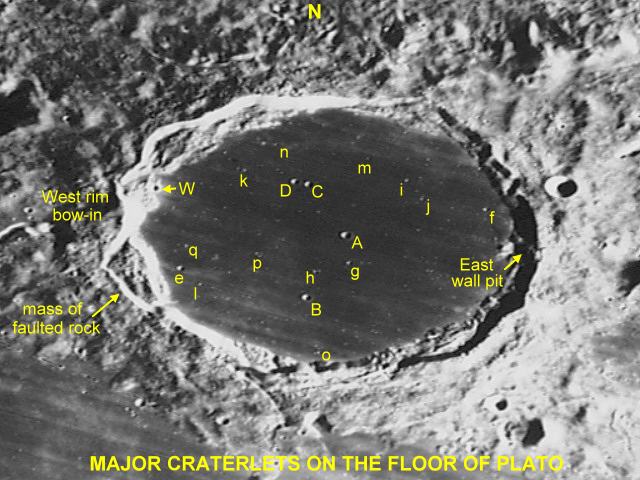
Seeing was steady enough I ought to try for the craterlets.  To my great surprise, I saw a light colored but very distinct crater near the center.  This is craterlet A.  On the next pass saw a close pair of craterlets, like a double star, to the lower left in the view from the first.  These were C and D.  All the craterlets were seeing dependant, but I could catch them on three out of four passes on the undriven mount.

This was exciting!  I had long thought of going after these, since they are considered a challenge.  I went into the house to grab a finder chart of the craters.  I studied that for a while, then went up to 589x and, with some effort noticed a light colored smear, which after a couple more passes resolved for a moment into a crater -- B!  So now I'm up to four craterlets seen.  I tried pretty hard for a couple more: e seemed a darkening in the notch of the crater rim, but it was too uncertain.  g seemed to be a light smear again, but it was too uncertain.

I was very happy with four, having not expected anything much from the session but casual viewing.

Image result for plato craterlets

By the way 589x was fairly comfortable.  The scope focused well and the seeing was merely watery.  It's more than 70 times aperture, which is a testament to the mirror's quality -- made by a total amature who learned how to do it reading a book!