Thursday, June 22, 2017

more doubles

The night of the 20th I was out with the 12.5-inch again.  There was a large temperature drop so seeing did not settle until after 10pm.  Viewed Jupiter for a while at 277x, with the GRS right in the middle of the band.  Spent some more time in CVn for doubles:

STT 272: Seeing not very good -- can't make out the 10th mag faint B
13H 54M 25.48S +29° 54' 56.3" P.A. 358 SEP 1.3 MAG 7.56,10.18 SP F2 DIST. 107.53 PC (350.76 L.Y.)

STF 1600: Pretty orange and blue pair, 8-9 mag, 1.5 delta mag, wide separation ~10"
12H 05M 34.42S +51° 55' 52.2" P.A. 94 SEP 7.8 MAG 7.63,8.28 SP G8III DIST. 369 PC (1203.68 L.Y.)

STF 1609: Orange and blue, 2 delta mag, pretty. [AB seen.  AC 13.78 mag, not seen]
12H 11M 41.76S +50° 50' 15.8" P.A. 204 SEP 11.3 MAG 7.98,9.55 SP F2 DIST. 184.84 PC (602.95 L.Y.)

STF 1679: Fairly faint equal magnitude, 3" [AB seen; AC 13.68 mag not seen]
12H 46M 00.83S +49° 49' 23.0" P.A. 207 SEP 5.9 MAG 9.62,10.01 SP F6IV DIST. 113.64 PC (370.69 L.Y.)

STF 1718: faint equal pair with wide separation [AB,C seen.  AB is 0.2" not seen--BU 643, Burnham find]
13H 05M 30.27S +50° 59' 11.0" P.A. 272 SEP 12.7 MAG 9.84,10.07 SP F8

STF 1758: Evenly matched yellow-orange pair ~4".  Nice
13H 32M 51.51S +49° 08' 24.3" P.A. 290 SEP 3.3 MAG 8.7,8.95 SP G0 DIST. 77.04 PC (251.3 L.Y.)

STF 1770: Tight light orange pair, 2 delta mag, ~1". Needed 443x to split.
13H 37M 42.92S +50° 42' 53.5" P.A. 122 SEP 1.7 MAG 6.93,8.18 SP K3III: DIST. 434.78 PC (1418.25 L.Y.)

STF 1774: Wide white and blue 3 delta mag.
13H 40M 23.35S +50° 31' 09.4" P.A. 135 SEP 18.1 MAG 6.34,10.51 SP F7.7V DIST. 25.33 PC (82.63 L.Y.)

HU 644: !! Orange-red pair, near equal mag, split with seeing at 443x
13H 19M 45.58S +47° 46' 41.1" P.A. 84 SEP 0.64 MAG 9.11,9.87 SP K0 DIST. 10.71 PC (34.94 L.Y.)

STF 1776: Near equal white, well split
13H 41M 47.70S +46° 13' 11.2" P.A. 18 SEP 7.3 MAG 9.36,9.37 SP G0+G0 DIST. 152.21 PC (496.51 L.Y.)

Nights are too short this time of year, so it was not a long session.  The night of the 21st was excellent but I did not feel well so did not observe.  I'm finding I very much enjoy finding these Burnham pairs, they are often challenging and very rewarding.

Tuesday, June 20, 2017

summer viewing

The nights are very short now, such that it's not really dark until 10pm, leaving a scant 1 hour of viewing.  It is made up for a little with twilight views of Jupiter.  So the last couple of nights have been clear with good seeing, and I've been able to spend some time on Jupiter and some fine double stars in CVn

The night of the 17th found Jupiter in the midst of some complicated Galilean moon movements.  I should have checked the ephemeris in advance!  Io and Ganymede were approaching the limb for a transit, and Europa was heading to the opposite limb for an occultation.  Using the 12.5-inch at  443x I watched Io begin its transit and could still see its disk for quite a ways into the NEB.  Europa disappeared a few minutes later after hanging on the limb like a bright bump.  Finally and hour later I saw Ganymede start its transit, very near the north pole.  I wonder why the orbits are tilted so low, when the planet appears to be viewed square on?  I viewed some double stars for a while then about another hour later Io's shadow began its transit, just about the same point at which its disk touched the limb.  I viewed Jupiter again the following night, with plenty of turbulence in the bands, but there were no moon events.

Here are doubles viewed both nights:

@ 277x:

STT 250: no chance for the close 0.3" and 1 delta mag pair, but there is a faint 3 delta mag star pretty widely separated.
12H 24M 24.51S +43° 05' 15.0" P.A. 351 SEP 0.3 MAG 8.27,9.18 SP F0 DIST. 245.7 PC (801.47 L.Y.)

A 1781: Very fine faint pair, 1 delta mag, ~3"
12H 16M 19.33S +44° 43' 25.9" P.A. 302 SEP 2.8 MAG 10.23,11 SP G5

STF 1642: Very nice light orange and blue, 1 delta mag, ~3"
12H 25M 45.00S +44° 44' 04.4" P.A. 179 SEP 2.5 MAG 8.8,9.4 SP F5 DIST. 244.5 PC (797.56 L.Y.)

STF 1645: Wide, bright yellowish-white pair, ~1 delta mag
12H 28M 04.45S +44° 47' 39.5" P.A. 157 SEP 9.8 MAG 7.49,8.08 SP F9V DIST. 43.61 PC (142.26 L.Y.)

Gamma CVn: Nice bright orange

STT 257: Wide white and dull blue-white pair.  
12H 56M 44.77S +45° 36' 45.1" P.A. 352 SEP 12.6 MAG 8.53,9.56 SP F2VP DIST. -2702.7 PC (-8816.21 L.Y.)

BU 925: Bright white and extremely faint B, wide separation.  B flashes with averted vision to see, can hold with direct vision with seeing
12H 56M 38.81S +43° 33' 07.2" P.A. 211 SEP 7.4 MAG 6.98,11.1 SP A3IV DIST. 302.11 PC (985.48 L.Y.)

@ 553x:

BU 930: Thought I saw some mis-shape to the airy disk, but not certain.  -- very faint and close B not seen.
13H 05M 52.28S +45° 16' 06.6" P.A. 123 SEP 2.5 MAG 5.6,10 SP K0III DIST. 132.63 PC (432.64 L.Y.)

@ 277x, seeing started a little mediocre at the start of the next night:

STT 269: Wide but pretty faint pair, 2 delta mag. [AB,C seen, 6.81/9.18 123.4".  AB 0.3" and not seen.  There's also an AB,D pair, impossibly far 351.6" split]
13H 32M 51.02S +34° 54' 25.8" P.A. 332 SEP 123.4 MAG 6.81,9.18 SP A6III DIST. 147.93 PC (482.55 L.Y.)

STF 1768: Very pretty pale yellow and orange, 2-3 delta mag, ~2" [AB seen.  6 stars total in the system, most very widely separated.]
13H 37M 27.70S +36° 17' 41.4" P.A. 94.8 SEP 1.69 MAG 4.98,6.95 SP A7IV DIST. 60.9 PC (198.66 L.Y.)

STF 1755: Pretty orange and blue, 5-6", 2 delta mag. Nice.
13H 32M 21.99S +36° 49' 05.6" P.A. 130 SEP 4.2 MAG 7.34,8.1 SP G5III DIST. 206.61 PC (673.96 L.Y.)

HJ 1234: AB: B a faint blue orb, looks like a planet reflecting A's light.  Yellow A.  Nice!  [There's an Aa,Ab, 1.4" 5.89/11.55 discovered in 2008 and only observed twice -- would be great to see that]
13H 34M 21.87S +38° 47' 21.3" P.A. 9 SEP 28.6 MAG 6.4,10.51 SP F0IV DIST. 69.83 PC (227.79 L.Y.)

S 654: Striking yellow-orange and blue-green fainter B. [There's an AC 999.9" away...]
13H 46M 59.77S +38° 32' 33.7" P.A. 239 SEP 71.8 MAG 5.62,8.91 SP K0III+F8V DIST. 97.18 PC (317 L.Y.)

R CVn: tight round orange star...

HJ 1244: AB: Wow!! Very faint B but can hold it direct vision with the seeing.  Well separated from and orange-yellow A. Nice!! I needed to check the list at first to find out what I was looking for since I didn't see anything at first -- listed as a faint pair and went looking for it, found it.
13H 53M 20.79S +42° 11' 05.3" P.A. 132 SEP 6.8 MAG 6.87,10.81 SP A2IV DIST. 238.66 PC (778.51 L.Y.)

STF 1789: Pretty equal magnitude white, well separated.
13H 54M 05.19S +32° 49' 35.2" P.A. 328 SEP 6.6 MAG 8.63,8.97 SP F8 DIST. 71.43 PC (233 L.Y.)

Wednesday, June 14, 2017

triple double with Cor Caroli

While hunting faint and close pairs with my 12.5-inch last night, I realized there is a "triple double" which includes Cor Caroli! They're not all physically bound to each other, but it was a nice scene all the same.

Cor Caroli = STF 1692 is the well beloved Alpha Canum Venaticorum and was the start of my star hop for the night's list. About half a degree to the west was STF 1688, a faint pair (9.24/11.06, 14.4", 343°), yellow A and orangish B, which I identified using 340x. Next on the list was STF 1702, which was about half a degree to the east of Cor Caroli. It was a wide orange-yellow pair, 8.72/9.41, 36.1", 82°.

It struck me it might be possible to see all three in the same FOV, so I went down to 71x and 1.1° and yes, I could just squeeze all three in the view, the two fainter Struves just within the field stop on either side of the showpiece in the center. It helped to have already seen STF 1688, since it was the faintest pair to pick out.

It's these little scenes which give me great satisfaction while observing. It's nice to have something new to look for when observing an old favorite.

I started out looking at Jupiter in the twilight, which was showing a great deal of turbulence in the equatorial bands, including four dark oval storms in the SEB.  The GRS was advancing toward the limb and was a more vivid red orange than even a couple weeks ago.  The color of Jupiter is strange this year, it seems very pale.  The northern half is a rusty pink and the southern a tan brown.  

Other doubles observed (or not), at 553x:

Ho 256: I tried pretty hard to find it, but I was confused by the star field, despite using an 80mm finder now with a 20mm super wide reticule.  This is a 0.7" separation so it should not be impossible, but maybe the 7th to 9th magnitude delta made the difference.  The star I thought it was showed a round airy disk.
12H 44M 08.82S +35° 46' 07.3" P.A. 117 SEP 0.7 MAG 7.3,9.55 SP KA5HF0V.. DIST. 88.57 PC (288.92 L.Y.)

STT 251: Decidedly not round disk -- there's also a brightening in the diffraction -- but not really split.
12H 29M 07.72S +31° 23' 25.4" P.A. 61.4 SEP 0.68 MAG 8.35,9.27 SP G0 DIST. 173.61 PC (566.32 L.Y.)

STF 1646: Yellow and blue.  Need averted vision for B to reveal itself. Pretty!
12H 28M 09.12S +36° 41' 02.1" P.A. 260 SEP 5.3 MAG 10.3,12.9 SP F5

J1023: Excessively faint, averted vision required to pick out; small patches, airy disks not well resolved even when seeing stills.  At my limits.  Well separated.
12H 30M 46.44S +36° 39' 34.5" P.A. 172 SEP 5.2 MAG 11.1,11.3 SP G0

STF 1653: Easy, near equal pair, yellowish A and bluish B.  10" or so.
12H 33M 22.34S +32° 02' 23.4" P.A. 342 SEP 8 MAG 9.66,9.67 SP F3V+F3V DIST. 121.8 PC (397.31 L.Y.)

EI 615: Well separated bright pair, about 2 delta mag.

STF 1613: Very tight equal white, splits clean with the seeing
12H 12M 34.01S +35° 45' 45.6" P.A. 11 SEP 1.1 MAG 9.29,9.36 SP F5 DIST. 200 PC (652.4 L.Y.)

STF 1607: Wide split, 0.5 delta mag. -- This is a triple system with an AC and BC -- but at 14th mag.12H 11M 33.63S +36° 05' 21.7" P.A. 27 SEP 27 MAG 8.89,9.83 SP A3 DIST. 188.68 PC (615.47 L.Y.)

It was a nice session overall, despite the only hour or so of true darkness.  I had been ill recently so I didn't quite have the energy to take on too much.  There's more clear nights predicted now as we move into summer.

Tuesday, June 6, 2017

changing forecast

Forecast yesterday was for clear skies and above average transparency and seeing.  But there was an awful lot of haze in the air as I drove home, so I didn't bother to open up the observatory.  Then at dusk when taking out the trash I noticed it was fairly clear!  I opened up and tried to cool the mirror.

I had nice views of Jupiter at 340x: a striated southern polar region, darker than the northern; a baby red spot and other dark barges in the SEB; a large bruise colored festoon in the central band, a thick arc shape with a lot of filigree; white and dark rust colored ovals in the NEB; a bright band just north of the NEB when the seeing stilled; a very uniform color northern polar region.

Once the just past quarter moon cleared the meridian tree I had a look at it; nice detail too.  But once again thin fog blew over, scattering the moon's light over much of the sky.  So packed in early.

Forecast is clear once again tonight but there are still clouds and haze in the sky.  We will see what it will be like tonight.

Sunday, June 4, 2017

surprise shadow transit

I had high hopes for some observing last night, but a marine layer haze interfered with viewing, scattering the moon's light over the sky.  The moon was ~3 degrees from Jupiter, which was a nice view.  Jupiter itself shown nicely at 277x but seeing was not very good.  I noticed with surprise there was a shadow transit nearly over when I looked at around 9:20pm.  I saw Ganymede's shadow very low on the northern limb of the planet.  I should have looked at the ephemeris earlier, for I missed seeing Io's shadow by just 10 minutes!  Had I known it would be been a more exceptional night.  The moons are at an odd angle this time, crossing Jupiter along the north and occulting far to the south.  Callisto was making very rapid progress toward occultation.

My main interest was to see some doubles in Cvn.  I noticed two faint STFs very close to Cor Caroli, and wondered if they could be seen in the same FOV.  Cor Caroli was near zenith and it took me some time to figure out its orientation in relation to my charts.  I did find the STFs, but the haze and scattered light from the moon and average seeing conspired to fuzz the view.  I did not try a low enough power to get them in the same field -- I will need a moonless night.

Here are the doubles I recorded, the first two being close to Cor Caroli:

STF 1702: Orange and blue, faint, 0.5 delta mag, wide separation.  277x
12H 58M 31.97S +38° 16' 43.6" P.A. 82 SEP 36 MAG 8.72,9.41 SP G5V DIST. 44.21 PC (144.21 L.Y.)

STF 1688: Yellow A, orangish B, wide separation, both faint. AB pair seen, AC 13.44 mag, not see.  277x
12H 53M 35.26S +37° 58' 20.9" P.A. 344 SEP 14.1 MAG 9.24,11.06 SP G0 DIST. 318.47 PC (1038.85 L.Y.)

HO 256: 553x I can tell the airy disk is not clean indicating it's not single, but can't split for the seeing.  0.7".
12H 44M 08.82S +35° 46' 07.3" P.A. 117 SEP 0.7 MAG 7.3,9.55 SP KA5HF0V.. DIST. 88.57 PC (288.92 L.Y.)

At this point I switched from Carro Catalog objects to ones plotted in CDSA and went back to 277x:

STF 1723: Yellow and blue, around 5", 2 delta mag
13H 08M 13.49S +38° 44' 20.2" P.A. 11 SEP 6.1 MAG 8.67,10.08 SP G2IV-V DIST. 73.05 PC (238.29 L.Y.)

15 Cvn: Not clean diffraction; should be close pair but not split. [This is BU 608, and is the BC of the AB 17 CVN = EI 24.  It is 6.26/9.23 1.3" -- do deserving of a better night]

EI 24: Wide bright pair? [Yes, is 15 & 17 Cvn, 6.0/6.3, 278"]

h2639: Nice triple.  Orange-yellow A and bluish 2 delta mag B and C, wide sep.
AB: 13H 06M 13.50S +40° 55' 21.0" P.A. 159 SEP 37.2 MAG 7.48,11.23 SP K7III DIST. 819.67 PC (2673.76 L.Y.)
AC: 10.77 53.6".

At this point some definite clouds of marine layer started blowing in -- not just the persistent haze -- and it was time to wrap it up.  It was 11pm already -- only an hour and a half of usable observing time!

Friday, June 2, 2017

la luna

We've been plagued with clouds and marine layer fog the last week or more, so little observing to report.  I've tried to occupy my time creating more double star finders for constellations coming up.

Last night was relatively clear, but with torn shreds of marine layer passing overhead.  I had about 40 minutes of views of the moon, mostly along the terminator at 277x.  It's odd to me that the seeing was pretty good even with the marine layer blowing overhead.  As more fox moved in I switched to 71x 1.1 degree FOV to take in the whole scene. The moon was very sharp with plenty of fine detail -- a good way to train the eye to pick out small detail.

Might have some clear weather the next few days so hope for better results...

Sunday, May 28, 2017

list catch up from the Peak

Since last weekend was busy with family events, I could not get out to observe until Tuesday the 23rd, a work night.  The forecast predicted cloudy skies by 1am, leaving only 3 hours of useful observing time.  But I was determined to get out so I could keep up with my H2 list, which was all in the Virgo cluster -- if I waited until June Virgo would be too low.

I packed my primary mirror is a box so I could keep it in the air conditioned office during the day, rather than baking in my car.  This was a wise decision, since upon arrival at Fremont Peak my mirror was closer to equilibrium, and I didn't have any major thermal issues.  I set up and waited a long time for it to be dark enough to observe.  Transparency was 3/5 but seeing was very good, 7/10.  There was haze in the sky but it cleared tolerably well; from midnight to 1:30 bands of cloud moved through so I was chasing holes, until it was overcast completely.  There was a marine layer over Salinas but not Hollister; SQML topped at 21.1.  Temperature was fairly warm as I was in an inversion layer.  The conditions affected my results, as objects appeared dimmer than they ordinarily would.

I dove right into the Virgo cluster, thick with galaxies.  I was worried I wouldn't be able to navigate but I didn't have much of a problem.  I didn't spend more than five minutes on any one object -- a symptom of list-o-mania where I felt compelled to keep going rather than "soaking in the view."  I only have a few H2 objects left after this session, which I can finish in June -- then I can switch to more leisurely viewing.

All with the 20-inch, 205x except for one object as noted:

NGC 4880: moderately large, faint, slightly brighter core, no nucleus; 3:2 NNW-SSE.  Diffuse halo edge.  [SB0-a].
Image result for NGC 4880

NGC 4647: ! Small, fairly faint, but much elongated streak.  There is a long brighter bar or elongated core along its major axis, which is twisted.  [seems I observed the wrong thing -- I seem to have seen NGC 4637, which is next to NGC 4638.  In this photo the middle pair is M60/NGC 4647, in the lower right is NGC 4637 & 8.]
Image result for NGC 4647Image result for NGC 4637


NGC 4608: Small, bright round core, just stellar nucleus.  Elongated SW-NE; bright halo to tips.  [SB0; I saw the bar as an elongation but there is a faint round halo around the whole].
Image result for NGC 4608

NGC 4639: Round, moderately large, fairly faint glow, 3:2 NW-SE, even surface brightness to nearly stellar nucleus.  Star just off eastern rim.
Image result for NGC 4639

NGC 4571: Bright egg-shaped core with very faint, large diffuse round halo.  Near bright (double?) star to NE.
Image result for NGC 4571

NGC 4313: Tough hop to find.  Long, faint inclined spiral -- spiral structure hinted by mottling in the halo.  Averted visions brightens the halo and reveals a round core & just stellar nucleus.  5:1 NW-SE.  Nice!
Image result for NGC 4313

NGC 4299 & 4294: Wow! 4294 moderately large, moderately bright inclined spiral 4:1 NNW-SSE, bright large core diffuse halo to tips.  Star on NW tip. 4299 faint, fairly large, round, very diffuse.  Orientated E-W of each other in same FOV.
Image result for NGC 4299

NGC 4267: Intense bright nucleus and small bright core, very faint diffuse moderately large round halo.
Image result for NGC 4267

NGC 4168: Fairly bright and large elliptical with bright core & stellar nucleus.  Two other smaller, fainter galaxies flank it to the NNW (NGC 4165-- small, fairly faint, stellar nucleus, faint halo elongated 3:1 N-S) and W (NGC 4164 -- small, round, bright small core and diffuse halo).
Image result for NGC 4168

NGC 4189: moderately large, fairly faint, round, diffuse with a brighter core.  SBc
Image result for NGC 4189

NGC 4212: Very diffuse halo with even surface brightness, very small stellar nucleus.  Some structure seen with averted vision.  Becomes larger, with slightly brighter core, and mottling in the halo, 2:1 WSE-ENE.  Interesting galaxy.
Image result for NGC 4212

NGC 4298 & 4302: Very remarkable!  4298 is to the west, pretty bright and large, 3:2 NW-SE, pretty much even surface brightness but with a largish bright core and diffuse edges.  4302 is very close to the east, a long edge on 6:1 N-S slightly mottled halo -- photos show a narrow dark lane which I did not see.  Low surface brightness and more diffuse than its companion.  Many stars scattered about...especially one at N tip of 4302 and one on NE rim of 4298.
Image result for NGC 4302

NGC 4237: pretty large, fairly bright, 3:2 WNW-ESE.  Brighter oval core with averted vision.
Image result for NGC 4237

NGC 4312: Fairly faint 4:1 N-S streak.  Double star following right in line with center of galaxy.  No core, even surface brightness, fading tips. [Did not notice faint galaxy near the double stars].  Adding photo with M100 which is nearby, but which I didn't frame in FOV -- I only took a glance at it as I was star hopping to 4312.]
Image result for NGC 4312Image result for NGC 4312


NGC 4340 & 4350: 4340 has a stellar nucleus, bright compact core, round fairly bright halo with diffuse edges; SB0-a.  4350 is bright, has a stellar nucleus, elongated core diffuse halo gradually fading, 4:1 SSW-NNE.
Image result for NGC 4340

NGC 4379: Very compact bright core, stellar nucleus, small round diffuse halo.  Small, pretty bright.
Image result for NGC 4379


NGC 4233: Fairly faint, small, 3:1 N-S with stellar nucleus and brighter rounded-to-oval core and fading tips. Near some bright stars.
Image result for NGC 4233

NGC 4223 & 4224: Just fits in 0.5° FOV.  4223 is larger, more diffuse, less bright core, 3:2 NW-SE, large and fairly faint.  4224 is smaller, brighter, with stellar nucleus and gradually brighter core, fading tips, 3:1 NE-SW.
Image result for NGC 4223Image result for NGC 4224


NGC 4235: Large and fairly bright, with a stellar nucleus, bright core, and 4:1 halo NW-NE with fading tips.  Cupped by an arc of three stars to the north.
Image result for NGC 4235

NGC 4241: Small, very faint, stellar nucleus and long tips which are a little twisted.  Near double star.
Image result for NGC 4241

NGC 4260: Bright nucleus and core, elongated 3:1 SW-NE.  Near bright star with two small, faint round galaxies next to it [NGC 4269/IC 3155].
Image result for NGC 4260Image result for NGC 4269

NGC 4264 & 4261: 4261 is large and bright oval shape, 3:1 NNW-SSE, very bright core and stellar nucleus.  Following it is its little brother 4264, fairly faint, small, slightly elongated.  Following it wherever it goes and looking like its big brother too.  There are many other galaxies in the area I did not note down.
Image result for ngc 4261

NGC 4270: 4270 is fairly bright with a bright round core and elongated 3:1 NW-SE.  4270 is to the upper center right in this image.  Four more galaxies in the field: NGC 4273 (center in this image), 4277 (just to the east of 4273) , NGC 4259 (center right), and NGC 4281 (upper left).
Image result for ngc 4270

NGC 4339: Brightest of three galaxies in field.  Fairly bright and small, it has a stellar nucleus, and diffuse round halo.  Two others in FOV to SW: 4333 (small, faint, round) and 4326 (small, fairly faint, round).  All three form a right triangle.
Image result for ngc 4339

NGC 4343: Brightest and furthest south of four forming a misshapen kite in the field.  Pretty bright and large, has a bright core 4:1 NW-SE.  Others are: NGC 4342 to north (fairly bright, small, stellar nucleus, elongated NNW-SSE); NGC 4341 farther to NE (small, faint, elongated 3:1 NW-SE), IC 3267 to the ENE (very faint, averted vision needed to see but can hold all the time, small, round diffuse halo).
Image result for ngc 4342

NGC 4586: Nice edge on. Bright oval core and long tapering tips, 6:1 NW-SE. Near bright star to west.

NGC 4612: Near string of stars.  Bright, small, stellar nucleus, round core, diffuse round halo.  It looks like the last star in a strung, but one that got smudged or is dissolving.
Image result for ngc 4612


NGC 4519: Moderately large patch, compact brighter core in center of very diffuse oval.  Globular cluster like, a glow with brighter patches or knots.  [It is a face-on spiral -- did not notice smaller galaxy to NE].
Image result for ngc 4519 

NGC 4608: Small, round, compact bright core and stellar nucleus.  Near NGC 4596 at the edge of the FOV, which is larger and brighter.
Image result for ngc 4608

NGC 4336: Very faint, small oval glow.  Can see direct vision but need averted to bring it out.  3:2, even surface brightness, near star just to south.
Image result for ngc 4336

NGC 4152: Fairly small, moderately faint oval glow, even surface brightness.  Stellar nucleus, large core with ragged edges that fade into diffuse halo.  [face on spiral]
Image result for ngc 4152

NGC 4124 (aka 4119: Moderately large, fairly bright streak, almost stellar nucleus, bright oval core and tapering tips, 3:1 WNW-ESE.  In a nice little star cluster.
Image result for ngc 4119

NGC 4169: The Box! 4169 is the brightest, 3:2 NNW-SSE elliptical with a bright core.  The other galaxies in view.  Dimmer than I recall seeing from Fremont Peak during the Herschel Sprint a couple years ago, must be the worse conditions.
Image result for ngc 4169

NGC 4136: Very diffuse large patch, no core.  Looks like a phantom of a galaxy.  Oval shape, gradually brighter to middle.  [Face on galaxy.]
Image result for ngc 4136

NGC 4185: Very faint irregularly shaped oval glow orientated N-S.  Moderately large.  Tough.  Direct vision ok but averted vision needed to confirm it.
Image result for ngc 4185

NGC 4310: Fairly small, fairly faint 3:1 NW-SE.  Gradually brighter middle oval core.  Double star nearby to south.
Image result for ngc 4310

NGC 4359: Not plotted on Interstellarum.  Very faint edge on.  Lovely!  Direct vision but need averted to brighten it up.  Very weakly brighter elongated core. but mostly even surface brightness halo 5:1 WNW-ESE fading imperceptibly at the tips. Very tenuous and hard won!
Image result for ngc 4359

NGC 4395: Needed to switch to 121x for this one as it is large and spread out.  Brighter almost stellar core area in middle of very faint, diffuse round glow uneven surface brightness.  Probably a face-on spiral.  Don't see any arms, just unevenness. [Turns out those uneven patches are distinct NGC designations, HII knots in the spiral]
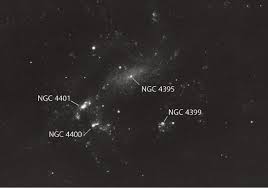
Image result for ngc 4395

NGC 4914: Small, stellar nucleus, bright round core and fainter halo with pointed tips, 3:1 NNW-SSE.
Image result for ngc 4914

LoTr5 (Longmore-Tritton 5): The only Planetary Nebula on the menu.  It is the middle star of an arc of three, which with OIII blinks and shows the faintest of a fairly large shell.
Image result for LoTr 5

NGC 4956: Small bright compact core and stellar nucleus, small halo with tapering tips, 2:1
Image result for NGC 4956

NGC 5056: Two galaxies near a star.  5056 is closest to the star to the south, is fairly faint and small, and has a brighter core but no nucleus, fainter 3:2 halo N-S.  NGC 5057 is to the NE in the FOV, faint and small, with a stellar nucleus and compact bright and small round halo.
 Image result for NGC 5056

NGC 5012: Pretty bright, large, 3:1 NE-SW with bright knots in halo -- or maybe superimposed star.  Irregular brightness.  [Star in front of NE part of halo]
Image result for NGC 5012

NGC 5595 & 5597: Close pair, both oval and diffuse with gradually brightening cores & just stellar nuclei.  Very similar looking though 5595 is more concentrated and elongated and 5597 is more diffuse and rounder
Image result for NGC 5595

NGC 5605: Very faint, moderately large oval glow, gradually brighter middle, though not by much.  Slightly uneven surface brightness.


NGC 5728: Inclined spiral 3:1 SSW-NNE faint star on north edge of bright core, and a star on the SW rim.  Halo is slightly mottled.
Image result for NGC 5728

NGC 5791: Fairly bright, large, 2:1 NW-SE, with a bright oval core and almost stellar nucleus.  Did not notice IC 1081 just to the NE!
Image result for NGC 5791

NGC 5812: Moderately large, fairly bright, with a stellar nucleus, bright round core, round halo with diffuse edges.
Image result for NGC 5812

NGC 5861: Large, diffuse, 3:2 NW-SE.  In a group of three with NGC 5858 (brightest of the three since most concentrated, small bright oval) and 5861 (averted vision only, small and round)
Image result for NGC 5861

NGC 5878: Near a bright star to NE.  Moderately large, fairly bright, stellar nucleus with bright core, 4:1 N-S.  Averted vision helped to brighten up the halo.
 Image result for NGC 5878

NGC 5813: Pretty bright, small, 2:1 elliptical on with almost stellar nucleus, and bright core, slightly oval NW-SE.  In the center of four stars which form a parallelogram.
Image result for NGC 5813
 
NGC 5806: Pretty bright and large 2:1 N-S with a stellar nucleus, bright oval core.

NGC 5383: Face on with bar; round diffuse halo but clearly a bright bar E-W coming out from a small very bright round core.
Image result for NGC 5383

NGC 5371: Pretty large low surface brightness glow, 2:1 N-s  No core brightening but a very compact nucleus, and some unevenness in the surface brightness.  
Image result for NGC 5371

For the last hour of the session I was chasing gaps in the clouds.  But now it was 1:30am and too much cloud cover.  Very close to the forecast I read before coming.  Slept fitfully in the car until morning.