Wednesday, June 16, 2021

15 june 2021

Finally, after a couple weeks of skies ruined by marine layer or wind, I had the chance to observe last night.  Seeing was good enough to use full aperture, but not perfect, so I used an apodising mask throughout.  I couldn't go down to the limits of the scope, but I was able to see come compelling pairs.  Transparency was softened by some marine haze.

Planes on approach to Oakland really wreck havoc on my seeing.  Just like a disturbance in a pool, it takes several minutes for their wake to settle out of the air.  I remember watching a line of plane wake slide over the face of the moon, with creases on either end diffract as they moved along either edge until they rejoined on the other side.  So I try to point away from the main flight path, but there's still disturbance.  Unfortunately the flight path is near zenith and the best part of the sky for viewing.  One just needs patience.  When one is coming I do my best to concentrate on the star; when it arrives I take a slight break, or maybe change eyepieces.

I would have observed longer, but the seeing seemed to deteriorate.  There should be some more good weather coming.

A 2065 AB: 508; 205x: Very fine pair, white A, 2 delta, very close but nice split.  WDS lists as uncertain but the EDR3 data show there is no parallax overlap (by a lot), so these are a comoving but not gravitationally bound pair.
14h 08m 19.11s +16° 43' 32.9" P.A. 342.00 sep 1.6 mag 9.52,11.13 Sp F5 dist. 152.21 pc (496.51 l.y.)

A 1098 AB: 508; 205x: Very light yellow-orange A, 2 delta, well separated B.  Not physical (no parallax overlap and proper motions are divergent).
14h 09m 49.14s +08° 22' 04.9" P.A. 282.00 sep 3.8 mag 9.20,11.20 Sp K0

HDS1989 Aa-Ab: 508; 1067x: Light orange, not round at all powers, it is misshapen with a small lump on one side, disks will not resolve.  EDR3 does not show any such close companion!  Maybe my "not round" is confirmation bias?
14h 10m 55.76s +15° 12' 55.7" P.A. 335.00 sep 0.4 mag 8.53,10.86 Sp G0 dist. 60.46 pc (197.22 l.y.)

A 1100 AB: 508; 533x: Subtle notched elongation.  EDR3 does not show any close companion.
14h 13m 50.60s +08° 58' 51.1" P.A. 173.00 sep 0.2 mag 8.40,9.30 Sp A5

HEI 530 AB: 508; 533x: Very brief split of unequal white stars, with seeing only.  EDR3 does not show any close companion
14h 14m 07.87s +10° 55' 46.7" P.A. 353.00 sep 0.5 mag 9.68,10.23 Sp G5

COU 482 AB: 508; 445x: ! Excellent white pair, brief splits with seeing at 205x, easy steady split with six, slightly unequal.  Uncertain in WDS, and no parallax data in EDR3
14h 21m 20.69s +30° 50' 07.1" P.A. 121.00 sep 0.6 mag 9.92,9.98 Sp G0

AGC 6 AB: 508; 445x: Small scale split with 205x, easy split with 445x.   Near Arcturus, so in wide field it looks like debris from the bright star.  No parallax data for the A star in EDR3
14h 33m 55.72s +29° 49' 19.1" P.A. 133.00 sep 0.8 mag 9.81,10.30 Sp G0III

A 347 AB: 508; 445x: Near equal white stars, suspected double at 205x, easy split at 445x.  Binary with 236.4-year period.
14h 36m 56.24s +48° 13' 17.9" P.A. 232.80 sep 0.6 mag 8.68,8.37 Sp F2 dist. 106.04 pc (345.9 l.y.)

STT 283 A-BC: 508; 205x: Faint and slightly reddish B, maybe due to faintness, bright white A, well separated.  HU 57 BC not tried for, 12.62/11.77 1.2".  WDS says A-BC is physical, however there is no parallax overlap -- it's not binary. 
14h 32m 30.86s +49° 11' 02.6" P.A. 130.00 sep 5.9 mag 8.08,12.62 Sp F5 dist. 87.41 pc (285.13 l.y.)

COU1586 AB: 508; 205x: Well seen at 205x, very bright white A and faint B hanging close to it, separated.  WDS says physical and I'd agree, it's s strong possibility of binarity.
14h 33m 44.62s +43° 00' 28.1" P.A. 143.00 sep 1.8 mag 6.82,10.27 Sp A2 dist. 79.62 pc (259.72 l.y.)
 
COU1587 AB: 508; 533x: Elongation at 205x since its faint, more magnification lengthens the elongation but it becomes more of a smear, transparency seems to be hindering resolution.  Uncertain in WDS, unfortunately no parallax data in EDR3.
14h 34m 02.12s +45° 00' 12.2" P.A. 27.00 sep 0.8 mag 11.44,11.68 Sp G0

A 1622 AB: 508; 205x: White A and dull-to-reddish B, well separated around 2" and 2 delta mag.  Uncertain in WDS, and the EDR3 data back that up with good parallax overlap and only 226 AU separation.
14h 40m 30.40s +46° 32' 32.8" P.A. 254.00 sep 1.9 mag 8.86,10.57 Sp G0 dist. 103.41 pc (337.32 l.y.)

HO 59 AB: 508; 205x: Well separated faint B to bright white A.  Not physical
14h 41m 33.22s +44° 22' 40.7" P.A. 9.00 sep 6.8 mag 8.33,11.82 Sp G0 dist. 89.45 pc (291.79 l.y.)

STF1875 AB: 508; 205x: Near equal, well separated white stars.  Uncertain in WDS, and while the proper motions are similar there is no parallax overlap, so these are comoving not binary.
14h 43m 38.57s +37° 44' 58.4" P.A. 128.00 sep 3.1 mag 10.22,10.24 Sp F8 dist. 151.29 pc (493.51 l.y.)

KU 49 AB: 508; 445x: A bit hazy, but suspected elongated at 205x, split with 445x. Faint white stars, near equal, more than 1".  Uncertain in WDS but pretty good parallax overlap
14h 44m 25.17s +41° 24' 11.3" P.A. 206.00 sep 1.6 mag 10.57,11.03

STT 285 AB: 508: 445x: Nicely split white stars, 1 delta mag, noted the PA with drift.  Short period, 88.993-year period, it is at apastron and will hang there for the next decade.
14h 45m 29.74s +42° 22' 56.4" P.A. 74.70 sep 0.5 mag 7.75,8.66 Sp F6V dist. 83.82 pc (273.42 l.y.)


STT 287 AB: 508; 533x: An elongated smear at 205x, split with seeing at 445x, stead split at 533x.  <1", near equal white stars.  Binary with 340-year period, currently tightening to periastron around 2044.
14h 51m 27.53s +44° 55' 42.6" P.A. 4.20 sep 0.7 mag 8.40,8.62 Sp G0 dist. 59.14 pc (192.91 l.y.)

STF1896 AB: 508; 205x: White stars, 1 delta mag, wide.  Stelle Doppie gives AB as physical with a 4.23-year period, and an orbital plot -- but with separations of 0.02-0.04".  Checking the WDS notes, I find: "AB: Radial velocity variations, based on 10 years of monitoring, indicate the presence of a giant planet orbiting the B component, with P = 1544 +/- 34d, a = 2.62 +/- 0.04 au. M sin i = 1.49 +/- 0.09 Mjup.  The primary is an SB in an eccentric orbit with period 25-30 y; mass of Ab 0.5-0.6 Msun. No companions were detected by AO imaging."  So it seems SD is giving the orbit of the giant planet!  Full paper here.
14h 58m 21.57s +44° 02' 35.9" P.A. 276.00 sep 4.1 mag 8.97,9.47 Sp F8 dist. 96.06 pc (313.35 l.y.)

Friday, June 4, 2021

3 june 2021

Once again, the seeing was optimistically forecast, but in reality was poor, even with the 7-inch mask. I changed my observing list to easier, wider pairs and made many observations. But most were wide, likely not physical, and uninteresting, and my descriptions reflected that.  I suppose early observers could be forgiven thinking some of these might be binary, and even 100 years ago with some proper motion data to think so.  But now we have more information and these are just not interesting to observe as binaries, and there's no point to continue to study them.  The WDS needs a major clean-up to establish which are true binaries and dump the rest.  

Summer twilight is in full effect, it seemed it never got dark even when I closed up at 11pm.  Observations not in time order: 

STF1773 AB: 178; 205x: Wide near equal, part of a triple system forming a triangle of near equal stars which are not physical
13h 41m 38.19s +07° 36' 21.3" P.A. 209.00 sep 30.6 mag 9.95,10.00 Sp F7V

STF1791 AB: 178; 205x: Faint, wide, 1 delta.  Not physical
13h 56m 49.22s +14° 25' 58.6" P.A. 159.00 sep 21.0 mag 9.39,10.73 Sp F7V+G1IV

STF1873 AB: 178; 205x: Pretty light orange and blue stars, wide, 1 delta.  Physical in WDS but my calculator shows there is no overlap in the stars' parallax
14h 44m 48.13s +07° 42' 04.0" P.A. 94.00 sep 6.9 mag 7.96,8.35 Sp G5III dist. 232.56 pc (758.61 l.y.)

ENG 51 AB: 178; 205x: Super wide faint companion, not physical.
14h 19m 16.28s +13° 00' 15.5" P.A. 219.00 sep 164.0 mag 5.44,10.84 Sp F5IV dist. 26.1 pc (85.14 l.y.)

STF1782 AB: 178; 205x: Wide 1 delta.  Physical in WDS and my calculator agrees.
13h 45m 06.87s +18° 22' 04.3" P.A. 185.00 sep 30.4 mag 7.98,9.81 Sp F5

S 656 AB: 178; 205x: Wide, white, half delta.  WDS says it's physical but I calculate no parallax overlap and the two are too far apart to be gravitationally bound.
13h 50m 23.51s +21° 16' 35.8" P.A. 209.00 sep 86.2 mag 6.93,7.37 Sp G0 dist. 105.71 pc (344.83 l.y.)

SHJ 169 AB: 178; 205x: Muphrid.  Very wide faint B to bright white A.  Not physical
13h 54m 41.07s +18° 23' 51.8" P.A. 85.00 sep 114.0 mag 2.72,9.99 Sp G0IV dist. 11.4 pc (37.19 l.y.)

BU 1442 AB: 178; 205x: 5 stars in the system, but only 3 are bright enough for me to see with 7-inch, they form an arc (like a jumping dolphin) of near equal stars. WDS says AB are physical and my calculator agrees, which is a surprise given the very wide separation -- they are relatively close stars so appear wide.
14h 25m 43.56s +23° 36' 59.9" P.A. 74.00 sep 45.2 mag 9.87,10.21 Sp M1+M1.5 dist. 16.36 pc (53.37 l.y.)

BGH 50 AB: 178; 205x: Very wide 1 delta mag.  WDS claims physical.  My calculator shows there is no parallax overlap by fractions of parsecs -- with should be enough to exclude them from being physical, but it's close.  This should be listed as uncertain.
14h 04m 45.95s +25° 49' 03.9" P.A. 32.00 sep 97.0 mag 7.00,8.90 Sp F5+K0 dist. 44.01 pc (143.56 l.y.)

STF1850 AB: 178; 205x: Near equal white wide.  WDS claims physical, and their parallax do overlap, however they are separated by 7168 AU, too far than the known 5000 AU limit of known orbital pairs.
14h 28m 33.29s +28° 17' 25.9" P.A. 263.00 sep 25.2 mag 7.11,7.56 Sp A1V+A1V dist. 349.65 pc (1140.56 l.y.)

STF1653 AB: 178; 205x: Wide one delta white pair.  WDS claims physical but there is no parallax overlap.
12h 33m 22.34s +32° 02' 23.4" P.A. 343.00 sep 8.0 mag 9.66,9.67 Sp F3V+F3V dist. 121.8 pc (397.31 l.y.)

STF1646 AB: 178; 205x: Faint, B seen averted vision only, fairly close.  WDS claims physical but there is no parallax overlap, with a 2 parsec gap -- too far to be gravitationally bound.
12h 28m 09.12s +36° 41' 02.1" P.A. 260.00 sep 5.6 mag 10.30,12.90 Sp F5

STF1727 AB: 178; 205x: B is faint but not too hard to pick out, well separated.  Physical, and I agree
13h 09m 52.02s +31° 22' 00.3" P.A. 333.00 sep 7.5 mag 9.81,10.99 Sp G dist. 138.5 pc (451.79 l.y.)

STF1672 AB: 178; 205x: B is quite faint but can see direct, well separated white.  Not physical
12h 42m 39.65s +33° 48' 51.3" P.A. 312.00 sep 4.3 mag 8.92,10.22 Sp F5V dist. 177.62 pc (579.4 l.y.)

STF1739 AB: 178; 205x: Very faint but surprisingly can see B direct, well separated one delta.  WDS lists as uncertain but there is no parallax overlap by a wide margin, so it can be listed as not physical.
13h 22m 33.24s +30° 30' 55.8" P.A. 126.00 sep 14.9 mag 11.05,11.80" P.A. 126.00 sep 14.9 mag 11.05,11.80

STF1854 AB: 178; 205x: White and wide faint B, 3 delta.  WDS claims physical but there is no overlap in their parallax range, with a gap of a fraction of a parsec, still enough to keep them from being gravitationally bound.
14h 29m 49.66s +31° 47' 28.2" P.A. 256.00 sep 26.1 mag 6.05,10.62 Sp A0Vs dist. 110.13 pc (359.24 l.y.)

STT 289 AB: 178; 205x: B seen averted vision only, well separated.  WDS is uncertain but there is a good parallax overlap and they are separated by 503 AU, so it's very likely these are gravitationally bound.
14h 55m 58.63s +32° 18' 00.3" P.A. 109.00 sep 4.8 mag 6.20,11.10 Sp A2V dist. 95.79 pc (312.47 l.y.)
 
STF1624 AB: 178; 205x: 3 delta white and bluish stars, well separated.  WDS uncertain, but no parallax overlap so not likely physical.
12h 16m 42.19s +39° 35' 34.5" P.A. 153.00 sep 5.9 mag 7.28,10.17 Sp A2.5V dist. 108.81 pc (354.94 l.y.)

STF1632 AB: 178; 205x: Light yellow and 3 delta B, wide.  WDS lists physical and I agree.
12h 20m 13.50s +37° 54' 07.7" P.A. 192.00 sep 10.1 mag 6.83,9.98 Sp K0III+F9V dist. 165.29 pc (539.18 l.y.)

STF1638 AB: 178; 205x: Faint pair, considerable delta, wide.  Not physical.
12h 24m 13.24s +43° 03' 37.1" P.A. 282.00 sep 8.3 mag 10.29,10.70 Sp F5

STF1645 AB: 178; 205x: Slight delta, wide, pretty light yellow-white stars.  WDS lists as physical, and I agree
12h 28m 04.45s +44° 47' 39.5" P.A. 156.00 sep 9.8 mag 7.49,8.08 Sp F9V+KV dist. 43.61 pc (142.26 l.y.)

STF1642 AB: 178; 205x: Closely separated 1 delta light yellow stars.  WDS uncertain, and I find there is no overlap in the parallax ranges, with 1 parsec separating the ranges, so these are not physical.
12h 25m 45.00s +44° 44' 04.4" P.A. 180.00 sep 2.5 mag 8.80,9.40 Sp F5 dist. 244.5 pc (797.56 l.y.)

STF1688 AB: 178; 205x: White B and B is very faint, wide, can just hold it direct vision.  Not physical.
12h 53m 35.26s +37° 58' 20.9" P.A. 344.00 sep 14.4 mag 9.24,11.06 Sp G0 dist. 318.47 pc (1038.85 l.y.)

STT 257 AB: 178; 205x: Easy wide one delta.  WDS claims physical but there is no parallax overlap, so these are not gravitationally bound.
12h 56m 44.77s +45° 36' 45.1" P.A. 353.00 sep 12.9 mag 8.53,9.56 Sp F2Vp+F6V dist. 2702.7 pc (8816.21 l.y.)

STF1747 AB: 178; 205x: Wide one delta.  WDS claims physical but there is no parallax overlap
13h 27m 45.73s +47° 45' 32.2" P.A. 345.00 sep 14.9 mag 9.31,10.22 Sp K0 dist. 222.72 pc (726.51 l.y.)

STF1679 AB: 178; 205x: White 1 delta, wide.  WDS is uncertain but there is good parallax overlap and 1183 AU separation, so likely physical.
12h 46m 00.83s +49° 49' 23.0" P.A. 208.00 sep 5.9 mag 9.62,10.01 Sp F6IV dist. 113.64 pc (370.69 l.y.)

STF1758 AB: 178; 205x: 1 delta, well separated.  WDS uncertain but there is definitely no parallax overlap, so these are not physical.
13h 32m 51.51s +49° 08' 24.3" P.A. 290.00 sep 3.4 mag 8.70,8.95 Sp G0 dist. 77.04 pc (251.3 l.y.)

Thursday, June 3, 2021

1 june 2021

Transparency was hurt by thin clouds, and seeing was not good enough for full aperture, so spent some time masked to 7-inches. Since twilight lasts so long I observed for a little more than an hour. Hoping for better weather the rest of this week.

STF1680 AB; 178; 205x: B seen with averted vision at first then I could hold it with direct, well separated, faint pair.
12h 49m 12.97s +21° 46' 30.0" P.A. 335.00 sep 2.9 mag 9.40,11.60 Sp G0

STF1707 AB: 178; 205x: B is wide and faint, seen with averted vision at first and held direct after foveal coaxing
13h 01m 14.16s +15° 51' 45.2" P.A. 41.00 sep 8.3 mag 9.70,11.50 Sp G0

STF1759 AB: 178; 205x: Faint and wide B.  Physical per WDS but my calculator shows there's no parallax overlap, 1 AU too far apart. 
13h 33m 44.39s +27° 27' 00.5" P.A. 155.00 sep 10.4 mag 9.87,11.22 Sp G5 dist. 74.4 pc (242.69 l.y.)

RX Boo 178; 205x: One of John Herschel's red stars, which he described as "Vivid red, almost a bright ruby colour, fine."  It appears noticeably orange-red, easily picked out in the field. 

STF1816 AB: 178; 533x: Notched elongation, unequal pair, seeing won't support higher magnification.  Physical with 1340-year period, it is near periastron now and will remain there the rest of my lifetime.
14h 13m 54.63s +29° 06' 19.5" P.A. 101.00 sep 0.3 mag 7.43,7.75 Sp F0+A2 dist. 113.38 pc (369.85 l.y.)

STF1931 AB: 178; 205x: Widely separated white stars.  WDS has as physical and my calculator agrees, though there is no orbit as yet.
15h 18m 41.98s +10° 25' 39.7" P.A. 166.00 sep 13.4 mag 7.20,8.07 Sp F7V+G3V dist. 49.98 pc (163.03 l.y.)

POU3145 AB: 178; 205x: Near equal wide white stars.  WDS lists as physical, and I agree.
13h 37m 02.85s +23° 18' 31.8" P.A. 200.00 sep 5.7 mag 10.06,10.11 Sp F8

Wednesday, May 12, 2021

11 may 2021, short periods

Last night's forecast was for "excellent" seeing and transparency, at least until 2am.  Seeing was not all that great, likely do to heat being released from the neighborhood roofs and pavement.  And transparency was more normal with a light marine haze, which subtly thickened through the night.  I tried to rest before going out, since I knew it would be a late night.  I observed from 10pm until 1:30am, when I felt kind of "done" and seeing hadn't improved from what it had been, and the haze seemed noticeably more dense.  I focused on the short period and sweet spot lists.

STF3121 AB: 508; 533x: IP Cnc.  I had observed this last year but failed to make a sketch, and wanted to re-observe it before it got too low, because it's a rapid mover.  Light yellow-orange stars, 1 delta mag, clean well split.  34.17-year period, it's coming off apastron and will make a quarter turn by 2030.  PA to the NE.  
09h 17m 53.45s +28° 33' 37.7" P.A. 34.40 sep 0.433" mag 7.90,8.00 Sp K0 dist. 17.27 pc (56.33 l.y.)


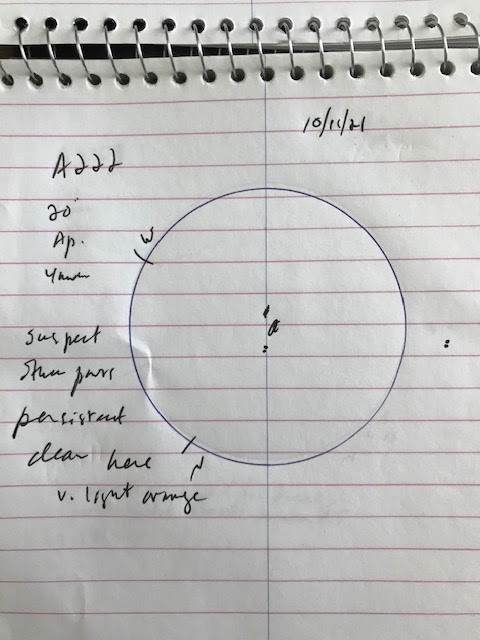
A 222 AB: 508; 667x: Suspect it at all powers up to 667x, where I get a persistent clean split through the seeing.  Light orange stars, 1 delta, PA just east of north.  155.08-year period, it will only cross the north line to head west by 2030.
09h 26m 02.33s +28° 39' 01.5" P.A. 2.60 sep 0.4 mag 9.13,9.41 Sp F8 dist. 111.61 pc (364.07 l.y.)


A 2373 AB: 508; 889x: Just split hairline at best moments, touching disks otherwise, 1 delta mag, very tough. In my notes I put the PA to the NNE, but this is a reversal of what is listed as SE.  100.26-year period, 0.218" now, it will make a barely perceptible arc to the south in the next couple of decades.
10h 52m 02.94s +16° 05' 44.0" P.A. 213.90 sep 0.2 mag 8.80,8.80 Sp F5 dist. 387.6 pc (1264.35 l.y.)


HU 874 AB: 508; 1067x:  34 Leo. A notched elongation is the best I could see, not resolved well.  Slight mag difference but really too hard to tell A from B.  My PA estimate is off 90-degrees.  This is rapidly closing and will be at periastron by the middle of 2022, opening again and should be better detectable again by 2029 when it will be 0.208".  17.962-year period.
10h 11m 38.19s +13° 21' 18.7" P.A. 288.40 sep 0.112" mag 6.90,7.87 Sp F6V dist. 64.6 pc (210.73 l.y.)


BU 614 AB: 178; 533x: "Very difficult, B is a very dim point just separated with seeing."  Turns out I did not see this.  I thought I confirmed by comparing its PA with the widely separated FOX 179 AB-C, but my SkyTools data is incorrect or out of date.  The PA now is due east, I had it the the NNW.  830.72-year period, it won't make a perceptible change in my lifetime -- but I should go back to try it again.  Burnham writes: "This very difficult pair was discovered with the 18.5-inch.  The principal star is identical with that of STT 271, which was marked 'oblonga?' in the Poulkowa Catalogue of 1843, but rejected as single in the revised edition of 1850.  It is not certain that the very minute star now measured [11.7m] has any connection with the suspected elongation previously noticed.  At the time of making the measures given above, the principal star was perfectly round, with the 18.5-inch and 36-inch refractors.  It is the southern star of three in the field."  AB is physical but WDS gives the magnitude as 9.95 -- delta mags often appear to be larger than reality for very close pairs.  0.6" at discovery, AB is physical with a 104.4 year period and currently to the east.  Burnham says it is "southerly" but spinning back the orbit should place it in the west around the time of discovery.  As for STT 271 and the close duplicity of the primary star, neither Aladin Simbad or Gaia DR2 give a second star next to A which would elongate it.  
13h 53m 56.79s +10° 08' 19.9" P.A. 97.40 sep 0.4 mag 8.02,9.95 Sp F0 dist. 141.84 pc (462.68 l.y.)
A 1609 AB:  508; 889x: Notched elongation with the fainter end PA just south of east, very difficult, with seeing only.  44.24-year period, it is nearing periastron and won't appreciably widen, at the opposite PA, until the mid 2030s.  
13h 25m 48.12s +44° 29' 38.3" P.A. 84.70 sep 0.228" mag 9.49,8.79 Sp K0 dist. 52.66 pc (171.78 l.y.)


STT 251 AB: 508; 667x: Best seen at 667x, but could also see at 533x and 445x.  Split, much fainter B about 1.5 delta mag, light orange A and blue B.  540.56-year period, it will reach apastron in 100 years but makes a very close periastron in 400 years.
12h 29m 07.72s +31° 23' 25.4" P.A. 62.20 sep 0.7 mag 8.35,9.27 Sp G0 dist. 173.61 pc (566.32 l.y.)


COU1579 AB: 508; 889x: Very tough notched elongation and instants of splits, I had difficulty sketching it and estimated PA west of north or along that line. Very small scale.  Actual PA is SSE, so I had the alignment correct.  It will be at periastron next year, and get to easy split by 2029 at around 0.231", at the opposite quadrant. 
12h 53m 17.33s +42° 46' 16.8" P.A. 158.30 sep 0.161 mag 9.40,9.70 Sp G9V


A 1095 AB: 508; 889x: Hairline split, >1 delta mag.  187-year period, it will make a slight movement to the north in my lifetime but will be closer to periastron. 
13h 33m 33.77s +29° 44' 16.9" P.A. 294.20 sep 0.3 mag 8.98,9.32 Sp G0 dist. 132.98 pc (433.78 l.y.)


Sunday, May 9, 2021

fun with 80mm pt 2

I added a 50mm finder scope to the 80mm and I was much more productive last night. I really appreciate how clean the airy disks are even with what would be poor seeing with the 20- or even 7-inch. I'll definitely continue to use this scope for night viewing even when I have the 6-inch set-up.

STF1596 AB; 80; 94x: 2 Com. I think last night I noted the incorrect star. This one is really nice, 2 delta mag, orange and blue, close but nicely split.
12h 04m 16.60s +21° 27' 33.0" P.A. 236.00 sep 3.7 mag 6.18,7.48 Sp F0IV-V dist. 101.01 pc (329.49 l.y.)

STF1657 AB: 80; 94x: 24 Com. Lovely bright orange A and blue B, wide.  Very deserving of its showcase reputation.
12h 35m 07.76s +18° 22' 37.4" P.A. 272.00 sep 20.2 mag 5.11,6.33 Sp K2III dist. 138.12 pc (450.55 l.y.)

STF 1633: 80; 94x: Close, equal white stars. 
12h 20m 41.37s +27° 03' 16.4" P.A. 245.00 sep 9.0 mag 7.04,7.13 Sp F3V+F3V dist. 91.83 pc (299.55 l.y.)

M53: Appears as a round haze, no stars resolved, really looks like a comet's halo, like Messier probably saw it.

STF 1854 AB: 80; 94x: B is widely separated but with averted vision
14h 29m 49.66s +31° 47' 28.2" P.A. 256.00 sep 26.1 mag 6.05,10.62 Sp A0Vs dist. 110.13 pc (359.24 l.y.)

STFA 27 AB: 80; 94x: Delta Boo.  Wide, large delta mag B, a 76,000-period pair!  
15h 15m 30.16s +33° 18' 53.4" P.A. 78.00 sep 105.0 mag 3.56,7.89 Sp G8IIICN-1 dist. 37.34 pc (121.8 l.y.)
STFA 28 AB: 80; 94x: Alkalurops  Bright yellow-white A and bluish B, which is itself a slightly unequal close double, finely split (STF 1938 Ba,Bb) -- 256.5-year period, now coming off apastron.
15h 24m 29.54s +37° 22' 37.1" P.A. 172.00 sep 109.0 mag 4.33,7.09 Sp F2IVa+G0V dist. 34.69 pc (113.16 l.y.)
15h 24m 30.89s +37° 20' 52.5" P.A. 2.10 sep 2.2 mag 7.09,7.63 Sp G0V dist. 36.06 pc (117.63 l.y.)

STF 1825: AB; 80; 94x: Very fine split, >2 delta mag, white A and blue B, nice.
14h 16m 32.84s +20° 07' 18.7" P.A. 152.90 sep 4.4 mag 6.47,8.42 Sp F6V dist. 32.63 pc (106.44 l.y.)

STF 1864 AB: 80; 94x: White stars, 1 delta mag, nicely split.
14h 40m 43.56s +16° 25' 05.9" P.A. 113.00 sep 5.4 mag 4.88,5.79 Sp B9pMnHg dist. 93.72 pc (305.71 l.y.)

STF 1888 AB: 80; 94: Yellow A and orange B, 2 delta mag, nice.  Only 22 light years distant, it is physical with a 298-year period, and will tighten the next 30 years.
14h 51m 23.38s +19° 06' 01.7" P.A. 297.00 sep 5.3 mag 4.76,6.95 Sp G8V+K5V dist. 6.71 pc (21.89 l.y.)

STF 1919 AB: 80; 94x: Near equal, white, wide
15h 12m 43.48s +19° 17' 09.8" P.A. 11.00 sep 23.4 mag 6.71,7.38 Sp G1V+G5V dist. 27.24 pc (88.86 l.y.)

STF 1884 AB: 80; 94x: More difficult than nearby Izar.  Extremely fine, 1 delta mag, notched, to overlapping disks at best moments.  Physical with a 1398.2859-year period, it has a nearly edge-on orbit and is currently at the shorter of the two furthest reaches of its orbit.
14h 48m 23.37s +24° 22' 01.0" P.A. 54.40 sep 2.1 mag 6.58,7.48 Sp F8IV-V dist. 84.67 pc (276.19 l.y.)

Saturday, May 8, 2021

fun with 80mm

I misjudged the weather last night. During the late afternoon a cool wind started, and that usually means the marine layer is on its way. So, I didn't open up. It turns out the sky did have a thin haze, but was not covered over, and the seeing was about average. So I brought out my 80mm f/15, which I've mainly used for solar observing, and set-up in the back yard. It has really good optics, and when matched with a 2" prism diagonal, produces very nice images. I only had a Telrad to find stars, but I think I'll add a finder scope to help navigate to fainter stars, since it would save having to swap eyepieces. As it was I found all the bright stars just with the Telrad. I'd even consider using an equatorial mount rather than the alt-az, maybe at least at a dark site. As always, it's always better to go out and observe...

Since I was using the CDSA 2nd edition, all of these are physical unless noted:

STF 1351: 80; 92x: 23 UMa.  Light yellow and much fainter wide B. 
09h 31m 31.57s +63° 03' 42.5" P.A. 267.00 sep 22.7 mag 3.65,9.19 Sp F0IV dist. 23.82 pc (77.7 l.y.)

STF 1315: 80; 92x: White, wide, near equal.
09h 12m 45.94s +61° 40' 32.7" P.A. 28.00 sep 25.1 mag 7.33,7.65 Sp A3IV dist. 100.2 pc (326.85 l.y.)

STF 1306: 80; 150x: Suspected very close unequal white stars.  920-year period, slowly widening
09h 10m 23.53s +67° 08' 03.3" P.A. 346.30 sep 4.5 mag 4.87,8.85 Sp F7V dist. 20.38 pc (66.48 l.y.)

STF1692 AB: 80; 92x: Cor Caroli, showpiece, almost three detla mag and nicely split.  Nice round star images.
12h 56m 01.67s +38° 19' 06.2" P.A. 230.00 sep 19.5 mag 2.85,5.52 Sp A0pSiEuHg dist. 35.2 pc (114.82 l.y.)

STF1877 AB: 80; 150x: Izar: Dull yellow-orange A and dull orange B, nice round images so split easily.  No parallax for the B star, so it's uncertain if physical
14h 44m 59.14s +27° 04' 29.9" P.A. 347.00 sep 2.8 mag 2.58,4.81 Sp K0II-III dist. 62.11 pc (202.6 l.y.)

STF1670 AB: 80; 92x: Porrima.  Nice and easy, yellow-white equal stars.  169-year period.
12h 41m 39.60s -01° 26' 57.9" P.A. 357.50 sep 2.9 mag 3.48,3.53 Sp F0V+F0V dist. 11.68 pc (38.1 l.y.)
STF 1724: 80; 92x: Extremely faint B, just visible, brighter white
13h 09m 57.01s -05° 32' 20.1" P.A. 342.00 sep 6.8 mag 4.40,9.39 Sp A0IV dist. 96.81 pc (315.79 l.y.)

STF 1764 80; 92x: Extremely faint B flashes with averted vision only.  Lower to horizon and in haze, so it was more difficult to see the faint star.
13h 37m 44.01s +02° 22' 56.5" P.A. 31.00 sep 16.1 mag 6.79,8.56 Sp K2III dist. 625 pc (2038.75 l.y.)

STF 1523 AB: 80; 150x: Alula australis.  Slight magnitude difference, hairline split, light yellow A and darker yellow B.
11h 18m 10.90s +31° 31' 45.0" P.A. 152.60 sep 2.2 mag 4.33,4.80 Sp F9V+G9V dist. 10.42 pc (33.99 l.y.)

BU 603 AB: 80; 150x: Elongated but not split.  129-year period.
11h 48m 38.71s +14° 17' 03.2" P.A. 327.70 sep 1.0 mag 5.97,8.53 Sp A8III dist. 59.74 pc (194.87 l.y.)

STFB 7 AB: 80; 92x: 93 Leo.  Pretty orange and blue, wide, 2 delta mag.
11h 47m 59.23s +20° 13' 08.2" P.A. 355.00 sep 74.9 mag 4.59,9.03 Sp A7V dist. 71.33 pc (232.68 l.y.)

Wednesday, May 5, 2021

waiting for the seeing

For months now I have not had good enough seeing conditions to push the limits of my double star observing.  So I've mostly just masked down to 7-inches to try to make the most of it, but I've tapped out most of the other >1" 5-8th magnitude pairs in the spring sky.  When seeing might be good, marine haze would roll in and rob me of the views. Yesterday's forecast was for both good transparency and "excellent" seeing -- but only after 1am. So I waited for it. I let the scope cool starting at 5pm after the hot day, and since I've been having some pointing problems, ran a 30 star TPAS cycle with my Argo as soon as it got dark. Then, at 9:30pm, instead of continuing to observe I disengaged the drives and went inside. I napped a little, and got up at midnight to go back outside.

Now the spring constellations were nearly set and summer's were getting pretty high. Seeing was not quite great when I started, but per forecast by 1am it was good enough to start pushing limits. I have two lists for such occasions: a Short Period list of physical doubles with <80-year periods which I am trying to track over the next many years to try to detect change, and a "Sweet Spot" list, which are doubles of 8th-9th mag with very close separations which are well suited for splits with the 20-inch scope -- the stars are not too bright to cause too much diffraction but bright enough for airy disks to show. Most of the latter are physical but the periods are >80-years, so I may or may not notice change, but they are good for challenge pairs.

This morning I have the feeling of having come back from some great adventure, seeing things few have seen, a kind of glow from the experience about me. That could just be feeling overtired, but it's a good feeling to have.

KUI 66 AB: 178; 445x: Light orange-yellow A, when it settles with seeing there is a persistent very faint point within the shifting diffraction, <1", large delta mag.  There are 36 measures in the WDS since 1936 discovery, but the nature of the pair is uncertain because there is no parallax data for the secondary star.
14h 14m 50.85s +10° 06' 02.2" P.A. 111.00 sep 0.8 mag 5.44,8.43 Sp K1III dist. 81.23 pc (264.97 l.y.)

BU 612 AB: 508; 1067x: Lightest orange, notched elongation to snowman at best moments.  Burnham discovered in 1878 with the Dearborn 18.5-inch, and in 1899 wrote: "It was very soon apparent from the measures that this was a binary system in rapid motion.  In the twenty years covered by the measures, the companion has passed over an arc of 175-degrees.  Glasenapp…has computed an orbit from which he finds a period of 30.00 years....This represents the observations as well as could be desired, but evidently the arc was too short for any very accurate determination, and even now widely differing apparent orbits will satisfy the observed positions equally.  It is probably that the measures of the next ten years will furnish sufficient data for an orbit which shall substantially correct."  In the period since, there have been many measures, and a grade 1 Definitive orbit is established. WDS lists it as physical with a 22.46-year period, currently at 0.1 but will widen to 0.3" by 2030 -- I can hope for a clean split by then. 
13h 39m 34.68s +10° 44' 46.7" P.A. 49.20 sep 0.1 mag 6.35,6.47 Sp F1V dist. 59.99 pc (195.69 l.y.)


STT 269 AB: 508; 1067x: Strong notch, good star images, not quite split.  I saw it as a rod at 205x, and the notch increased in strength with each magnification step up.  PA to SW.  Physical with grade 2 orbit and 53.2-year period (having made nearly one revolution in my lifetime so far!), it is 0.297" now and is coming off apastron, it will rapidly close to undetectability by the late 2030s.
13h 32m 51.02s +34° 54' 25.8" P.A. 227.60 sep 0.3 mag 7.27,8.08 Sp A6III dist. 147.93 pc (482.55 l.y.)


HU 644 AB: 508; 533x: Quite perfect star images, light orange stars, nearly 2 delta mag, well separated, PA northwest.  Grade 2, physical, 48.776-year period.  It has a slightly out of round orbit from our perspective, near it's periastron now and will widen to an easy 1.584" by 2030.
13h 19m 45.58s +47° 46' 41.1" P.A. 287.90 sep 0.3 mag 9.11,9.87 Sp M2V dist. 10.71 pc (34.94 l.y.)


A 1120 AB: 508; 889x: Fairly strong notch but no split, not separated, snowman PA to west of north, >1 delta mag.  Physical with 51.75-year period, grade 3 orbit (likely), 0.246" now.  It is now coming off apastron and will close by the early 2030s, detectible visually again by 2045 or so. 
15h 27m 18.03s +09° 42' 01.1" P.A. 336.90 sep 0.2 mag 8.50,9.10 Sp G0 dist. 96.9 pc (316.09 l.y.)


COU 612 AB: 508; 889x: Very slight elongation all powers, PA N-S but can't tell A from B.  Physical with 63.09-year period, it's coming off apastron and will be difficult to detect visually until the 2060s.  No sketch!
15h 39m 02.60s +25° 44' 47.0" P.A. 150.40 sep 0.24 mag 9.15,9.04 Sp G5 dist. 106.04 pc (345.9 l.y.)

COU 798 AB: 508; 889x: Barest of notches, white stars, noticeable magnitude difference.  PA to the south.  It's in the same low power (205x) field of view with Gemma, alpha CrB, so it looks like a piece of debris from the bright star explosion as seen in the eyepiece.  Grade 4 orbit, 0.256" now, will widen only slightly by 2050 apastron.  154.7-year period.
15h 34m 40.64s +26° 54' 42.8" P.A. 212.70 sep 0.2 mag 9.50,9.80 Sp G0+G2


HU 1163 AB: 508: 667x: Barest hairline split at the best moments, snowman otherwise, very noticeable magnitude difference, PA to south.  0.257" now, it will widen slightly the next 30 years, reaching apastron around 2090 at ~0.4".  Grade 3 orbit, 217-year period. 
15h 30m 44.95s +38° 09' 48.7" P.A. 189.70 sep 0.257 mag 9.23,9.73 Sp G5 dist. 243.31 pc (793.68 l.y.)


STF2028 AB: 508; 533x: Nice delicate split with 445x, well split clean with 533x, white stars, ~1 delta, PA to SE.  Grade 3 orbit, 105.34-year period, 0.519" now it's at apastron now and will sit there until 2050 when it will start close again in its nearly edge-on orbit.
16h 12m 48.11s +39° 21' 35.6" P.A. 147.00 sep 0.519 mag 9.88,9.14 Sp G0 dist. 67.2 pc (219.21 l.y.)