Friday, February 11, 2022

10 february 2022

Seeing was forecast to be above average, and I was all set to go after the close pairs on the true binary list, but the sky would not support it.  So I masked to 7-inches and went after Struves, mainly in Monoceros.  It was fun popping these off and I covered many in just 90 minutes.  I went after a couple of small aperture Burnhams in the same area of the sky.  

By observing one and then the other, I could immediately tell Struves are brighter and generally more widely separated, while Burnhams are closer and have a larger delta mag.  One can deduce this by just reviewing magnitude and separation tables of their pairs, but it is striking and obvious to see in the eyepiece.  Struve should have been able to see many of the the Burnham 6-inch pairs, especially given his 3-inch aperture advantage over Burnham.  I read somewhere Struve observed very quickly, spending only a minute or two on each star, so it could be he did not pay the close attention needed to detect close unequal pairs.  Or maybe he saw these, but there was a limitation with his micrometer in getting a faint pair under the wire for measurement, so didn't take a measure and didn't publish the discovery.

The Struves are a fun project and I'll make another set of SkyTools list just for them and the Burnhams, it should only take a year or two to polish them all off.  I could do those on the mediocre nights and save the physicals for the best nights.

STF1029 AB: 178; 205x: Nice close split, <1 Dm, white stars.  WDS uncertain, however there is strong parallax range overlap 79%, 337 AU weighted separation, and 2.47+2.21 Msol, so very likely these are binary.
07h 07m 56.87s -04° 40' 39.8" P.A. 27.00 sep 1.6 mag 7.47,7.95 Sp A9V dist. 225.23 pc (734.7 l.y.)

STF1003 AB: 178; 150x: Close pair, pretty faint near equal, well split around 4".  WDS says proper motion indicates physical, and there is 6% parallax range overlap, 1,284 AU weighted separation, and 1.98+1.84 Msol.
06h 58m 34.62s -09° 10' 02.3" P.A. 321.00 sep 3.9 mag 9.57,9.92 Sp F2

STF1015 AB: 178; 150x: Well split, near equal, white.  WDS says parallax indicates physical, however their ranges do not overlap (-33%), so really these are not likely to be physical.
07h 04m 55.36s -05° 46' 28.4" P.A. 199.00 sep 4.9 mag 9.41,9.40 Sp A0

STF1028 AB: 178; 150x: Light orange A and wide, much fainter B, at the edge of a triangle-shaped open cluster (NGC 2343).  WDS uncertain, and there is 32% parallax range overlap, a rather wide 11,464 AU weighted separation, but large 4.82+2.64 Msol -- so might be binary.  SIMBAD shows the secondary as part of NGC 2343 (#11), but the primary, HD 54387, is not included as an NGC 2343 member; maybe the NGC count needs to be revised given the EDR3 parallax data?
07h 08m 16.08s -10° 37' 25.8" P.A. 304.00 sep 11.0 mag 8.59,11.10 Sp G5

STF1034 AB: 178; 150x: Close unequal pair, just split this low magnification.  WDS says parallax indicates physical.  It has 7% parallax range overlap, 281 AU weighted separation, 1.26/1.11 Msol, and the radial velocity delta (2.31) is less than the escape velocity (3.86), so it is binary.
07h 09m 21.70s -08° 18' 58.4" P.A. 10.00 sep 2.4 mag 9.43,9.89

STF1036 AB: 178; 150x: Wide 1 Dm.  Not physical.
07h 10m 12.63s -06° 16' 42.9" P.A. 103.00 sep 17.4 mag 9.22,9.92 Sp F5

STF1043 AB: 178; 150x: Very fine, equal white stars, just split.  WDS says parallax indicates physical, and they do overlap 84% of their parallax ranges, have 977 AU weighted separation, and equal 2.26 Msol, so likely binary
07h 12m 36.98s -00° 40' 46.4" P.A. 68.00 sep 2.4 mag 9.37,9.42 Sp A0

STF1045 AB: 178; 150x: Ice blue A and 2 Dm B, well separated.  WDS says proper motion indicates non-physical.  They don't share parallax ranges, -96%, so certainly not binary.
07h 12m 42.24s -03° 10' 41.0" P.A. 236.00 sep 5.6 mag 8.01,9.08 Sp F5 dist. 73.48 pc (239.69 l.y.)

STF1049 AB: 178; 150x: Close pair, 1 Dm, pretty pair in a rich field.  WDS says not physical, and they don't share parallax ranges (-51%)
07h 13m 42.33s -08° 55' 31.0" P.A. 41.00 sep 3.6 mag 8.36,9.47 Sp B9.5V dist. 338.98 pc (1105.75 l.y.)

STF1056 AB: 178; 150x: White and 2 Dm, well separated in a rich field.  WDS uncertain, however they share 79% of their parallax ranges, have a moderate 1,095 AU weighted separation, and 2.79+2.02 Msol, so these are likely binary.
07h 15m 34.34s -01° 51' 36.8" P.A. 299.00 sep 3.9 mag 8.04,8.88 Sp G0 dist. 246.91 pc (805.42 l.y.)

STF1060 AB: 178; 150x: Well split 1 Dm, white, and arc of faint stars nearby, in a rich field.  WDS not physical, and they don't overlap parallax ranges, -20%
07h 16m 06.71s -09° 16' 10.9" P.A. 24.00 sep 6.9 mag 8.60,9.59 Sp B7V dist. 284.9 pc (929.34 l.y.)

STF1077 AB: 178; 150x: Faint near equal stars, well separated, and the C star appears with averted vision a little wider than the others, at 90-degrees difference in PA.  WDS says physical, however they do not overlap parallax ranges (-10%), and the radial velocity delta (1.85) just exceeds the escape velocity (1.81), so these are not binary
07h 20m 59.96s -00° 40' 13.1" P.A. 319.00 sep 5.5 mag 9.89,9.78 Sp A3

STF1085 AB: 178; 150x: Nicely separated around 3", white A and 1 Dm B.  WDS says not physical, but in fact they share 80% of their parallax ranges, have a small 785 AU weighted separation, and a healthy 2.10+1.57 Msol -- these are likely binary.
07h 24m 28.43s -04° 36' 30.3" P.A. 283.00 sep 3.2 mag 8.63,10.04 Sp A3

STF1109 AB: 178; 150x: Quite fine, white stars, near equal, nicely separated around 3".  WDS says not physical, but they share 38% parallax overlap, 3,023 AU weighted separation, and healthy 3.57+3.60 Msol, and are likely binary
07h 31m 54.40s -00° 31' 30.9" P.A. 17.00 sep 3.1 mag 9.26,9.26 Sp A0

STF1133 AB: 178; 150x: Ice blue-white A and light orange B, brighter than 10th magnitude, around 1 Dm.  WDS uncertain, but 68% of their parallax ranges overlap, 956 AU weighted separation, and 1.89+1.50 Msol, so they are likely binary.
07h 42m 34.02s -04° 01' 35.4" P.A. 108.00 sep 4.3 mag 8.88,9.96 Sp A5 dist. 152.21 pc (496.51 l.y.)

STF1152 AB: 178; 150x: 2 Dm, well split stars.  WDS says not physical, but 5% of their parallax ranges overlap, 1,693 AU weighted separation, 2.48+1.59 Msol, and the radial velocity delta (0.5) is much less than the escape velocity (2.07), so they may be binary.
07h 50m 59.24s -03° 07' 15.6" P.A. 314.00 sep 6.0 mag 8.41,10.29 Sp G5 dist. 316.46 pc (1032.29 l.y.)

STF1154 AB: 178; 150x: Very pretty pair, 2 Dm, closely separated around 3".  WDS says proper motion indicates physical, but they do not share parallax ranges (-16%), so likely not binary.
07h 52m 08.46s -03° 03' 14.9" P.A. 353.00 sep 2.8 mag 7.13,9.26 Sp A5 dist. 111.98 pc (365.28 l.y.)

STF1157 AB: 178; 300x: Snowman, light yellow stars, significant delta magnitude.  WDS says physical with 1448 year period, however they do not share parallax ranges (-43%), even though the lateral separation is 85 AU.  This is not binary.
07h 54m 33.03s -02° 47' 44.9" P.A. 170.80 sep 0.7 mag 7.93,7.89 Sp F0
STF1183 AB: 178; 150x: Wide, 2 Dm.  Other faint close pairings not seen.  WDS uncertain, they share 10% of parallax ranges, but very far 8,454 AU weighted separation, 3.85+2.56 Msol, so there is some chance these could be binary.
08h 06m 27.42s -09° 14' 40.1" P.A. 328.00 sep 30.6 mag 6.22,7.77 Sp B9.5IV dist. 307.69 pc (1003.68 l.y.)

STF1189 AB: 178; 150x: White and 3 Dm wide B.  WDS uncertain, but they share 10% parallax ranges, 4,625 AU weighted separation, and 3.66+2.01 Msol, so they could be binary.
08h 07m 56.30s -01° 20' 58.1" P.A. 334.00 sep 8.9 mag 7.82,10.08 Sp A1V dist. 1470.59 pc (4797.06 l.y.)

BU 196 AB: 178; 300x: Faint pairing, B is quite faint by comparison to A but only 1 Dm, around 3" separation, best seen with higher magnification.  Discovered with 6-inch.  WDS uncertain, but they share 30% of their parallax ranges, 2,269 AU weighted separation, 2.95+2.15 Msol, so these might be binary.
07h 12m 20.84s -05° 25' 53.8" P.A. 193.00 sep 3.1 mag 9.90,10.90 Sp A2

BU 197 AB: 178; 150x: Very fine, rather difficult, 2 Dm, <3" separation.  Discovered with 6-inch.  WDS uncertain, but with 44% parallax range overlap, 1,784 AU weighted separation, and large 4.81+3.17 Msol, they are likely binary.
07h 12m 49.38s -07° 08' 57.8" P.A. 148.00 sep 2.2 mag 7.82,9.34 Sp F2 dist. 699.3 pc (2281.12 l.y.)

BU 330 AB: 178; 150x: Extremely fine, with seeing only, 1 Dm, light orange stars, tough pair.  Discovered with 6-inch.  WDS uncertain, but they do not overlap parallax ranges (-34%), so are not binary.
07h 19m 33.10s -00° 54' 30.3" P.A. 214.00 sep 1.3 mag 8.75,9.83 Sp B8

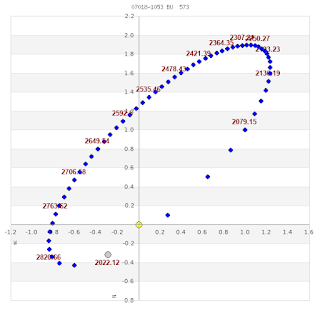
BU 573 AB 178; 150x: Hairline split, 1 Dm, quite a pair.  Discovered with 18.5-inch.  WDS says physical with an 855-year period, but there is no EDR3 data for the secondary, so can't verify
07h 01m 49.89s -10° 52' 56.3" P.A. 316.00 sep 0.5 mag 7.16,7.83 Sp F8 dist. 118.34 pc (386.03 l.y.)
BU 583 AB: 178; 205x: Hairline split at low power, split at 205x, very nice near equal pair.  Discovered with 18.5-inch.  WDS uncertain, but 27% of the parallax ranges overlap, 775 AU weighted separation, and 2.4+2.2 Msol, so likely binary.
08h 09m 11.66s -06° 42' 08.0" P.A. 71.00 sep 1.8 mag 9.60,9.95 Sp G5

BU 903 AB: 178; 205x: Very faint B just resolved with seeing, very closely split.  Discovered with 18.5-inch.  WDS uncertain, but 95% of the parallax ranges overlap, only 521 AU weighted separation, and 2.6+1.8 Msol, so these are very probably binary.
08h 04m 14.08s -01° 51' 10.1" P.A. 34.00 sep 1.6 mag 8.21,9.81 Sp B9 dist. 323.62 pc (1055.65 l.y.)

BU 1279 AB: 158; 300x: Very tough, with seeing, unequal closely separation around 1".  Discovered with 18.5-inch.  WDS uncertain, but 5% of the parallax ranges overlap, only 879 AU weighted separation, and 3.1/2.7 Msol, so it is possible they are binary.
07h 10m 24.09s -04° 05' 45.4" P.A. 12.00 sep 1.2 mag 9.33,9.74 Sp B9

Wednesday, February 9, 2022

8 february 2022

Bad news on the 6-inch, the RA motor seems to be malfunctioning.  It makes a loud clacking noise and has an electrical-sounding buzz when I try to slew.  It still tracks and I'll use it for solar observing for the time being.  I bought that motor used, thinking to save money, but I suppose the seller offloaded a bum unit on me.  I've ordered two new ones from Hurst and also ordered replacement belts for the encoders, so I'll be forced into doing the maintenance. 

Last night I observed the moon for a while at 20-inches.  The Leica zoom is perfect for this observing, as I can take in the scene then zoom in for more detail.  The TPAS seemed to help.  Seeing did not hold up after 9pm when it started to get cold, and a thin marine haze blew in.  I masked to 7-inches and went after some easy doubles.  I decided to clean up some Struves I haven't observed in Gem, CMi, and Cnc -- at least ones with <15" separation as that was the upper limit of my list.  Knocked them all off... 

STF1007 AB: 178; 150x: A is white and has a near equal very wide companion (AD, 7.43/7.74 67.7").  AB is faint, 4 Dm, and around 15", I needed to use averted vision at first but then could hold it.  Not physical.
07h 00m 37.12s +12° 43' 24.2" P.A. 300.00 sep 14.6 mag 7.43,11.40 Sp A2V dist. 280.11 pc (913.72 l.y.)

BU 100 AB: B is quite faint, 4 Dm, can see it direct vision, and very close to the white primary star, around 3".  Very nice looking pair.  Burnham discovered with his 6-inch.  WDS uncertain, but there is a good chance it is binary: 35% parallax overlap, 2,277 AU weighted separation, and high solar mass 5.16/2.46.
07h 00m 56.55s +12° 24' 00.4" P.A. 259.00 sep 3.4 mag 7.34,11.10 Sp K0

STF1008 AB: 178; 150x: B is very closely split, around 2", and about 1 Dm.  WDS uncertain, but it is a good possibility to be binary: 63% parallax range overlap, 1,240 AU weighted separation, 2.96/2.14 Msol.
07h 01m 36.12s +26° 34' 25.3" P.A. 272.00 sep 2.3 mag 8.70,9.96 Sp B9

STF1012 AB: 178; 150x: Wide, 1 Dm.  WDS calls it physical and likely this is correct: 21% parallax range overlap, 1,050 AU weighted separation, 1.10/0.94 Msol--however lacking radial velocity data for the secondary.
07h 04m 54.51s +28° 07' 01.3" P.A. 168.00 sep 12.8 mag 9.20,9.83 Sp G0

STF1116 AB: 178; 150x: Fine hairline split at 150s.  B is orange color, closely split about 2", more than 1 Dm.  WDS uncertain, but they don't share parallax ranges (-25%), so these are not binary.
07h 34m 32.02s +12° 18' 16.9" P.A. 95.00 sep 1.7 mag 7.81,8.50 Sp B8 dist. 248.14 pc (809.43 l.y.)

STF1047 A-BC: 178; 150x: The A-BC pair is easy, wide, nearly 2 Dm.  BC not seen.  Not physical.
07h 14m 20.05s +15° 45' 33.5" P.A. 30.00 sep 24.1 mag 8.07,9.66 Sp A5III

STF1046 AB: 178; 150x: B is wide and faint, needed averted vision to detect it, then can hold direct.  Not physical.
07h 14m 38.43s +14° 33' 41.1" P.A. 244.00 sep 9.3 mag 9.41,12.50 Sp A4V

STF1155 AB: 178; 150x: Faint and wide B.  BC is a near equal 0.5" pair, COU1111.
07h 54m 28.38s +26° 10' 01.9" P.A. 343.00 sep 16.8 mag 8.67,10.40 Sp K2 dist. 694.44 pc (2265.26 l.y.)

STF1143 AB: 178; 150x: Very faint, barely there, seen with averted vision only.  Well separated around 10".  WDS uncertain, and I don't find Gaia data for the secondary.
07h 48m 03.42s +05° 24' 35.5" P.A. 152.00 sep 9.3 mag 6.60,11.00 Sp K0 dist. 254.45 pc (830.02 l.y.)

STF1134 AB: 178; 150x: White A and very faint B, well separated around 10".  WDS claims physical, though I don't find Gaia data for the secondary.
07h 43m 31.09s +03° 29' 09.8" P.A. 147.00 sep 9.6 mag 7.07,10.38 Sp F8 dist. 50.94 pc (166.17 l.y.)

STF1114 AB: 178; 150x: Well split, half delta mag.  WDS says physical, however they do not share parallax ranges (-82%) so they are not binary.
07h 33m 41.76s +09° 17' 18.0" P.A. 52.00 sep 6.4 mag 9.23,9.99 Sp G5

STF1103 AB: 178; 150x: Ice blue-white A and Dm B, well separated.  WDS uncertain, however the chances are good it is binary: 41% parallax range overlap, 931 AU weighted separation, 2.75/1.93 Msol.
07h 30m 33.61s +05° 15' 16.8" P.A. 245.00 sep 4.2 mag 7.12,8.64 Sp B9 dist. 187.62 pc (612.02 l.y.)

STF1099 AB: 178; 150x: White stars, near equal, good split.  WDS uncertain, but they do not share parallax ranges (-47%), so they are not binary.
07h 29m 25.86s +11° 31' 44.5" P.A. 344.00 sep 3.9 mag 8.54,8.94 Sp A0

STF1063 BC: Near equal faint stars, well separated around 7".  WDS says physical, and they probably are: 59% parallax range overlap, 2,885 AU weighted separation, 1.80+1.65 Msol. 
07h 18m 02.98s +04° 21' 03.8" P.A. 208.00 sep 7.1 mag 10.42,10.95

STF1168 AB: 178; 150x: Bright white A and very much fainter B, closely split, can just see direct.  BV CMi, WDS is uncertain, however their parallax ranges do not overlap (-77%), so they are not binary.
07h 58m 45.18s +05° 37' 23.8" P.A. 218.00 sep 6.0 mag 6.97,14.60 Sp B9 dist. 1086.96 pc (3545.66 l.y.)

STF1185 AB: 178; 150x: Faint but pretty pair, nearly 1 Dm, close but nice split.  WDS says physical, and the parallax range do overlap (24%), there is a modest 348 AU weighted separation, and 1.06+0.93 Msol, and the delta in radial velocities (0.21) is less than the escape velocity (3.18), so they are indeed very likely to be binary.
08h 07m 07.38s +01° 20' 46.5" P.A. 94.00 sep 3.8 mag 9.59,10.26 Sp K0

STF1194 AB: 178; 150x: White stars, B is very closely separated around 3", and very faint.  WDS says not physical, however there is 12% parallax range overlap, 2,192 AU weighted separation, and 2.91+2.21 Msol, so it is possible they could be binary.
08h 10m 27.54s +01° 55' 03.5" P.A. 319.00 sep 3.3 mag 9.40,10.70 Sp A2

STF1167 AB: 178; 150x: Faint but well separated pair, 1 Dm.  WDS uncertain, but there is no parallax range overlap (-56%), so they are not binary.
07h 58m 34.29s +16° 28' 09.3" P.A. 229.00 sep 12.2 mag 9.79,11.80 Sp G0

STF1179 AB: 178; 150x: Faint, near equal, wide.  Not physical.
08h 04m 44.84s +12° 04' 22.9" P.A. 202.00 sep 23.4 mag 10.19,9.95 Sp G0

STF1191 AB: 178; 150x: Near equal white stars, pretty close.  WDS says not physical, however they share parallax ranges (16%), only 552 AU weighted separation, 1.19+1.10 Msol, and the radial velocity delta (0.1) is less than the escape velocity (2.71), so they are likely binary.
08h 10m 47.59s +19° 01' 51.9" P.A. 77.00 sep 3.6 mag 10.30,10.80 Sp G5

STF1202 AB: 178; 205x: White A, faint B seen best with higher magnification, very closely separated around 3".
08h 13m 34.20s +10° 50' 49.7" P.A. 305.00 sep 2.7 mag 7.37,9.61 Sp F7V dist. 77.28 pc (252.09 l.y.)

STF1206 AB: 178; 150x: Near equal, pretty wide.  WDS uncertain, but they do not share parallax ranges (-70%), so they are not binary.
08h 14m 41.20s +07° 10' 42.4" P.A. 200.00 sep 11.7 mag 9.90,10.38 Sp A2

STF1214 A-BC: 178; 150x: Faint, very close around 5".  BC not seen.  WDS not physical, and they do not share parallax ranges (-84%).  Also, the BC pair, BU 1320, is also not physical in spite of the the 0.6" separation, as this pair also does not share parallax ranges (-58%)
08h 20m 12.15s +17° 00' 19.4" sep 4.8 mag 10.70,11.00 Sp F8

STF1218 AB: 178; 150x: B is very faint, and just hold it direct, 2 Dm, well split around 4".  WDS says physical, and they do share parallax ranges (34%), 1,281 AU weighted separation, 1.81+1.38 Msol, however the radial velocity delta (3.28) exceeds the escape velocity (2.1), so these are not or will not remain binary.
08h 23m 27.70s +23° 10' 47.6" P.A. 268.00 sep 4.1 mag 9.76,11.30 Sp F2

STF1221 AB: 178; 150x: B is faint 1 Dm, well split around 5".  WDS uncertain, however they share parallax ranges (18%), 2,112 AU weighted separation, 1.94+1.63 Msol, so might be binary.
08h 24m 35.10s +13° 40' 12.2" P.A. 110.00 sep 4.9 mag 10.40,11.60

Monday, February 7, 2022

6 february 2022

A few days ago Steve posted on TAC about Sirius B, and I shared some of my prior observations.  I gave it a try Saturday night with the 6-inch f/15 refractor, and was pleased to see it after Sirius had moved away from a neighbor's roof at around 9:30pm.  It was faint, but not too difficult.  It was my first time using the Leica zoom, a lovely and surprisingly large and heavy eyepiece.  Sirius is so bright that even when focused it showed several concentric rings, and Sirius B was a faint star fairly well separated from the primary but still within the outermost rings.  Seen even with lowest power 134x (actually it was best at this power).  I plan to try my NP101 some night this week to see if I can make an observation that low -- I am sure it is possible.

The bad news from that Saturday is I think the declination encoder is either broken or the belt has snapped or slipped off the gear wheels.  After observing Sirius I was going to observe more using the Argo but the declination numbers would not change.  I reseated all the connectors, but still no movement.  It stinks because to get at that encoder I have to tear the whole mount down.  That might turn out to be a good thing since I might change out the rings and do some other maintenance.  

Last night I observed with the 20-inch.  Seeing was ok, but not great.  Transparency better than the usual winter haze.  I ran through a 30 star TPAS with the Argo, hoping I did it correctly (the instructions are confusing) and that it sticks.  It seemed to help with initial observations but the pointing accuracy started to drift during the night.

I created new lists of doubles, specifically those only with known orbits.  I'm combining what was generated by SkyTools, which seems to be an out-of-date database, and a fresh list from StelleDoppie.  There are plenty of pairs and this should keep me occupied for a couple of years.  It will also help me sweep up some short period pairs, those with periods of greater than 80 years, which was the limit on my prior lists.  I ran through the pairs in CMi and some of Gemini last night, with good results.

STF1130 AB: 508; 300x; Light yellow-orange stars, noticeable magnitude difference, elongated at lower magnifications, hairline split at 300x.  Discovered at 2", it has a 1000-year period (give or take 300 years), it is coming off a very fast and close periastron and will widen very considerably in the coming decades.  WDS notes the orbit is premature, and needs speckle for future observations.  I don't find parallax for them in EDR3, so can't determine further.
07h 41m 42.35s +09° 42' 17.3" P.A. 69.30 sep 0.6 mag 8.76,9.48 Sp G0 dist. 66.45 pc (216.76 l.y.)

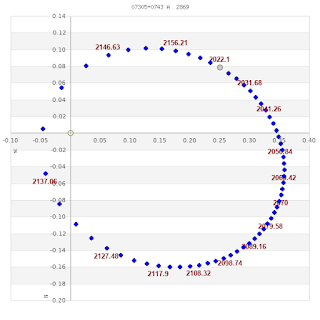
A2869 AB: 508; 667x: Light yellow-orange stars, hairline to strongly notched overlapping disks at 667x, as much as seeing will support.  PA is ESE, and the pair forms an equal triangle with two other stars in the field.  143-year period, it will made a modest movement of around 0.1" wider separation by 2040.  I don't find parallax in EDR3.
07h 30m 27.65s +07° 43' 09.3" P.A. 108.50 sep 0.3 mag 8.30,8.50 Sp A5 dist. 207.47 pc (676.77 l.y.)


STF1175 A pretty white and light yellow b, nicely split, two dm. twenty seventeen.  WDS notes this is a premature orbit, and it may not turn out to be physical.  With EDR3 data I find there is no parallax range overlap (-65%) so very likely this is not a binary.
08h 02m 26.06s +04° 09' 07.5" P.A. 288.70 sep 1.4 mag 7.89,9.13 Sp G5 dist. 40.55 pc (132.27 l.y.)
A2880 AB: 508; 1334x: Elongated with moments of strong notching, noticeable magnitude difference, PA to the SSE.  106-year period, it will have a SSW PA by 2040.  I don't find the EDR3 data.
07h 50m 47.36s +03° 16' 38.4" P.A. 176.20 sep 0.2 mag 7.10,7.10 Sp K1III dist. 150.15 pc (489.79 l.y.)


J420 AB: 508; 150; An equilateral triangle of similar magnitude stars, one corner of which is J420, which is a near equal pair, nicely split.  A 168-year period, it will remain in the same quadrant for the next 40 years.  WDS notes "Appears to be in rapid retrograde motion," and what I find in EDR3 is there is no parallax range overlap, -94%, so this is not binary at all.
08h 06m 15.16s +02° 00' 47.3" P.A. 192.70 sep 2.2 mag 11.06,11.46 dist. 114.03 pc (371.97 l.y.)
STT175 AB: 508; 889x: Light orange stars, elongated out of round but not notched, seems to be one delta.  213-year period, it may widen by 0.1" by 2040 so might become better resolved by then.  
07h 35m 08.79s +30° 57' 39.3" P.A. 338.80 sep 0.1 mag 6.08,6.49 Sp K0III dist. 114.16 pc (372.39 l.y.)
STT187 AB: 508; 667x: White stars, 1 Dm, hairline at 333x, nice close split at 667x.  254-year period, it will pretty much stay where it is the next couple of decades.  Lacks EDR3 data.
08h 04m 08.38s +33° 01' 50.8" P.A. 334.60 sep 0.4 mag 6.94,8.50 Sp A1.5V dist. 172.71 pc (563.38 l.y.)

STT149 AB: 508; 889x: At 2 Dm the pair is fairly tough to resolve.  PA is just south of west (actually just north of west), nicely split B in A's diffraction. 119-year period, it will tighten rapidly to the south and become close to undetectable by 2040.  Insufficient data in EDR3.
06h 36m 26.26s +27° 16' 42.2" P.A. 276.40 sep 0.7 mag 7.14,8.97 Sp dG2 dist. 33.11 pc (108 l.y.)
      

Saturday, January 29, 2022

26 january 2022

Another night out with the 6-inch refractor, fairly decent seeing with some marine haze.  I find just using the Tour mode on the Argo leads to some repeated observations as there's no way, outside of reloading the target list, to remove what has already been observed.

STF 816 AB: 152; 175x: Ice blue-white A and 3 Dm faint blue B, well separated.
05h 54m 55.46s +05° 51' 38.8" P.A. 287.00 sep 4.0 mag 6.90,9.27 Sp B9 dist. 239.23 pc (780.37 l.y.)

STF 795 AB: 152; 245x: Hairline split, slightly unequal white stars.  1260-year period, it will tighten rapidly the next 40 years or so
05h 48m 00.21s +06° 27' 14.5" P.A. 220.50 sep 1.0 mag 5.99,6.03 Sp A5V dist. 165.02 pc (538.3 l.y.)

STF789 AB: 152; 175x: Fairly bright white A and very much fainter B, quite wide
05h 45m 01.80s +04° 00' 29.3" P.A. 150.00 sep 14.0 mag 6.13,10.17 Sp gF0n dist. 58.86 pc (192 l.y.)

STF840 A-BC: 152; 175x: White stars, wide, 1 Dm.  BC is 9.8/10.1 0.4"
06h 06m 28.04s +10° 45' 01.0" P.A. 248.00 sep 21.5 mag 7.17,8.95 Sp A0V+F0 dist. 225.73 pc (736.33 l.y.)
 
STF788 AB: 152; 175x: White stars, wide, 1 Dm.
5h 44m 43.46s +03° 49' 53.1" P.A. 91.00 sep 7.5 mag 7.61,10.05 Sp B9 dist. 295.86 pc (965.1 l.y.)

STT124 AB: 152; 456x: Softly notched elongation, 140-year period and will close rapidly the next 20 years
05h 58m 53.23s +12° 48' 29.8" P.A. 306.40 sep 0.3 mag 6.11,7.37 Sp K2III+A5V dist. 243.31 pc (793.68 l.y.)

STF738 AB: 152; 175x: Meissa.  Bright pair, 2 Dm, nicely separated.  
05h 35m 08.28s +09° 56' 03.0" P.A. 44.00 sep 4.3 mag 3.51,5.45 Sp O8III+B0V dist. 336.7 pc (1098.32 l.y.)

ARN 37 AC: 152; 175x: Wide, white, near equal, called physical due to proper motions, with a third much fainter star closer in at a right angle to the first (this is H5 100 AB, 5.91/10.44 36.7").  
05h 58m 24.44s +01° 50' 13.6" P.A. 293.00 sep 177.8 mag 5.92,6.94 Sp A5m dist. 111.73 pc (364.46 l.y.)

STF 982 AB: 152; 175x: Cream white A and 2 Dm B, well split.  1750-year period, it has a very rapid periastron in its orbit, but not until the 3400s
06h 54m 38.63s +13° 10' 40.1" P.A. 142.40 sep 7.4 mag 4.75,7.80 Sp F0Vp dist. 25.63 pc (83.61 l.y.)
STF1007 AD: 152; 175x: Wide, white, near equal, with one having a much fainter star close by (AC)
07h 00m 37.12s +12° 43' 24.2" P.A. 28.00 sep 67.7 mag 7.43,7.74 Sp A2V dist. 280.11 pc (913.72 l.y.)

BU100 AB: 152; 175x: Very fine, moderately bright white A and very faint B, quite close, near STF 1007.
07h 00m 56.55s +12° 24' 00.4" P.A. 259.00 sep 3.4 mag 7.34,11.10 Sp K0

HJ 3288 AB: 152; 175x: Wide, 1 Dm
7h 02m 18.43s +12° 34' 54.2" P.A. 247.00 sep 38.5 mag 7.29,8.67 Sp A2 dist. 165.56 pc (540.06 l.y.)

HO342 AB: 152; 175x: Amazingly fine hairline split, slight magnitude difference, white stars. 
07h 02m 50.54s +13° 05' 21.7" P.A. 89.00 sep 1.2 mag 7.99,8.71 Sp F5 dist. 212.31 pc (692.56 l.y.)

ENG 28 AB: 152; 175x: Super-wide white stars, slight magnitude difference.  Parallax indicates they are physical but I doubt they are close enough together to be gravitational.
07h 08m 00.24s +15° 31' 42.9" P.A. 99.00 sep 171.9 mag 7.86,7.74 Sp G0V dist. 46.75 pc (152.5 l.y.)

STF1027 AB: 152; 175x: Near equal, light orange stars, around 6"
07h 08m 46.74s +16° 54' 31.8" P.A. 356.00 sep 6.9 mag 8.47,8.69 Sp K3III dist. 312.5 pc (1019.38 l.y.)

WEI14 AB: 152; 175x: Wow! Very fine, 1 Dm, just split.
07h 12m 48.16s +15° 10' 41.9" P.A. 160.00 sep 2.1 mag 7.77,8.91 Sp B9.5IV dist. 1351.35 pc (4408.1 l.y.)

STF1088 AB: 152; 175x: White stars, 2 Dm
07h 26m 02.42s +14° 06' 10.7" P.A. 195.00 sep 10.9 mag 7.38,9.37 Sp A0V dist. 458.72 pc (1496.34 l.y.)

H5 63 AB: 152; 175x: Wide, 2 Dm.  Not physical
09h 58m 39.35s +10° 57' 37.4" P.A. 348.00 sep 49.4 mag 7.47,11.68 Sp F0III dist. 83.47 pc (272.28 l.y.)

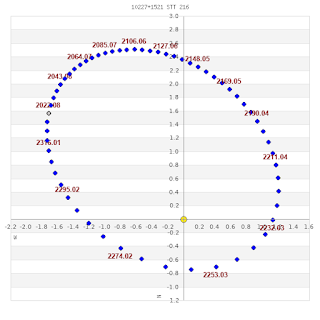
STT216 AB: 152; 175x: White A and B is a very faint close companion. 315-year period nearing apastron
10h 22m 43.81s +15° 20' 39.7" P.A. 228.20 sep 2.3 mag 7.38,10.28 Sp G5 dist. 28.77 pc (93.85 l.y.)

STF1431 AB: 152; 175x: White and 2 Dm, fairly close.
10h 25m 35.12s +08° 46' 35.4" P.A. 76.00 sep 3.6 mag 7.76,9.07 Sp A8III dist. 151.98 pc (495.76 l.y.

Friday, January 28, 2022

24 january 2022

This time with the 6-inch f/15, which now have the Argo Navis setting circles working. And how convienent they are! I can just align to a bright star in the area I want to observe, then the tour double stars from catalogs I've loaded, and can easily slew target to target. What a great tool. No charts, very effecient.

Seeing was average, but good enough for most observations:

STF 667 AB: 152; 175: Light yellow A and light orange B, 2 delta mag, well split 
05h 14m 41.31s -07° 04' 18.1" P.A. 316.00 sep 4.2 mag 7.15,8.78 Sp K2 dist. 297.62 pc (970.84 l.y.)

STF 701 AB: 152; 175x: Yellow A and orange B, wide.
05h 23m 18.50s -08° 24' 55.9" P.A. 139.00 sep 6.2 mag 6.13,8.09 Sp B8III dist. 122.7 pc (400.25 l.y.)

STF 688 AB: 152; 175x: Wide near equal, light yellow stars.
05h 19m 20.88s -10° 44' 49.9" P.A. 95.00 sep 10.5 mag 7.52,7.55 Sp K3V+F1

BU 189 AB: 152; 175x: B is very much fainter and rather wide.  One of Burnham's 6-inch discoveries
05h 20m 26.41s -05° 22' 03.1" P.A. 285.00 sep 4.6 mag 6.41,9.80 Sp B8III dist. 281.69 pc (918.87 l.y.)

STF 747 AB: 152; 175x: Wide near equal in cluster of stars, other double nearby
05h 35m 02.68s -06° 00' 07.2" P.A. 224.00 sep 36.3 mag 4.70,5.51 Sp B0.5V+B1V dist. 495.05 pc (1614.85 l.y.)

STF 752 AB: 152; 175x: Close pair, large delta mag. 
05h 35m 25.98s -05° 54' 35.6" P.A. 146.00 sep 12.5 mag 2.77,7.73 Sp O9III dist. 714.29 pc (2330.01 l.y.)

STF 754 AB: 152; 175x: Bright A and much fainter B, well separated
05h 36m 35.69s -06° 03' 53.1" P.A. 288.00 sep 5.3 mag 5.71,9.24 Sp B1V dist. 471.7 pc (1538.69 l.y.)

BU 13 AB: 152; 285x: Very close split, with seeing, at least 1 delta mag. Brunham says "In a low-power field  with STF 743"
05h 34m 32.43s -04° 29' 14.8" P.A. 144.00 sep 0.8 mag 7.57,9.22 Sp B8V

BU 743 AB: 152; 175x: Very fine, 1 Dm, just split.
03h 55m 38.76s +52° 15' 37.4" P.A. 261.00 sep 1.1 mag 8.86,10.03 Sp A5 dist. 336.7 pc (1098.32 l.y.)

STF 750 AB: 152; 175x: White A, light yellow 1 Dm B, well split
05h 35m 31.07s -04° 21' 50.6" P.A. 61.00 sep 4.2 mag 6.43,8.39 Sp B2.5IV dist. 361.01 pc (1177.61 l.y.)

BVD 51 AB: 152; 175x: Faint stars, very wide separation, 1 Dm
05h 15m 23.69s -03° 21' 57.4" P.A. 317.00 sep 44.5 mag 7.76,9.56 Sp F7V+G1V dist. 83.26 pc (271.59 l.y.)

H 6 68 AB: 152; 175x: Very wide, 1 Dm, faint.
05h 25m 01.20s -02° 48' 55.7" P.A. 282.00 sep 135.6 mag 7.31,9.16 Sp B5V dist. 425.53 pc (1388.08 l.y.)

DA 5 AB: 152; 175x: Textbook!  Bright stars, around 1 Dm, closely split.
05h 24m 28.62s -02° 23' 49.7" P.A. 77.00 sep 1.9 mag 3.56,4.87 Sp B1V+B2e dist. 299.4 pc (976.64 l.y.)

WNC 2 A-BC: 152; 175x: Excellent near equal white stars, nice.  BC is for the 20-inch, A 847, 7.67/7.84 0.2"
05h 23m 51.32s -00° 51' 59.8" P.A. 158.20 sep 3.1 mag 6.87,6.96 Sp F6V dist. 55.71 pc (181.73 l.y.)

STF 725 AB: 152; 175x: Light orange and very much fainter and wide B.
05h 29m 43.98s -01° 05' 31.8" P.A. 87.00 sep 12.7 mag 4.69,9.70 Sp K5III dist. 155.76 pc (508.09 l.y.)

STF 734 AB: 152; 175x: Exquisite close pair, 1 Dm, with a third star at a wide right angle.
05h 33m 07.35s -01° 43' 02.5" P.A. 355.00 sep 1.6 mag 6.67,8.22 Sp B4Vn dist. 315.46 pc (1029.03 l.y.)

BU 1048 AB: 152; 175x: Very bright white A, dim B is a tiny point, with seeing, in A's diffraction.  
05h 32m 41.35s -01° 35' 30.6" P.A. 355.00 sep 2.2 mag 5.30,9.80 Sp B1IV dist. 478.47 pc (1560.77 l.y.)

STF 743 AB: 152; 175x: Near equal, very close, around 1.5"
05h 34m 43.20s -04° 23' 31.5" P.A. 284.00 sep 1.8 mag 7.74,8.25 Sp B5V

STF 14 AB: 152; 175x: Bright white, wide 2 Dm B.
00h 15m 48.93s -11° 59' 24.7" P.A. 237.00 sep 14.5 mag 8.90,10.85 Sp A0V dist. 1724.14 pc (5624.14 l.y.)

STF 761 AB: 152; 175x: Double double with STF 762.  Really too many stars here being counted as double, it's a small cluster.
05h 38m 36.54s -02° 33' 12.7" P.A. 202.00 sep 68.1 mag 7.86,8.39 Sp B5V

BU 89 AB: 152; 285x: Very tough, notched elongation, much fainter B.  Burnham discovered with his 6-inch and says "A difficult pair with that aperture"  0.55" at discovery!
05h 37m 34.81s -01° 25' 19.6" P.A. 16.00 sep 0.7 mag 7.27,8.94 Sp B3/4V dist. 641.03 pc (2091.04 l.y.)

BU 1032 AB: 152; 450x: Can't see any out of round no matter the power used.  
05h 38m 44.77s -02° 36' 00.2" P.A. 243.30 sep 0.3 mag 4.07,5.27 Sp +B0.2V dist. 328.95 pc (1073.03 l.y.)

ALC 3 AE: 152; 175x: Orange A and super wide B.  WDS asserts physical based on proper motions
07h 29m 06.72s +31° 47' 04.3" P.A. 355.00 sep 755.4 mag 4.16,7.82 Sp F0V dist. 18.05 pc (58.88 l.y.)

STT 171 AB: 152; 175x: Extremely faint B, seen with averted vision only, very closely separated
07h 26m 39.61s +31° 37' 11.9" P.A. 138.00 sep 1.0 mag 7.39,9.19 Sp G5 dist. 159.49 pc (520.26 l.y.)

STF 1119 AB: 152; 175x: Very closely split, slight Dm
07h 38m 30.23s +33° 42' 41.4" P.A. 353.00 sep 3.3 mag 8.08,9.35 Sp F0 dist. 161.81 pc (527.82 l.y.)

STF 1126 AB: 152; 175x: Near equal hairline split, white stars
07h 40m 06.99s +05° 13' 51.9" P.A. 178.80 sep 0.8 mag 6.55,6.96 Sp A0III

STF 1134 AB: 152; 175x: White A and much fainter wide B
07h 43m 31.09s +03° 29' 09.8" P.A. 147.00 sep 9.6 mag 7.07,10.38 Sp F8 dist. 50.94 pc (166.17 l.y.)

STF 1137 AB: 152; 175x: 1 Dm white stars, well split.  
07h 46m 35.35s +04° 07' 50.1" P.A. 133.00 sep 3.1 mag 7.96,9.12 Sp F5 dist. 440.53 pc (1437.01 l.y.)

STF 1103 AB: 152; 175x: Light yellow A and light orang B, 1 Dm, well split
07h 30m 33.61s +05° 15' 16.8" P.A. 245.00 sep 4.2 mag 7.12,8.64 Sp B9 dist. 187.62 pc (612.02 l.y.)

STF 1149 AB: 152; 175x: Wide 1 Dm pair
07h 49m 29.79s +03° 13' 15.6" P.A. 41.00 sep 21.7 mag 7.81,9.19 Sp G0 dist. 130.21 pc (424.75 l.y.)

BU 21 AB: 152; 175x: Extremely faint B, well separated, seen with averted vision only
07h 28m 02.08s +06° 56' 31.5" P.A. 28.00 sep 4.3 mag 5.25,11.10 Sp F0III dist. 97.56 pc (318.24 l.y.)

STT 182 AB: 152; 245x: Extremely fine hairline split, near equal white
07h 52m 42.12s +03° 23' 02.2" P.A. 7.90 sep 0.9 mag 7.82,7.93 Sp A2 dist. 210.08 pc (685.28 l.y.)

STT 176 AB: 152; 175x: Fine, 2 Dm, around 4"
07h 38m 30.46s +00° 30' 18.1" P.A. 220.00 sep 1.5 mag 7.21,9.24 Sp B9 dist. 485.44 pc (1583.51 l.y.)

STF 1175 AB: 152; 175x: Very close, around 2", 1.5 Dm, fine pair.  Physical with 2929-year period
08h 02m 26.06s +04° 09' 07.5" P.A. 288.70 sep 1.4 mag 7.89,9.13 Sp G5 dist. 40.55 pc (132.27 l.y.)
STF 1182 AB: 152; 175: Fairly wide 1.5 Dm
08h 05m 24.43s +05° 49' 38.9" P.A. 75.00 sep 4.9 mag 7.48,8.76 Sp B9 dist. 328.95 pc (1073.03 l.y.)

STF 1074 AB: 152; 450x: Touching at all powers
07h 20m 31.07s +00° 24' 13.1" P.A. 172.00 sep 0.8 mag 7.44,7.80 Sp B9.5V dist. 228.31 pc (744.75 l.y.)

STF 1073 AB: 152; 175x: White A and 2 Dm wide B
07h 21m 00.62s +10° 11' 44.2" P.A. 67.00 sep 9.0 mag 7.87,10.15 Sp A1IV dist. 164.2 pc (535.62 l.y.)

STT 170 AB: 152; 450x: Notched elongation all powers.  289-year period, it will widen slightly in 20 years and may be splittable.
07h 17m 38.51s +09° 17' 31.5" P.A. 284.00 sep 0.6 mag 7.37,7.67 Sp G0IV-V dist. 41.61 pc (135.73 l.y.)

23 january 2022

This was a pretty decent night, so I used the 20-inch throughout.  I have been trying over the last several nights, whenever it was clear, to split Joy 1, which is Mira's white dwarf companion.  Or, more correctly, the glow from the white dwarf's accretion disk of Mira's material it is absorbing.  This can only be seen when Mira is at minima, which it is now, however the target is getting tough to see since it is narrowing separation of 0.45" currently, and it is itself variable of indeterminate period and range.  I could not get any resolution because Mira is low in the sky and the seeing was always too poor.  I'll keep trying, but it may have to wait until the end of this year when Mira is at minima again.

EDG 2 AB: 508; 205x: Bright white star with two fairly bright stars close by (AB and AC).  Did not try for Aa,Ab, 5.51/8.68 0.4". 
05h 08m 06.62s +24° 15' 54.6" P.A. 154.00 sep 17.9 mag 5.51,11.00 Sp B2V dist. 458.72 pc (1496.34 l.y.)

A 2427 AB: 508; 205x: Light orange A, much fainter B well separated.
4h 59m 25.67s +20° 11' 38.6" P.A. 264.00 sep 4.0 mag 8.49,11.98 Sp K0 dist. 336.7 pc (1098.32 l.y.)

COU 709 AB: 508; 553x: Very fine, nice split, light yellow A and one delta blue B
04h 58m 21.47s +18° 59' 36.2" P.A. 242.00 sep 0.5 mag 9.69,11.52 Sp F2 dist. 147.93 pc (482.55 l.y.)

COU 568 AB: 508; 205x: Just split, near equal white stars, faint
04h 59m 32.61s +25° 15' 34.9" P.A. 159.00 sep 0.8 mag 11.80,11.80 Sp G0

BU 1238 AB: 508; 205x: B just seen as a point outside of much brighter very light yellow A's glare.
05h 01m 18.91s +26° 32' 03.5" P.A. 16.00 sep 1.6 mag 7.56,10.52 Sp B2IV dist. 171.53 pc (559.53 l.y.)

HU 445 AB: 508; 667x: Fine hairline split, noticeable magnitude difference, <1 delta, light yellow stars.  Physical with an 83.24-year period, it will make a little less than a quarter turn by 2040.
05h 01m 44.19s +20° 49' 47.6" P.A. 171.70 sep 0.3 mag 9.32,8.45 Sp G0 dist. 38.21 pc (124.64 l.y.)
COU 759 AB: 508; 205: Very nice near equal white stars, split, one of three stars in wide equal triangle
05h 02m 53.63s +28° 02' 22.7" P.A. 258.00 sep 1.4 mag 9.97,10.33 Sp G5

A 1845 AB: 508; 205x: Near equal white stars, well separated.
05h 05m 15.46s +27° 39' 35.9" P.A. 140.00 sep 2.0 mag 10.39,10.41 Sp G0

STT 97 AB: 508; 667x: With best seeing only, white stars, snowman of very much fainter B to the south.
05h 05m 37.72s +23° 03' 39.8" P.A. 149.00 sep 0.4 mag 6.97,8.45 Sp B5I dist. 320.51 pc (1045.5 l.y.)

STT 95 AB: 508; 205x: Bright white stars, near equal, just hairline split.  760-year period.
05h 05m 32.08s +19° 48' 24.4" P.A. 295.20 sep 1.0 mag 7.02,7.56 Sp A5m dist. 137.74 pc (449.31 l.y.)
COU 155 AB: 508; 1334x: Best impression at maximum magnification is a slightly NNW PA elongation.  
05h 07m 09.95s +22° 23' 37.0" P.A. 331.00 sep 0.2 mag 8.60,8.70 Sp F5

HU 446 AB: 508; 205x: Wow! superfine equal white stars, just split
05h 07m 22.87s +22° 42' 42.6" P.A. 190.00 sep 0.9 mag 10.19,10.35 Sp A0

STF 694 AB: 508; 205x: Nice white stars, good split, slight magnitude difference
05h 24m 01.17s +24° 57' 37.8" P.A. 13.00 sep 1.3 mag 8.65,8.54 Sp A2 dist. 114.16 pc (372.39 l.y.)

HO 226 AB: 508; 205x: White, just split, one delta.  374-year period
05h 27m 01.32s +27° 36' 36.9" P.A. 274.30 sep 0.6 mag 8.71,8.61 Sp F8 dist. 167.79 pc (547.33 l.y.)

COU 268 AB: 508; 445x: Suspected at 205x, clean split with 445x, near equal, very nice
05h 31m 54.80s +21° 40' 53.4" P.A. 165.00 sep 0.7 mag 10.11,10.24 Sp G0

STF 779 AB: 508; 205x: Bright white and much fainter B, wide
05h 44m 21.16s +27° 43' 53.3" P.A. 254.00 sep 8.6 mag 7.50,9.78 Sp A0 dist. 271.74 pc (886.42 l.y.)
 
HU 450 AB: 508; 445x: Very fine, good split, significant magnitude difference
06h 06m 01.80s +23° 30' 51.5" P.A. 246.00 sep 0.4 mag 8.80,10.30 Sp B9

BU 1241 AB: 508; 1067x: Out of round at highest powers but no notch, it is weaker to north
06h 09m 43.99s +23° 06' 48.5" P.A. 347.00 sep 0.6 mag 5.90,8.48 Sp B2.5Ibe dist. 4347.83 pc (14182.62 l.y.)

COU 273 AB: 508; 445x: Very fine, need foveal coaxing before I can hold it direct, with seeing, significant magnitude difference.
06h 12m 41.09s +21° 58' 44.3" P.A. 140.00 sep 1.3 mag 9.49,10.95 Sp G0

Tuesday, January 25, 2022

20 january 2022

Had a night out with the 20-inch but the seeing and transparency were not great, so spent the time masked down to 7-inches. I tried out the 18mm zoom eyepiece which generally works well but seems to have some scattered light and ghost images on bright stars. Will go back to my usual eyepiece set.

STF 752 AB: 178; 148x: Bright white A and faint wide B, with other wider stars nearby.
05h 35m 25.98s -05° 54' 35.6" P.A. 146.00 sep 12.5 mag 2.77,7.73 Sp O9III dist. 714.29 pc (2330.01 l.y.)

STFA14 AC: 178; 148: Bright white A and very wide, mag 6 B. Did not try for AB, HEI 42, 0.3" 2.41/3.76
05h 32m 00.40s -00° 17' 56.7" P.A. 4.00 sep 56.2 mag 2.41,6.83 Sp O9.5II+

STF 701 AB: 178; 148: White A and pale orange B, wide, 2 delta mag.
05h 23m 18.50s -08° 24' 55.9" P.A. 139.00 sep 6.2 mag 6.13,8.09 Sp B8III dist. 122.7 pc (400.25 l.y.)

STF 721 AB: 178; 148: Easy wide pair, 2 delta mag, white A and light blue B
05h 29m 33.52s +03° 08' 52.5" P.A. 149.00 sep 25.3 mag 7.09,9.14 Sp B5V

STF 724 AB: 178; 148: Easy wide pair, 1 delta mag
05h 30m 17.57s +11° 01' 17.1" P.A. 253.00 sep 6.8 mag 9.30,10.60 Sp A2

A 2705 AB: 178; 296x: Faint B about 1 delta mag, very close split
05h 30m 43.48s +11° 53' 45.4" P.A. 251.00 sep 1.0 mag 9.24,9.95 Sp K0

STF 729 AB: 178; 148x: Very nice tight split, 1 delta mag, fairly bright yellow-white A and light blue B.
05h 31m 14.53s +03° 17' 31.7" P.A. 26.00 sep 1.8 mag 5.71,6.74 Sp B1.5V dist. 348.43 pc (1136.58 l.y.)

STF 731 AB: 178; 148x: White stars, slight magnitude difference, well separated
05h 31m 21.21s -02° 05' 57.1" P.A. 328.00 sep 4.8 mag 8.61,9.16 Sp A0 dist. 401.61 pc (1310.05 l.y.)

STF 734 AB: 178; 222x: White A and 2 delta mag small B, nicely split
05h 33m 07.35s -01° 43' 02.5" P.A. 355.00 sep 1.6 mag 6.67,8.22 Sp B4Vn dist. 315.46 pc (1029.03 l.y.)

BU 13 AB: 178; 222x: Nice 1 delta pair, just split. Burnham notes "In a low-power field with STF 743"
05h 34m 32.43s -04° 29' 14.8" P.A. 144.00 sep 0.8 mag 7.57,9.22 Sp B8V

STF 743 AB: 178; 148x: Obvious but close split, less than 1 delta mag
05h 34m 43.20s -04° 23' 31.5" P.A. 284.00 sep 1.8 mag 7.74,8.25 Sp B5V

STF 747 AB: 178; 148x: Very wide near equal pair
05h 35m 02.68s -06° 00' 07.2" P.A. 224.00 sep 36.3 mag 4.70,5.51 Sp B0.5V+B1V dist. 495.05 pc (1614.85 l.y.)

STF 741 AB: 178; 148x: easy white and wide three delta
05h 34m 56.49s -00° 07' 22.3" P.A. 286.00 sep 10.0 mag 7.14,10.03 Sp B5

STF 746 AB: 178; 148x: Faint, near equal, wide
05h 35m 18.44s -04° 40' 55.9" P.A. 219.00 sep 13.9 mag 10.40,10.70 Sp A0

STT 111 AB: 178; 148x: White and fairly faint B, about 2 delta, light blue B, nicely split.
05h 35m 13.24s +10° 14' 24.2" P.A. 351.00 sep 2.8 mag 5.65,9.68 Sp B9IIIp dist. 343.64 pc (1120.95 l.y.)

STF 754 AB: 178; 148x: Bright yellow-white A and 3 delta mag B, fairly close
05h 36m 35.69s -06° 03' 53.1" P.A. 288.00 sep 5.3 mag 5.71,9.24 Sp B1V dist. 471.7 pc (1538.69 l.y.)

PRT 1 AB: 178; 148x: Unremarkable white stars, very wide 1 delta B
05h 36m 59.80s +00° 06' 00.2" P.A. 136.00 sep 28.9 mag 9.45,10.99 Sp B9

STF 757 AB: 178; 222x: Nice near equal white stars, close split, several other stars appear to be in a group
05h 38m 06.52s -00° 11' 03.5" P.A. 242.00 sep 1.5 mag 7.96,8.33 Sp B6V