Wednesday, May 25, 2022

25 may 2022 physical pairs on the 20-inch

It was forecasted to be clear, transparent, with excellent seeing last night. While transparency was indeed good, due to a hot high pressure area over California, the seeing did not live up to expectations. I think there was still too much radiating cooling from the surrounding houses, roads, and land in general. And maybe the mirror was not all the way cooled, in spite of opening up and letting it in the shade since 4pm. But seeing was good enough to go after a few good close pairs. I worked my known-physical list. I started in Virgo but since that was over a neighbor's roof currents I redirected upward to better seeing.  I used my apodising mask throughout.

A 79 AB: 508; 600x: Light orange stars, good clean split, 1 Dm, PA to the east.  WDS grade 4 (medium confidence) orbital solution, 232-year period.  However, there is no overlap to the parallax ranges, -43%, so this one likely is not binary.  
12h 27m 00.77s -03° 32' 05.6" P.A. 97.50 sep 0.5 mag 8.89,10.03 Sp G5 dist. 63.05 pc (205.67 l.y.)

A 78 AB: 508; 600x: Clean split with seeing, white stars, 1 Dm.  WDS grade 3 orbital solution, 111.93-years.  Unfortunately there is no parallax data for the primary.  The orbital solution has this widening a small amound and crossing to the ESE in the 2040s.
12h 26m 47.72s -05° 35' 31.6" P.A. 82.30 sep 0.3 mag 8.11,8.79 Sp F4V dist. 110.38 pc (360.06 l.y.)

HU 640 AB: 508; 500x: Light orange stars, PA WSW, nicely split, 1 Dm.  WDS grade 3 orbital solution 124.8-year period.  Gaia is missing parallax data.  This will tighten to 0.2" and be due north by 2038.
12h 50m 41.87s +20° 32' 04.9" P.A. 262.80 sep 0.4 mag 10.19,9.91 Sp K5 dist. 38.27 pc (124.84 l.y.)

HU 739 AB: 508; 500x: Rather difficult faint B star can be seen with foveal coaxing and then held with direct vision, very much fainter around 3 Dm, well split, PA to the SW.  Seen with 300x but better view with 500x.  WDS grade 5 orbital solution 307-year period.  It has 23% of the parallax ranges overlapping, only 23 AU weighted separation (a little more than the distance from Earth to Neptune!), 0.5+0.3 Msol, so it is certainly binary.  It will widen a half an arcsecond by 2042.
13h 06m 15.40s +20° 43' 45.1" P.A. 197.00 sep 1.8 mag 9.72,12.11 Sp K4V dist. 18.8 pc (61.33 l.y.)

A 2166 AB: 508; 600x: KR Com.  Rod with a weaker end to the north west, white.  Pretty tough.  WDS grade 2 orbital solution with an 11.228-year period, there is no Gaia data for the secondary (likely too close).  In two years it will be 0.14" separated due north, and continue to make its turn eastward into imperceptability by 2029's periastron.  Difficult as it is, this is one to keep an eye on each year.
13h 20m 15.78s +17° 45' 57.7" P.A. 326.00 sep 0.1 mag 7.78,8.38 Sp F8V dist. 83.96 pc (273.88 l.y.)

A 570 AB: 508; 600x: Notched elongation, noticable difference in magnitude, PA westerly.  WDS grade 1 (definitive) orbit, 29.9-year period, no Gaia parallax data for the primary.  It will make more than a quarter turn to the east by 2034.
14h 32m 20.27s +26° 40' 38.4" P.A. 217.50 sep 0.2 mag 6.61,7.08 Sp A6V dist. 73.64 pc (240.21 l.y.)

Saturday, May 21, 2022

20 may 2022 bootes struves

A clear night with hazy transparancy and average seeing, 6/10, but good enough for the 6-inch.  I got the Nexus DSC dialed in and it was quite accurate, everything landing in the field, especially as I continued sychronizing the objects.  The Nexus conviently has many pre-loaded catalogs, including the Struves, so I simply went Struving in Bootes, which was well placed.  Most were typical Struves, though many were faint pairs, and a couple were too closely separated for the 6-inch.  Observed from 9:30 (late darkeness now) to a little past 11pm.

STF 1772 AB: 152; 150x: Whitely and lovely 3 Dm B which appears as a fine point closely separated.  WDS asserts it's physical, but there is no parallax range overlap, -13%, so it is not binary.
13h 40m 40.50s +19° 57' 20.4" P.A. 133.00 sep 4.4 mag 5.76,9.60 Sp A1V dist. 100.6 pc (328.16 l.y.)

STF 1773 AB: 152; 150x: Faint B, super wide, 1 Dm.  WDS says proper motion indicates not physical.  There is no overlap of the parallax ranges, -98%, definitely not binary.
13h 41m 38.19s +07° 36' 21.3" P.A. 209.00 sep 30.6 mag 9.95,10.00 Sp F7V

STF 1779 AB: 152; 200x: Difficult faint pair (in poor transparency), just split with seeing when the hazy stars resolve to harder points, around 4" and 1 Dm.  WDS uncertain.  I find there is 88% parallax range overlap, 1,135 AU weighted separation, 2.0+1.5 Msol, so it is probable this is binary. 
13h 44m 33.98s +23° 40' 06.0" P.A. 145.00 sep 3.8 mag 9.26,10.37 Sp A5 dist. 775.19 pc (2528.67 l.y.)

STF 1782 AB: 152; 150x:  1 Dm, wide.  WDS asserts it's physical.  I find no parallax range overlap, -32%, so it is not binary.
13h 45m 06.87s +18° 22' 04.3" P.A. 185.00 sep 30.4 mag 7.98,9.81 Sp F5

STF 1785 AB: 152; 150x:  Very pretty light orange stars, 1 Dm.  WDS says physical with a 156-year period.  I find 47% parallax range overlap, only 48 AU weighted separation, 0.7+0.6 Msol, so it certainly is binary.  It will close another 1.5" in the next 20 years but remain resolvable in the 6-inch.  
13h 49m 04.00s +26° 58' 47.7" P.A. 191.40 sep 2.7 mag 7.36,8.15 Sp K4V+K6V dist. 13.41 pc (43.74 l.y.)
STF 1791 AB: 152; 150x: Faint near equal pair, around 4" separation.  WDS notes parallax indicates components are non-physical.  Unfortunately Gaia lacks parallax data.
13h 56m 49.22s +14° 25' 58.6" P.A. 159.00 sep 21.0 mag 9.39,10.73 Sp F7V+G1IV

STF 1792 AB: 152; 150x: Very difficult, with seeing, faint stars nearly 1 Dm, just seaprated.  WDS uncertain.  There is no parallax range overlap, -50%, so it is not binary.
13h 57m 03.72s +12° 27' 03.5" P.A. 291.00 sep 2.3 mag 9.98,10.89 Sp F8 dist. 1470.59 pc (4797.06 l.y.)

STF 1793 AB: 152; 150x: Pretty blue-yellow A, 1 Dm yellow B, wide.  WDS uncertain.  There is 1% parallax range overlap, 859 AU weighted separation, 2.3+1.8, so it might be binary.
13h 59m 05.25s +25° 48' 57.6" P.A. 243.00 sep 4.8 mag 7.46,8.39 Sp A5V dist. 153.61 pc (501.08 l.y.)

STF 1794 AB: 152; 150x: Very nice, closely split near equal white stars.  WDS uncertain, but I find 73% parallax range overlap, only 252 AU weighted separation, 1.3+1.2 Msol, and the radial velocity delta 2.1 is less than the escape velocity 4.2, so this is binary.
13h 59m 48.26s +19° 52' 57.8" P.A. 125.00 sep 1.8 mag 9.48,9.65 Sp F8 dist. 151.29 pc (493.51 l.y.)

STF 1779 AB: 152; 150x: Well separated 1 Dm light orange stars.  WDS uncertain, but I find 88% parallax range overlap, 1,135 AU weighted separation, 2.0+1.5 Msol, so it is likely binary.
13h 44m 33.98s +23° 40' 06.0" P.A. 145.00 sep 3.8 mag 9.26,10.37 Sp A5 dist. 775.19 pc (2528.67 l.y.)

STF 1804 AB: 152; 150x: Very pretty light blue A and light orange B, 2 Dm, fairly close split.  WDS asserts phycial, but there is no overlap of the parallax ranges -92%, so it is not binary.
14h 08m 15.53s +21° 11' 34.9" P.A. 13.00 sep 4.7 mag 8.17,9.28 Sp F8 dist. 72.46 pc (236.36 l.y.)

STF 1806 AB: 152; 150x: Faint stars, 1 Dm, fairly wide, white.  WDS says parallax indicates physical, but there is no overlap of the parallax ranges, -10%, and the radial velocity delta exceeds the escape velocity.  It is not binary.
14h 08m 44.98s +48° 30' 24.5" P.A. 173.00 sep 13.1 mag 10.08,11.03 Sp F8

STF 1808 AB: 152; 150x: Very pretty close pair, 2 Dm.  WDS asserts it is physical, but there is no overlap of their parallax ranges, -5%, it is not binary.
14h 10m 07.76s +26° 35' 58.1" P.A. 83.00 sep 2.7 mag 8.83,9.63 Sp G5 dist. 70.87 pc (231.18 l.y.)

STF 1809 AB: 152; 150x: The B star is very faint, seen with averted vision only, very close to A.  WDS is uncertain, but there is 58% overlap of the parallax ranges, 1,199 AU weighted separation, 1.9+1.1 Msol, and the radial velocity delta 0.0 is less than the escape velocity 2.1, so it is very likely binary.
14h 08m 54.59s +46° 08' 03.4" P.A. 196.00 sep 4.3 mag 9.42,11.98 Sp G0 dist. 353.36 pc (1152.66 l.y.)

STF 1810 AB: 152; 150x: Fine white stars, close around 3".  WDS asserts physical, but there is no overlap of the parallax ranges, -15%, it is not binary.
14h 11m 33.66s +28° 02' 12.2" P.A. 183.00 sep 2.4 mag 8.98,9.60 Sp G0 dist. 116.28 pc (379.31 l.y.)

STF 1812 AB-C: 152; 150x: White stars, 2 Dm, fairly wide.  WDS says proper motion indicates physical, and there is 48% overlap of parallax ranges, 2.1+1.4 Msol, so it is likely binary.  AB is STT 277, 0.2" 8.73/8.61, not seen.
14h 12m 26.68s +28° 43' 02.3" P.A. 108.00 sep 14.1 mag 7.88,9.45 Sp F2V dist. 1000 pc (3262 l.y.)

STF 1814 AB: 152; 150x: Pretty, near equal, wide.  WDS says parallax indicates physical, and there is 83% parallax range overlap, 1,304 AU weighted separation, 1.3+1.1 Msol, and the radial velocity delta 0.3 is less than the escape velocity 1.8, so it is very likely binary.
14h 11m 00.99s +50° 15' 08.3" P.A. 256.00 sep 11.2 mag 9.25,9.83 Sp G5+G5

STF 1815 AB: 152; 150x: DQ Boo.  9th and 10th magnitude stars, well separated, in a rich field.  WDS asserts it is physical, but there is no -89% parallax range overlap, it is not binary.
14h 12m 36.22s +45° 11' 52.5" P.A. 151.00 sep 9.0 mag 9.58,10.92 Sp K0 dist. 170.07 pc (554.77 l.y.)

STF 1816 AB: 152; 400x: Notched elongation in a ENE-WSW direction, near equal.  WDS orbit with 1340-year period, and unfortunately there is no parallax data for the secondary.
14h 13m 54.63s +29° 06' 19.5" P.A. 101.80 sep 0.3 mag 7.43,7.75 Sp F0+A2 dist. 113.38 pc (369.85 l.y.)
STF 1818 AB: 152; 150x: Faint stars, 2 Dm, well separated.  WDS says proper motion indicates physical, and there is 56% overlap of the parallax ranges, 457 AU weighted separation, 1.1+0.8 Msol, and the radial velocity delta 0.6 is less than the escape velocity 2.8, so it is very likely binary.
14h 14m 16.33s +33° 55' 41.8" P.A. 330.00 sep 5.4 mag 9.01,10.24 Sp G2III dist. 72.78 pc (237.41 l.y.)

STF 1821 AB: 152; 150x: Blazing bright yellow A and 2 Dm yellow B, well separated.  WDS orbit with a 20-year period -- must be incorrect as they are showing 0.04" separation for the orbit.  There is no parallax data for the secondary.
14h 13m 29.00s +51° 47' 23.8" P.A. 235.00 sep 13.8 mag 4.53,6.62 Sp A7V+F1V dist. 50.1 pc (163.43 l.y.)

STF 1823 AB-C: 152; 150x: Faint light orange stars, 1 Dm, closely separated.  AB is A 1101, 9.69/10.32 0.3".  WDS says proper motion indicates physical.  No Gaia parallax data for the primary.
14h 15m 50.57s +10° 17' 59.3" P.A. 148.00 sep 3.9 mag 9.19,9.77 Sp K0 dist. 59.88 pc (195.33 l.y.)

STF 1825 AB: 152; 150x: Bright A, 2 Dm B is well separated.  WDS orbital solution 1085-year period, proper motion indicates physical.  There is 31% parallax range overlap, 147 AU weighted separation, 1.3+0.8 Msol, so it likely is binary.
14h 16m 32.84s +20° 07' 18.7" P.A. 152.80 sep 4.4 mag 6.47,8.42 Sp F6V dist. 32.63 pc (106.44 l.y.)

STF 1826 AB: 152; 150x: White stars, nearly 2 Dm, well separated.  WDS says not physical.  But I find 62% overlap of the parallax ranges, only 802 AU weighted separation, 1.7+1.4 Msol, so it is likely binary.
14h 15m 12.13s +46° 58' 26.6" P.A. 310.00 sep 4.5 mag 8.94,9.69 Sp F8 dist. 176.99 pc (577.34 l.y.)

STF 1828 AB: 152; 200x: Difficult, equal faint stars, with seeing when the faint haze sharpens to points.  WDS uncertain, and I find no -4% overlap of the parallax ranges, so they very likely are not binary.
14h 16m 58.35s +24° 11' 33.4" P.A. 159.00 sep 2.1 mag 10.40,10.75 Sp F2

STF 1829 AB: 152; 150x: Pretty, sharp white equal stars, closely separated.  WDS asserts physical, and there is 27% parallax range overlap, 825 AU weighted separation, 1.9+1.6 Msol, and the radial velocity delta 2.1 is less than the escape velocity 2.7, so it is very likely binary.
14h 15m 27.95s +50° 26' 24.6" P.A. 151.00 sep 5.6 mag 8.10,8.63 Sp F5 dist. 160.51 pc (523.58 l.y.)

STF 1834 AB: 152; 200x: Excellent equal white stars, nice and sharp.  Split with 150x but best view at 200x.  WDS orbit 413-year period.  But there is no parallax range overlap, -12%, so this likely is not binary.
14h 20m 17.60s +48° 30' 25.1" P.A. 103.50 sep 1.6 mag 8.09,8.29 Sp F9V dist. 75.36 pc (245.82 l.y.)

STF 1835 A-BC: 152; 150x: Very pretty light yellow stars, bright A and 2 Dm deeper yellow B, well separated.  BC is BU 1111, 7.4/7.7 0.3" not seen.  WDS says proper motion indicates physical, unfortunately Gaia has no data for the secondary.
14h 23m 22.74s +08° 26' 47.9" P.A. 197.00 sep 6.4 mag 5.03,6.78 Sp A0V+F2V dist. 65.92 pc (215.03 l.y.)

STF 1838 AB: 152; 150x: Equal white stars, well split.  WDS says proper motion indicates physical.  There is 21% overlap of the parallax ranges, 354 AU weighted separation, 1.1+1.0 Msol, so it is likely binary.
14h 24m 05.76s +11° 14' 49.1" P.A. 335.00 sep 9.4 mag 7.47,7.73 Sp F8V+G1V dist. 37.08 pc (120.95 l.y.)

STF 1839 AB: 152; 150x: Equal magnitude white stars, wide separation.  WDS says parallax indicates physical, and there is 42% parallax range overlap, 1,989 AU weighted separation, 1.5+1.5 Msol, and the radial velocity delta 0.5 is less than the escape velocity 1.7, so it likely is binary.
14h 21m 27.38s +53° 53' 50.9" P.A. 83.00 sep 14.5 mag 8.84,8.92 Sp G0 dist. 178.89 pc (583.54 l.y.)

STF 1843 AB: 152; 150x: White stars, wide, 1 Dm.  WDS says proper motion indicates physical, and there is 52% parallax range overlap, 1,909 AU weighted separation, 1.7+1.1 Msol, however the radial velocity delta 2.0 exceeds the escape velocity 1.6, so it might not be binary.
14h 24m 38.91s +47° 49' 50.0" P.A. 186.00 sep 19.8 mag 7.68,9.23 Sp F4V dist. 92.08 pc (300.36 l.y.)

STF 1848 AB: 152; 150x: B is very faint, seen with averted vision only, very closely separated.  WDS asserts it is physical, and there is 36% overlap in their parallax ranges, 684 AU weighted separation, 2.0+1.0 Msol, so it may be binary.
14h 27m 45.30s +32° 57' 02.9" P.A. 356.00 sep 3.1 mag 8.67,11.69 Sp A3 dist. 196.46 pc (640.85 l.y.)

STF 1850 AB: 152; 150x: Bright white stars, wide, 1 Dm.  WDS asserts it is physical, and there is 18% overlap of the parallax ranges, a pretty wide 6,819 AU weighted separation, 3.1+2.7 Msol, so it might be binary.
14h 28m 33.29s +28° 17' 25.9" P.A. 263.00 sep 25.2 mag 7.11,7.56 Sp A1V+A1V dist. 349.65 pc (1140.56 l.y.)

STF 1854 AB: 152; 150x: Bright yellow-white A, very faint B appears and can be held after foveal coaxing.  WDS asserts it is physical, but there is no -32% overlap of the parallax ranges, it is not binary.
14h 29m 49.66s +31° 47' 28.2" P.A. 256.00 sep 26.1 mag 6.05,10.62 Sp A0Vs dist. 110.13 pc (359.24 l.y.)

STF 1855 AB: 152; 150x: Wide light orange stars, slight Dm.  WDS says proper motion indicates physical, however there is no -37% parallax range overlap, so it is not binary.
14h 32m 22.73s +31° 38' 12.5" P.A. 247.00 sep 15.7 mag 9.24,9.94 Sp G0 dist. 112.87 pc (368.18 l.y.)

STF 1857 AB: 152; 150x: Very faint, B is on the edge of detectability and with averted vision only, wide separation.  WDS uncertain, but there is no overlap -91% of the parallax ranges, so it is not binary.
14h 34m 40.35s +10° 10' 17.6" P.A. 354.00 sep 16.8 mag 10.02,12.49 Sp K0

STF 1858 AB: 152; 200x: 2 Dm, fairly close split at 150x, better view at 200x.  WDS orbital solution 1329-year period.  But there is no overlap -27% of the parallax ranges, it is not binary.
14h 33m 36.45s +35° 35' 08.0" P.A. 37.60 sep 3.0 mag 8.13,8.98 Sp G5 dist. 36.79 pc (120.01 l.y.)

STF 1861 AB: 152; 150x: Easy, faint pair, wide, less than 1 Dm.  WDS says parallax indicates physical, and there is 14% overlap of the parallax ranges, 2,930 AU weighted separation, 1.6+1.4 Msol, however the radial velocity delta 46.4 far exceeds the escape velocity 1.3, these are not binary.
14h 36m 42.39s +12° 10' 10.5" P.A. 174.00 sep 13.9 mag 9.73,10.28 Sp G0 dist. 268.1 pc (874.54 l.y.)

STF 1862 AB: 152; 150x: Easy 1 Dm wide pair.  WDS says parallax indicates physical, and there is 8% parallax range overlap, 3,461 AU weighted separation, 1.8+1.3 Msol, however the radial velocity delta 1.4 exceeds the escape velocity 1.3, so this probably is not binary.
14h 37m 49.07s +14° 54' 09.6" P.A. 125.00 sep 14.9 mag 9.31,10.51 Sp F5IV dist. 558.66 pc (1822.35 l.y.)

Friday, May 6, 2022

3 may 2022, supurb night with the 6-inch refractor

Since replacing the motor on the Byers mount and fixing up the 6-inch, I had used it a couple of times for stunning solar views, but not yet at night.  Tuesday night's forecast was for clear skies with ok transparency and good seeing.  So I let the refractor cool down as soon as it was in shadow, and started observing at around 9pm.  Seeing was good to start but steadily improved, to the point I was getting clean airy disks and diffraction rings at high power.  I was completely impressed with what I could resolve.  I spent the time in Ursa Major and Draco, since the northern part of the sky is not convienent with the 20-inch.  

STF 1863 AB: 152; 250x: Hairline split, unequal.  WDS grade 4 orbit with a 538-year period, but there is -24% parallax range overlap, so these are not binary.
14h 38m 00.71s +51° 34' 42.1" P.A. 58.80 sep 0.7 mag 7.71,7.80 Sp F4V dist. 82.17 pc (268.04 l.y.)

STF 1871 AB: 152; 125x: White stars, nice clean split.  WDS grade 4 orbit 3658-year period, but there is no parallax range overlap (-75%), so these are not binary.
14h 41m 35.50s +51° 23' 51.3" P.A. 313.10 sep 1.9 mag 8.02,8.07 Sp F3V dist. 99.3 pc (323.92 l.y.)

STF 1860 AB: 152;125x: Near equal faint wide stars, near a bright orange star in field. WDS uncertain, but there is 93% parallax range overlap, only 182 AU weighted separation, 2.0+1.6 Msol, so these are very likely to be binary.
14h 33m 52.49s +55° 14' 09.6" P.A. 113.00 sep 1.0 mag 7.99,8.97 Sp A5 dist. 152.21 pc (496.51 l.y.)

STF 1831 AB: 152; 125x: Double double with STF 1830 EF.  There is a bright light orange star in the center (the C star), and on opposite sides are double stars of similar delta mag and approximately the same separation from the center star, but one is about half the separation (AB) of the other (EF).  WDS says AB is uncertain, but there is no parallax range overlap (-65%), so they are not binary.
14h 16m 08.47s +56° 42' 45.7" P.A. 138.00 sep 5.8 mag 7.16,9.56 Sp A7IV dist. 156.01 pc (508.9 l.y.)

STF 1830 EF: 152; 125x: Double double with STF 1830 EF. There is a bright light orange star in the center (the C star), and on opposite sides are double stars of similar delta mag and approximately the same separation from the center star, but one is about half the separation (AB) of the other (EF).  WDS says EF is not physical, and there is no (-89%) parallax range overlap, so it is not binary.
14h 15m 44.70s +56° 40' 20.3" P.A. 312.00 sep 10.6 mag 9.33,10.28 Sp G5

STF 1872 AB: 152; 125x: Light yellow A and blue B, 1 Dm, well separated.  WDS grade 5 orbit with a 2,000-year period, and says proper motion indicates physical, however there is -2% parallax range overlap, 424 AU weighted separation, 1.4+1.1 Msol, and the proper motion vector is low.  Doubtful this is binary, but time will tell.
14h 41m 00.84s +57° 57' 28.1" P.A. 50.00 sep 7.4 mag 7.53,8.32 Sp K0 dist. 55.46 pc (180.91 l.y.)

STF 1878 AB: 152; 125x: Low power double double with STF 1882 AB, both are light yellow stars, both A stars have similar magnitude, STF 1882 AB has twice the separation as STF 1878 AB.  WDS grade 5 orbit 1555-year period.  There is 35% overlap of the parallax ranges, only 172 AU weighted 
separation, 1.5+0.8 Msol, so these likely are binary.
14h 42m 03.25s +61° 15' 42.9" P.A. 314.20 sep 4.1 mag 6.33,9.16 Sp F4V dist. 40.67 pc (132.67 l.y.)


STF 1882 AB: 152; 125x: Low power double double with STF 1882 AB, both are light yellow stars, both A stars have similar magnitude, STF 1882 AB has twice the separation as STF 1878 AB.  WDS says parallax indicates physical, however there is no overlap of parallax ranges (-2%), and in spite of 1,135 AU weighted separation and 2.0+1.1 Msol, the radial velocity delta 4.0 exceeds the escape velocity 2.2, so these are not binary.
14h 44m 03.55s +61° 05' 53.7" sep 11.3 mag 6.92,9.23 Sp F3V dist. 82.17 pc (268.04 l.y.)

HU 149 AB: 152; 350x: Overlapping discs at all powers, similar magnitude.  WDS grade 4 orbit, 770-
year period, but unfortunately there is no parallax data for the primary.
15h 24m 35.30s +54° 12' 46.1" P.A. 270.30 sep 0.7 mag 7.48,7.62 Sp K0 dist. 234.74 pc (765.72 l.y.)


BU 946 AB: 152; 250x: ! Light yellow A is fairly bright, B is very faint and an extremely fine point, good close separation.  Burnham discovered it with the 18.5-inch refractor, and called it  "A fine unequal pair in Draco."  The star hop to this star is interesting, three pointed triangle asterisms.  WDS is uncertain, and sadly there is -28% parallax range overlap, so they are not binary. 
15h 47m 37.92s +55° 22' 35.9" P.A. 129.00 sep 2.3 mag 5.91,9.53 Sp A3m dist. 73.8 pc (240.74 l.y.)

STF 1984 AB: 152; 125x: 2 Dm, wide.  WDS uncertain, and there is -17% parallax range overlap, so they are likely not binary.
15h 51m 10.09s +52° 54' 25.2" P.A. 279.00 sep 6.4 mag 6.89,8.94 Sp A1V dist. 127.06 pc (414.47 l.y.)

STT 312 AB: 152; 125x: Bright orange A and very faint, well separated B.  WDS uncertain, but there is 69% parallax range overlap, only 138 AU weighted separation, 2.9+0.7 Msol, so these are likely binary.  
16h 23m 59.51s +61° 30' 50.7" P.A. 142.00 sep 4.7 mag 2.80,8.20 Sp G8IIIab dist. 28.23 pc (92.09 l.y.)

STF 2054 AB: 152; 250x: Hairline split with seeing, 1 Dm, light orange stars.  WDS uncertain, and unfortunatly no Gaia data for the secondary.
16h 23m 47.19s +61° 41' 47.0" P.A. 350.00 sep 1.0 mag 6.15,7.09 Sp G8III dist. 155.28 pc (506.52 l.y.)

STF 2118 AB: 152; 125x: Very fine hairline split, slightly unequal.  WDS grade 3 orbit, 321-year period.  There is 43% overlap of the parallax ranges, 76 AU weighted separation, 1.6+1.5 Msol, so these are binary.  It will tighten considerably to around 0.5" by the 2040s.
16h 56m 25.32s +65° 02' 20.6" P.A. 64.90 sep 0.9 mag 7.07,7.30 Sp F2IV dist. 69.93 pc (228.11 l.y.)

STF 2155 AB: 152; 125x: Well separated 3 Dm.  WDS says physical, and there is 59% overlap of the parallax ranges, 1,560 AU weighted separation, 2.5+1.2 Msol, so it very likely is binary.  
17h 16m 04.88s +60° 42' 49.7" P.A. 113.00 sep 10.0 mag 6.93,9.97 Sp F3III dist. 182.48 pc (595.25 l.y.)

BU 953 AB: 152; 350x: Hint of elongation, but I am tentitive of the observation, the current separation 
is beyond the scope's resolution. WDS grade 3 orbit 220-year period, and there is no Gaia data for the primary.
16h 36m 39.05s +69° 47' 34.7" P.A. 49.70 sep 0.2 mag 8.56,9.27 Sp F2V dist. 106.95 pc (348.87 l.y.)


STF 2241 AB: 152; 125x: Bright yellow stars, 1 Dm, wide. WDS grade 5 orbit with 10,000-year period, proper motion indicates physical.  There is 89% overlap of the parallax ranges, 691 AU weighted separation, 1.7+1.2 Msol, however the radial velocity delta (7.4) exceeds the escape velocity (2.7), so it is not binary.  
17h 41m 56.36s +72° 08' 55.8" P.A. 14.00 sep 29.6 mag 4.60,5.59 Sp F5IV+F8V dist. 22.84 pc (74.5 l.y.)

LDS 5227 AB 152; 125x: Super wide light orange stars, 1 Dm.  WDS says parallax indicates physical. 
17h 29m 44.45s +63° 51' 09.5" P.A. 288.00 sep 193.5 mag 7.67,8.40 Sp F9V+G0 dist. 45.21 pc (147.48 l.y.)

STF 2218 AB: 152; 350x: Appears as a very squat snowman, so it must be very closely separated with significant Dm.  WDS grade 4 orbit, 1051-year period.  But there is no overlap of the parallax ranges, -74%, so there is no possibility of these being binary.
17h 40m 18.07s +63° 40' 31.4" P.A. 306.80 sep 1.4 mag 7.08,8.37 Sp F8V dist. 68.49 pc (223.41 l.y.)

STF 2130 AB: 152; 125x: Light yellow-orange stars, wide, 1 Dm.  WDS grade 3 orbit, 424-year period.  There is 63% parallax range overlap, a mere 63 AU weighted separation, 1.4+1.4 Msol, so likely binary.
17h 05m 20.20s +54° 28' 14.3" P.A. 357.30 sep 2.6 mag 5.66,5.69 Sp F7V dist. 27.43 pc (89.48 l.y.)

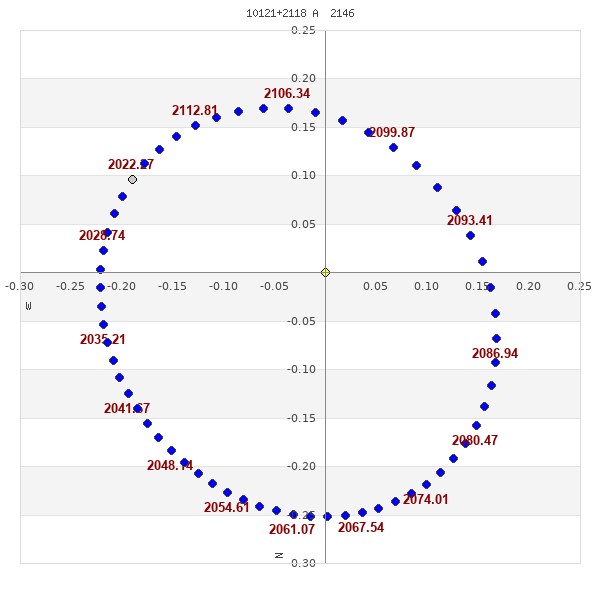
STF 2146 AC: 152; 125x: Super wide, hald Dm.  
17h 13m 06.26s +54° 08' 20.9" P.A. 235.00 sep 89.3 mag 8.36,8.87 Sp F0+G5 dist. 108.81 pc (354.94 l.y.)

STF 2078 AB: 152; 125x: AC is a superwide split of light yellow stars, finder split.  AB is a closer split, around 3", 1 Dm.  WDS asserts it is physical, but there is no -29% overlap of the parallax ranges, so it is not binary.
16h 36m 13.72s +52° 55' 27.8" P.A. 104.00 sep 3.2 mag 5.38,6.42 Sp B9.5V dist. 126.42 pc (412.38 l.y.)

STF2199 AB: 152; 125x: Excellent, close split, near equal white stars.  WDS grade 4 orbit, 1126-year period.  But there is no -88% overlap of the parallax ranges, it is not binary.  
17h 38m 38.32s +55° 45' 34.9" P.A. 53.50 sep 2.0 mag 8.03,8.60 Sp F8V dist. 121.21 pc (395.39 l.y.)


STF2278 BC: 152; 125x: Nice 2+1 set, all the similar magnitude, white.  BC is around 6" separation, and the AB is very wide.  WDS asserts physical, and there is 27% overlap of the parallax ranges, 1,253 AU weighted separation, 2.1+1.9 Msol, so it likely is.
18h 02m 54.92s +56° 26' 12.4" P.A. 147.00 sep 6.0 mag 8.14,8.53 Sp A0 dist. 187.62 pc (612.02 l.y.)

STF2261 AB: 152; 125x: Light yellow A and blue B, 1 Dm.  WDS asserts physical, but there is no -59% overlap of the parallax ranges, they are not binary.
17h 58m 05.37s +52° 13' 06.0" P.A. 261.00 sep 9.6 mag 7.56,10.02 Sp A2 dist. 113.64 pc (370.69 l.y.)

STF 2180 AB: 152; 125x: Excellent near equal white stars, very closely separated.  WDS uncertain, but there is 82% overlap in their parallax ranges, 355 AU weighted separation, and 1.8+1.7 Msol, it is likely binary.
17h 28m 58.17s +50° 52' 13.0" P.A. 260.00 sep 3.0 mag 7.79,8.06 Sp A7IV dist. 110.99 pc (362.05 l.y.)

STF2189 AB: 152; 125x: Faint B appears with averted vision and can then hold direct, wide, >3 Dm.  AC is 1 Dm, super wide.  WDS says AB is physical, but there is -25% parallax range overlap, it is not binary.
17h 32m 49.72s +47° 53' 19.2" P.A. 99.00 sep 21.2 mag 7.83,11.24 Sp A2V dist. 213.22 pc (695.52 l.y.)

STF2142 AB: 152; 125x: White A and blue B, 2 Dm, around 2" separation.  WDS asserts physical, and there is 57% overlap in parallax ranges, 467 AU weighted separation, 2.3+1.0 Msol, so it is likely binary.
17h 11m 40.26s +49° 44' 46.7" P.A. 110.00 sep 4.9 mag 6.18,9.35 Sp A5III dist. 94.88 pc (309.5 l.y.)

BU 627 A-BC: 152; 250x: Perfect airy disks, bright A a little blue-green color, B is very faint, 4 Dm, close to A.  Excellent!  WDS grade 5 orbit 870-year orbit.  Unfortunately there is no Gaia data for the secondary. 
16h 49m 14.21s +45° 58' 59.9" P.A. 42.40 sep 2.0 mag 4.84,8.45 Sp A1V dist. 55.25 pc (180.23 l.y.)

I ended the night with M92, which filled the eyepiece and was resolved to the core.  It was dim, but the contrast provided by the scope was able to bring it forth.

Sunday, May 1, 2022

29 april 2022 - spring calstar

The weather has been hazy at best for the last couple of weeks, and unfortunately into this new moon period.  The Spring CalStar was planned for this weekend.  I wanted to go as many days as possible, but kept an eye on the weather to make sure the trip would be worth it.  Friday night seemed the best out of a bad lot, with maybe Saturday getting a pocket of relatively clear weather but with poor seeing.  I drove down on Friday afternoon and struggled with a bit of traffic (note for the future: leave before noon), picked up some groceries in King City, and reached the overflow lot / baseball field at around 5:00pm.

The event was more sparesely attended this year, but it seemed most people chose to set-up in the baseball field, in more or less random order, and it felt crowded.  I noticed Peter and David, and pulled up next to them at the shortstop position on the field.  Set-up was a relatively short affair but I managed to lose my 1/16th hex key, needed for the 3"-2" adapter on the 8-inch scope, and luckily David lent me his.  I met and chatted with Jordan who is super nice.  Ate my dinner of a kale salad and patay chicken skewers.  Several people came over to ask about my curious 8-inch bent refractor.  Once dark I tried to align my Nexus DSC, but received an error.  I tried a few more times before getting frustrated and turning it off.  It meant I needed to star hop, which I find is needlessly time-consuming (nudge, check chart, nudge...).  The bad luck was a portent of the rest of the night.

The seeing was poor, though in night vision the stars are bloated anyway.  The main problem was transparency, with ripples of high clouds rolling throughout the night.  My SQM reached 21.2 before midnight.  I tried using NV on galaxies, once I could find them after star hopping.  I wanted to test how NV did on them.  M51 looked good, but on a small image scale.  The cores of both galaxies were bright, and I could see spiral arm structure.  But when I tried to increase the magnification, swithching from the 67mm plossl to the 13mm Ethos, the device was too-starved of light and I only got a snowy pattern.  M101 had a similar result as M51, though the arms were less distinct.  I panned around the Virgo cluster aimlessly, not checking charts.  I could see galaxies, and they appeared pretty good so long as they were already bright and large.  I could see smaller ones, but not particularly well.  I'm sure the poor transparency spoiled the view, but I was disappointed.  While I'm sure one can see more galaxies with NV in the smaller aperture commonly used, large aperture remains the best instrument for them.

I chatted with some others who were similarly frustrated by the night.  David had to give up his Arp project and settle for bright eye candy.  Jamie shared a view of 2022hrs, a Type I supernova that was discovered in NGC 4647 on 4/16/2022 by Koichi Itakagi.  M60 is right next to it and it was an excellent view.

Marko shared some Redbreast aged Irish whiskey, and it was excellent, and good to calm my nerves a bit.

Around 1am many started to pack in and go to bed.  I noticed that the sky actually seemed to be getting better; the SQML read 21.4 now.  There are not many HII regions up in the spring sky, but Scorpio was pretty well up and out of most of the low horizon haze, so I gave a few tries:

Antares area: M4 was bright and well resolved.  Nearby globular NGC 6144 was a small, granular puff.  Sh2-9 with the 3nm filter was a bean shaped, large nebula, brighter and larger to the west of bright  away from Sigma Scorpii.  It is part of the Scorpius OB2 association.  With the 8-inch, the nebula showed rippled and feathered detail in this western part, with a relatively bright squiggly vein near the edge.  

LBN 30, from Beverly Lynds Catalog of Bright Nebulae (1965), was a very faint, thin wing of nebula just northeast of a widely spaced trapesium of stars.  Due to its large size, it was best with the 4-inch.  Nearby, just south of that trapesium, was Sh2-27, which was brighter and longer, rather fish shaped, with a short tail of nebuocity turning north on the western end.  There's a sparse and loose open cluster, Do 27, near the fish's head, which had one bright star dominating it and 8 fainter but similar magnitude stars which seemed to be part of it.  It turns out, after researching this after getting home, these are the two brighter parts of a 10-degree bubble of gas which is overall known as Sh2-27.  According to project-nightflight.net, from which the below image is taken, "The actual distance of the obscure nebula Sh2-27 still remains uncertain. Estimations are around approximately 500 light years, which would mean the gas cloud spans about 100 light-years across. The bright star in the center of the image is Zeta Ophiuchi, a hot O type runaway star probably ejected from a binary system a long time ago. It will go supernova in the next few million years."  The nebula was so large I could not see both LBN and Sh2-27 as part of the same structure.  

I panned upward to see M10 and M12 both just fitting in the same FOV with the 4-inch.  Both were bright, granular knots in a very rich field of stars, quite impressive.  

Sh2-23: extremely faint molecular cloud, seen best with the 8-inch, it seemed broken up into three wisps running east-west between two bright stars.  

Sh2-24 was like a koi fish seen from above, the wider head/body to the northwest and the diffuse tail to the southeast.  Also with the 8-inch and 3nm filter.  In his Sharpless guide Vogel notes: "The eerie blue glow of MBM 57 is at a distance stretching between 50 and 240 pc, making it one of the closest known molecular clouds."

Sh2-36, molecular cloud in Serpens Caput was very challenging, a round cloud with some crenellations along the edges and brighter swirls inside.  

At this point the observing seemed to become harder, and I looked up to see thin clouds sweeping overhead.  By this time all the others had already gone to bed.  I set about packing up and covering my scope.  But before turning in I looked up once more to see the sky had mostly cleared.  Scorpius was standing straight up on its tail, and I could clearly see all the stars of the lowest curve of the tail.  So I decided to pull out a mirror mount I have made for my night vision device, which I could quickly set-up on the hood of my car.  First I used a 5nm Ha filter and panned all the gas clouds through the Milky Way, from the horion all the way past the North American nebula, which by this time had cleared the tree tops.  At 1x the NV device has a field of view of 40-degrees (I could fit two Cygni with plenty of room to spare).  Then with a 610nm longpass filter, I made the same pan, this time seeing all the stars and dark nebulae, giving the whole a dusty, cloudy, 3-dimensional view.  It was really stunning and a great way to cap the night.

Unfortunately I did not sleep well, and in the morning felt very out of sorts.  I was not optomistic about the weather forecast and did not think the transparency would improve.  So rather than feeling tired and frustrated another night I decided to go home.  After saying my farewells (and jump-starting two cars whose batteries had died overnight), I headed home.  They'll be more nights, the stars will still be there.

Thursday, April 7, 2022

7 april 2022 early morning observing

Yesterday the Clear Sky Chart forecast was for solid dark blue boxes, which meant 100% clear skies, excellent transparency, excellent seeing -- but only starting at 1am 4/7 to dawn.  Since conditions like that don't come very often, I decided to observe during those wee hours.  I took a short nap in the afternoon, opened the shed during the late afternoon to start cool-down, and took another short nap in the late evening.  I started observing around midnight.  The first quarter moon had not quite set, but the light haze around it told the tale: the lower elevations of the Bay Area was still under a bubble of marine haze, which wrecked the transparency and would hurt the seeing too.  I decided to continue.  I found I could still use full 20-inch aperture, but the seeing and transparency would fuzz the stars out if I tried to go over 600x.  I tried to keep to higher elevations, though the seeing did improve enough at 2am for me to go into Virgo, since I had nearly tapped out my short period and physical lists higher up.  Still a very worth-while session, many very fine pairs observed.  I lasted until 3:30am when I finally packed in and slept on the couch until the rest of the family got up at 6am to start their day.

BU 604 AC: 508; 150x: Bright white A, very faint C seen direct vision in the glow A casts off in poor transparency, very wide separation.  Burnham discovered with the 18.5-inch.  15.7 mag AB not seen.   WDS says not physical, and I can't find the Gaia data for the pair.
11h 49m 03.58s +14° 34' 19.4" P.A. 25.00 sep 101.2 mag 2.14,13.20 Sp A3V dist. 11 pc (35.88 l.y.)

A 2375 AB: 508; 600x: Clean, well split light orange stars, <1 Dm, PA to the south. WDS gives a 152.5-year period, nearing apastron and won't change much the next 20 years.  Grade 3 orbit.  There is -20% parallax range overlap, meaning none, and only 46 AU weighted separation and 1.0+1.0 Msol.  It may eventually be found this is not truly a binary.
10h 58m 28.33s +17° 11' 06.2" P.A. 165.00 sep 0.5 mag 10.44,10.03 Sp G5 dist. 109.77 pc (358.07 l.y.)
HEI 360 AB: 508; 150x: Pretty, near equal white stars, well split around 4".  WDS uncertain, but there is 26% parallax range overlap, 579 AU weighted separation, 1.1+1.0 Msol, and the radial velocity delta 0.0 is less than the escape velocity 2.5, so it is more than likely to be binary.
10h 59m 30.13s +12° 48' 05.5" P.A. 102.00 sep 3.8 mag 9.90,10.00 Sp G5

A 1773 AB: 508; 200x: Very nice white and 2 Dm close B, 2 Dm, PA NE, which was revealed while increasing magnification from 150x.  WDS uncertain, but there is 33% parallax range overlap, 335 AU weighted separation, 1.4+1.0 Msol, so it is likely to be binary.
11h 03m 19.03s +23° 22' 36.5" P.A. 43.00 sep 2.4 mag 9.31,11.50 Sp G0

HO 48 AB: 508; 300x: Excellent pair, seen with 200x but better at 300x, white stars, 2 Dm B, nice and closely separated around 2".  WDS uncertain, but there is 78% parallax range overlap (though with 9% error), 366 AU weighted separation, 1.9+1.1 Msol, so it is likely to be binary.
11h 03m 57.05s +23° 08' 51.3" P.A. 355.00 sep 1.8 mag 8.61,10.79 Sp G0 dist. 255.75 pc (834.26 l.y.)

STF1506 A-BC: 508; 150x: Typical Struve, light yellow A and wide blue B, 2 Dm.  A676 BC is a component, I have hints of NS elongation at 600x but this might be atmopsheric dispersion.  WDS says A-BC proper motion indicates physical, however there is no Gaia data for the B star(s).
11h 04m 41.47s -04° 13' 15.9" P.A. 224.00 sep 11.9 mag 7.68,10.15 Sp G5 dist. 26.27 pc (85.69 l.y.)

HU 885 AB: 508; 150x: Light orange stars, 2 Dm, 2" separation.  WDS says physical, however there is no parallax range overlap, -43%, it is not binary.
11h 06m 31.58s +14° 15' 44.3" P.A. 254.00 sep 2.1 mag 9.42,10.93 Sp K2V dist. 42.03 pc (137.1 l.y.)

A 2146 AB: 508; 600x: Very subtly notched elongation, fainter bump to SW.  WDS grade 4 orbit 94-year period.  No parallax data for the primary.
10h 12m 05.05s +21° 17' 54.6" P.A. 238.90 sep 0.2 mag 9.74,9.59 Sp F8 dist. 210.97 pc (688.18 l.y.)

STF1606 AB: 508; 300x: Close but clean split, white stears, slight magnitude difference.  WDS grade 4 orbit 1431-year period.  No Gaia parallax for the primary.
12h 10m 47.34s +39° 53' 29.5" P.A. 139.10 sep 0.6 mag 7.44,7.93 Sp A8III dist. 120.19 pc (392.06 l.y.)

HU 736 AB: 508; 600x: Hairline split, white stars, 1 Dm, with seeing.  WDS grade 4 orbit 245-year period.  No Gaia parallax data for the primary.
12h 16m 00.42s +48° 06' 58.4" P.A. 177.10 sep 0.3 mag 9.57,9.99 Sp F8 dist. 123.15 pc (401.72 l.y.)
HU 641 AB: 508; 550x: Excellent hairline split of faint stars, with seeing.  WDS grade 5 orbit 323-year period.  No Gaia data for the secondary.
12h 57m 53.94s +49° 48' 16.8" P.A. 290.30 sep 0.3 mag 10.30,10.30 Sp K3III
STT 278 AB: 508; 600x: Perfect airy discs, white stars, 1 Dm, a bit more than a hairline split.  WDS grade 3 orbit, 506-year period.  I don't find the Gaia data.
14h 12m 14.66s +44° 11' 22.5" P.A. 269.60 sep 0.4 mag 8.43,8.76 Sp F2IV dist. 192.68 pc (628.52 l.y.)
SWI 1 AB: 508; 150x: Ordinary equal 10th magnitude white stars, 3" separation.  This is a Lewis Swift double; better known for his deep sky discoveries, he has two other doubles, both in Draco.  WDS grade 4 orbit 1278-year period.  Sadly there is no parallax range overlap (-4%), so in spite of the very small 42 AU weighted separation, 0.4+0.4 Msol, it may not be binary.
14h 02m 33.18s +46° 20' 23.9" P.A. 25.70 sep 3.7 mag 10.05,10.26 Sp M2+M2.5
ES 608 AB: 508; 200x: Very lovely light yellow-orange A, 2 Dm B, closely split about 1".  HJ 2667 is a near an equal wide pair in the FOV 7' to the north.  WDS grade 5 orbit, 322-year period.  There is an 86% overlap of the pair's parallax ranges, a mere 43 AU weighted separation, and 0.5+0.4 Msol, only 72 ly distant, and surely a binary.
13h 37m 51.20s +48° 08' 17.2" P.A. 343.40 sep 1.4 mag 10.28,11.49 Sp M0.5+M1.5 dist. 22.14 pc (72.22 l.y.)

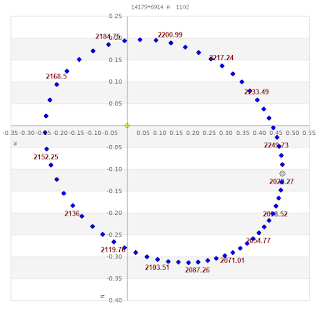
A 1102 AB: 508; 550x: Nice close split, near equal white stars.  Suspected at 300x.  WDS grade 4 orbit, 243-year period.  I don't find Gaia data for the primary.
14h 17m 52.83s +69° 14' 03.5" P.A. 77.60 sep 0.5 mag 9.33,8.65 Sp F2 dist. 182.48 pc (595.25 l.y.)
STF1621 AB: 508; 300x: 1 Dm, nearly 2" separation, light orange stars.  WDS grade 4 orbit, 1379-year period.  There is 83% overlap of their parallax ranges, only 45 AU weighted separation, 0.6+0.6 Msol, very likely a binary.
12h 15m 58.34s +05° 38' 24.8" P.A. 49.50 sep 1.8 mag 10.22,10.59 Sp K8 dist. 28.99 pc (94.57 l.y.)
STF1647 AB: 508; 200x: Near equal white stars, >1" separation.  WDS grade 4 orbit, 1010-year period.  However the stars do not share their parallax ranges, -8% overlap, so in spite of the mere 130 AU weighted separation and 1.5+1.4 Msol, it likely is not binary. 
12h 30m 33.75s +09° 42' 56.4" P.A. 249.50 sep 1.3 mag 8.09,8.37 Sp F2 dist. 92.51 pc (301.77 l.y.)
HU 138 AB: 508; 600x: Faint pair, near equal, well split when resolved to good discs with seeing.  WDS grade 4 orbit, 151.4-year period, it will tighten 0.1" in the next 20 years.  No Gaia parallax data for the primary.
14h 16m 00.46s -07° 03' 43.4" P.A. 216.60 sep 0.6 mag 9.80,9.79 Sp K0 dist. 68.73 pc (224.2 l.y.)
STF1876 AB: 508; 200x: Slightly unequal white stars, nice close split >1".  WDS grade 4 orbit, 966-year period, they unfortunately do not share their parallax ranges (-17% overlap), 104 AU weighted separation, 1.3+1.2 Msol, likely is not a binary.
14h 46m 21.64s -07° 22' 48.7" P.A. 114.80 sep 1.3 mag 8.46,8.62 Sp G0
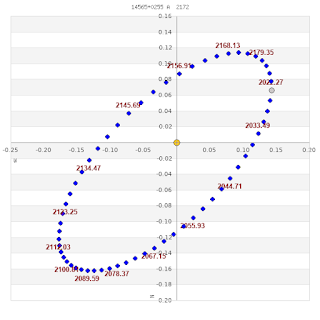
A 2172 AB: 508; 600x: Out of round, but too tough to pin down a position angle, I guess south or east [actually ESE].  WDS grade 3 orbit, 168-year period, it will shift to the NE by the 2040s but become quite difficult to detect.  No Gaia parallax data for the primary.
14h 56m 30.89s +02° 55' 12.2" P.A. 116.60 sep 0.2 mag 8.00,8.60 Sp K0
A 2074 AB: 508; 600x: Overlapping discs / snowman at best moments, PA to the west, 1 Dm.  WDS grade 4 orbit, 59-year period.  At apastron now, it will close rapidly in the coming years and make a dramatic close pass in 2040. No Gaia parallax data for the primary.
15h 27m 20.82s +17° 38' 06.3" P.A. 269.30 sep 0.3 mag 8.55,9.37 Sp F8 dist. 90.74 pc (295.99 l.y.)


5 april 2022, leo doubles

Transparency was not very good last night, a typical warm weather marine haze settling in the Bay Area.  But seeing was pretty good, and I went after some challenge pairs in Leo with fairly good results.  Observed from 9:30pm to a bit after 11pm.  I experimented with 16-inch and 10-inch center masks, but since they were placed on the top of the mirror box they seemed to cause thermal seeing problems.  I may mount them at the top of the tube to see how they do.  The goal is better brightness and resolution with still a relatively small central obstruction.  As it was, I used my apodising mask throughout.

HDS1348 AB: 508; 150x: Obvious light yellow A and orange B, 2 Dm, wide about 9".  WDS says proper motion indicates physical.  There is 2% parallax range overlap, 281 AU weighted separation, 0.7+0.5 Msol, and the radial velocity delta 0.1 is less than the escape velocity 2.7, so it is very likely binary.
09h 23m 06.33s +22° 18' 20.4" P.A. 343.00 sep 8.3 mag 9.77,11.48 Sp M0 dist. 36.04 pc (117.56 l.y.)

COU1563 AB: 508; 150x: Nice near equal white stars, well separated, noticable Dm.  WDS uncertain, but there is -4% parallax range overlap, 930 AU weighted separation, 1.4+1.4 Msol, so not likely binary.
09h 23m 56.58s +32° 00' 22.6" P.A. 34.00 sep 2.5 mag 11.17,11.41

HU 869 AB: 508; 300x: Very fine white stars, 1 Dm, nicely split.  WDS uncertain, and no parallax data for the primary.
09h 25m 09.29s +14° 48' 36.2" P.A. 277.00 sep 0.7 mag 9.87,9.77 Sp K0

COU 935 AB: 508; 550x: Very faint haze resolves with seeing to a small point, 4 Dm and separated from the yellow-white A star.  WDS says physical, but there is -80% parallax range overlap, so it is not binary.
09h 26m 02.70s +18° 54' 02.2" P.A. 240.00 sep 0.9 mag 8.87,11.83 Sp A0 dist. 319.49 pc (1042.18 l.y.)

A 4 AB: 508; 550x: Light yellow-orange A and 2 Dm B, nicely separated around 1".  WDS uncertain, but there is -57% parallax range overlap, they are not binary.
09h 26m 17.45s +31° 08' 50.9" P.A. 37.00 sep 0.9 mag 9.59,10.69 Sp G0

COU1121 AB: 508; 300x: Very tough, very faint B seen with the best seeing, when light orange A tightens and B becomes resolves, separated around 1".  WDS uncertain, and there is -79% parallax range overlap, so they are not binary, in spite of the difficulty.
09h 28m 10.54s +28° 11' 21.8" P.A. 35.00 sep 1.0 mag 9.14,11.85 Sp K0 dist. 434.78 pc (1418.25 l.y.)

COU 936 AB: 508; 500x: Well separated around 1", white A and light orange B, 2 Dm.  WDS has 180.5-year period, it is currently near apastron.  However, Gaia shows -39% parallax range overlap, 70 AU weighted separation, 0.9+1.3 Msol -- so it is questionable whether this is binary at all.
09h 29m 00.67s +19° 17' 18.6" P.A. 224.40 sep 1.0 mag 8.42,9.96 Sp F5 dist. 83.13 pc (271.17 l.y.)

A 130 AB: 508; 300x: Quite a faint pair, slighy delta mag, needed best seeing for the 1" separation to settle.  WDS uncertain, however there is 25% parallax range overlap, 297 AU weighted separation, 1.2+1.2 Msol, so it is likely to be binary.
09h 30m 33.34s +20° 25' 48.6" P.A. 280.00 sep 1.0 mag 11.52,11.53

BU 909 AB: 508; 150x: Nice bright white A, B is very faint but plainly seen, well separated around 6".  WDS uncertain, but there is 50% parallax range overlap, 2,232 AU weighted separation, 3.5+1.2 Msol, so it is likely binary.
09h 32m 13.23s +21° 51' 23.1" P.A. 90.00 sep 6.2 mag 7.59,12.30 Sp K0III dist. 400 pc (1304.8 l.y.)

A 224 AB: 508; 150x: Well separated around 4", 1 Dm, light orange stars.  WDS says not physical, and there is -68% parallax range overlap.
09h 32m 08.01s +30° 26' 55.1" P.A. 145.00 sep 4.0 mag 10.20,11.17 Sp G

HO 368 AB: 508; 150x: White stars, significant delta mag, nice close split <2".  WDS uncertain, but there is 49% parallax range overlap, only 341 AU weighted separation, 1.4+1.6 Msol, so it is likely binary.
09h 37m 25.28s +25° 21' 36.8" P.A. 112.00 sep 1.4 mag 10.05,10.61 Sp F2

A 2479 AB: 508; 600x: Hairline split at the best moments, 1 Dm, PA WSW.  Short 108-year period, it is to make a slow rotation and tighten to the NW by 2040.  No parallax data for the B star.
09h 37m 38.81s +15° 27' 30.7" P.A. 257.60 sep 0.3 mag 9.23,9.87 Sp F8 dist. 174.52 pc (569.28 l.y.)


COU1254 Ba-Bb: 508; 550x: Very finely split, half delta mag, light yellow-white stars.  Component of ARY 51 AB, which is a super-wide separation pair.  WDS uncertain, and unfortunately there is no parallax data for either star.
09h 38m 50.20s +30° 16' 38.0" P.A. 88.00 sep 0.6 mag 10.32,10.12 Sp G0

COU 283 AB: 508; 550x: White stars, near equal, hairline split with the best seeing.  WDS uncertain, and there is no parallax data for the B star.
09h 42m 34.48s +19° 58' 01.7" P.A. 52.00 sep 0.6 mag 10.18,10.42 Sp F0

COU 776 AB: 508; 300x: Nicely split around 1", near equal, white.  WDS uncertain, but there is -21% parallax range overlap, in spite of the 293 AU weighted separation and 1.4+1.4 Msol, it is not likely binary.
09h 45m 45.65s +25° 00' 29.0" P.A. 245.00 sep 1.0 mag 10.84,11.01 Sp F8

COU 285 AB: 508; 600x: Exceptionally fine split with seeing, 1 Dm, light orange stars, very tough.  WDS uncertain, and there is no Gaia data for the B star.
09h 49m 53.92s +19° 47' 05.0" P.A. 187.00 sep 0.5 mag 9.80,10.70 Sp G5

AG 340 AB: 508; 150x: Near equal white stars, well separated around 5".  WDS uncertain, and there is no Gaia data for the primary.
09h 50m 28.65s +26° 02' 25.1" P.A. 310.00 sep 4.8 mag 10.10,10.60

COU 49 AB: 508; 200x: Fine pair, 1 Dm, well separated.  GII 80 not seen, near equal 0.2" to the B star.  WDS uncertain, and unfortunately no Gaia data for the B star.
09h 50m 54.20s +20° 15' 25.0" P.A. 357.00 sep 2.2 mag 10.30,11.10

A 344 AB: 508; 300x: Hairline split, slight delta mag, yellow-white stars.  WDS uncertain, and there is no Gaia data for the B star. 
09h 52m 06.88s +29° 15' 52.2" P.A. 68.00 sep 0.7 mag 9.63,9.96 Sp F8

Saturday, March 26, 2022

two nights this week

I'm combining the observations from two nights earlier this week, only to save some time.  Both nights the seeing was forecasted to be good, and it was pretty decent but only enough to mask to 7-inches.  The first night I focussed on Struves in Lynx (of which there are quite a lot).  The second night, finding I had already observed most the of higher declination Struves, went after a few low in Canis Major, adding some Burnhams which were all in the same area (and visible to me through a slot in the neighbor's bushes).  Pretty good overall.

STF 946 AB: 178; 150x: Light yelow A and 2 Dm, more deeply yellow B, fairly closely separated around 4".  WDS uncertain, however there is no parallax range overlap, -85%, so they are not binary.
06h 44m 51.62s +59° 26' 57.4" P.A. 129.00 sep 4.0 mag 7.30,9.11 Sp F5 dist. 101.11 pc (329.82 l.y.)

STF 881 AB; 178; 600x: 4 Lyn. Very difficult, barest of separations with seeing only, 2 Dm.  WDS binary with 503-year period, it will not make any appreciable change in the coming years.  No Gaia data.
06h 22m 03.57s +59° 22' 19.5" P.A. 150.90 sep 0.6 mag 6.13,7.71 Sp A3V dist. 152.21 pc (496.51 l.y.)
STF 887 AB: 178; 150x: Extremely faint pair, wide, 2 Dm.  WDS not physical, and there is no parallax range overlap, -97%.
06h 24m 19.47s +60° 07' 23.6" P.A. 210.00 sep 7.8 mag 11.05,12.90

STF 916 AB: 178; 150x: White stars, B is considerably fainter, wide.  WDS uncertain, and there is -14% parallax range overlap, so it is not binary.
06h 34m 12.46s +56° 38' 46.1" P.A. 254.00 sep 9.4 mag 9.43,10.55 Sp A3

STF 923 AB: 178; 150x: Light yellow-orange A, wide 2 Dm B.  WDS says parallax indicates physical, however I don't know what they're smoking, there is -94% parallax range overlap, it is not binary.
06h 38m 06.95s +59° 26' 57.9" P.A. 144.00 sep 33.0 mag 7.57,11.47 Sp G8III dist. 226.24 pc (737.99 l.y.)

STF 936 AB: 178; 300x: Light orange A and blue B, delicate split at 200x, better at 300x, 2 Dm, 1" separation, very pretty.  WDS uncertain, and there is no Gaia data for the B component.
06h 39m 43.55s +58° 05' 42.1" P.A. 284.00 sep 1.1 mag 7.26,9.04 Sp G5 dist. 254.45 pc (830.02 l.y.)

STF 963 AB-C: 178; 150x: Light yellow-orange A and very faint B, well separated, not physical.  A is not round at 300-600x but it will not resolve with 7-inch aperture, and seeing would not support 20-inch aperture. 
06h 53m 05.06s +59° 26' 55.2" P.A. 359.30 sep 0.3 mag 6.00,6.53 Sp G4III+A2V dist. 149.25 pc (486.85 l.y.)

STF 968 AB: 178; 150x: Straight-forward Struve, white stars, wide, 1 Dm.  WDS uncertain, but there is 50% parallax range overlap, a pretty wide 5,245 AU weighted separation, 2.3+1.8 Msol, so there is a chance it is binary.
06h 52m 52.01s +52° 40' 49.5" P.A. 289.00 sep 20.7 mag 8.28,9.19 Sp A3

STF1020 AB: 178; 150x: White A and 2 Dm B, wide, seen with direct vision but brightens considerably with averted vision.  WDS says parallax indicates physical, but they are wrong again, -52% parallax range overlap, they are not binary.
07h 11m 56.72s +57° 30' 27.5" P.A. 285.00 sep 13.3 mag 8.76,10.44 Sp F5

STF1032 AB: 178; 300x: Challenging, white A, 3 Dm and very closely separated B, seen only with foveal coaxing.  WDS uncertain, but there is -2 parallax range overlap, so not likely binary.
07h 13m 52.61s +48° 29' 55.8" P.A. 114.00 sep 2.7 mag 7.32,10.34 Sp A2V dist. 148.81 pc (485.42 l.y.)

STF1033 AB: 178; 200x: Very finely split at 150x, better seen at 200x, white A and very light blue B, 1 Dm, very pretty.  WDS uncertain, but there is 33% parallax range overlap, only 280 AU weighted separation, 2.2+1.9 Msol, so there's a good chance it's binary.
07h 14m 48.05s +52° 32' 44.1" P.A. 278.00 sep 1.5 mag 7.81,8.44 Sp F0 dist. 271 pc (884 l.y.)

STF1040 AB: 178; 150x: Blue-white A and red B, wide, 2 Dm.  WDS says physical, and there is 7% parallax range, 1,321 AU weighted separation, 1.7+1.2 Msol, so there is some chance it is binary.
07h 16m 20.14s +48° 12' 54.0" P.A. 261.00 sep 7.3 mag 8.79,10.34 Sp A3

STF1044 AB: 178; 150x: White A and slightly fainter wide B.  WDS says not physical, however they prove themselves incorrect again: 69% parallax range overlap, 1,106 AU weighted separation, 0.9+0.9 Msol -- so there is some chance this could be binary.
07h 17m 08.96s +47° 39' 18.1" P.A. 169.00 sep 13.1 mag 10.08,10.60 Sp K0

STF1065 AB: 178; 150x: Equal white stars, very wide.  WDS says proper motion indicates physical, but there is -7% parallax range overlap, so they cannot be binary. 
07h 22m 15.11s +50° 08' 55.7" P.A. 256.00 sep 15.1 mag 7.51,7.67 Sp A6II dist. 283.29 pc (924.09 l.y.)

STF1092 AB: 178; 150x: Very nice close split around 3", almost 2 Dm.  WDS uncertain, but there is -4% parallax range overlap, so it is not binary.
07h 30m 22.47s +49° 14' 20.4" P.A. 71.00 sep 2.9 mag 8.56,10.45 Sp A2

STF1093 AB: 178; 300x: Excellent pair, near equal, elongated at 150x, delicate split at 200x, best seen at 300x.  WDS gives and orbital solution with a 715-year period, and there is 28% parallax range overlap, only 115 AU weighted separation, 1.5+1.4 Msol.  
07h 30m 16.51s +49° 58' 42.0" P.A. 207.40 sep 0.9 mag 8.79,8.98 Sp F5 dist. 90.42 pc (294.95 l.y.)

STF1117 AB: 178; 150x: Wide one delta, faint stars.  WDS says parallax indicates physical, but in reality there is no parallax range overlap, -60%, so it is not binary.
07h 36m 43.19s +35° 23' 30.0" P.A. 228.00 sep 11.6 mag 9.10,10.59 Sp F0

STF1145 AB: 178; 300x: Fine pair, a challenge with 3 Dm, very closely split at 200x, best seen with 300x.  WDS uncertain, but there is -54% parallax range overlap, it is not binary.
07h 51m 19.02s +38° 49' 17.3" P.A. 42.00 sep 1.3 mag 8.73,10.39 Sp A3 dist. 311.53 pc (1016.21 l.y.)

STF1204 AB: 178; 150x: Easy, wide, 1 Dm.  WDS says physical, but there is -46% parallax range overlap, it is not binary.
08h 15m 54.24s +38° 28' 53.3" P.A. 104.00 sep 11.5 mag 9.24,10.33 Sp F8

STF1211 AB: 508; 800x: AC is a wide 1 Dm pair.  The A star is suspected of being out of round with 7-inch 300x, one detla, with PA to the south.  It resolves to a near equal pair, hairline split, with 20-inch at 800x.  AB has an orbital solution in WDS, 407-year period, it will widen to 0.6" by the 2040s.
08h 18m 19.65s +38° 59' 10.0" P.A. 156.60 sep 0.4 mag 9.65,9.97 Sp K0 dist. 62.97 pc (205.41 l.y.)
STF1222 AB: 178; 150x: Easy, 1 Dm, wide.  WDS says parallax indicates physical, and there is 82% overlap of the parallax ranges, 2,179 AU weighted separation, 1.9+1.4 Msol, so it is very possibly binary.
08h 26m 20.39s +37° 32' 43.3" P.A. 49.00 sep 10.0 mag 8.71,10.20 Sp A3 dist. 502.51 pc (1639.19 l.y.)
STF1239 AB: 178; 150x: Rather uninteresting, wide separation, >1 Dm.  WDS says parallax indicates physical, however there is -22% (no) overalp of the parallax ranges, so it cannot be binary.
08h 32m 29.47s +37° 29' 19.8" P.A. 290.00 sep 12.8 mag 9.64,11.03 Sp A5

STF1282 AB:178; 150x: Lovely white stars, near equal, around 3" separation, pleasingly close at this low mangnification.  WDS orbital solution with 804-year period.  There is 29% overlap of the parallax ranges, only 195 AU weighted separation, 1.3+1.3 Msol, and the radial velocity delta 0.7 is less than the escape velocity 4.8, so it is binary.  Too bad the human lifespan is so short as it will tighten to an impossibly close separation 300 years from now.
08h 50m 44.28s +35° 04' 15.4" P.A. 278.70 sep 3.4 mag 7.59,7.76 Sp F8 dist. 51.6 pc (168.32 l.y.)

STF1296 AB: 178; 150x: Beautiful hair, hairline split with low magnification, 0.5 Dm.  WDS says parallax indicates physical, and there is 54% overlap of their parallax ranges, only 184 AU weighted separation, 1.2+1.0 Msol, and the radial velocity delta 0.3 is less than the escape velocity 4.7, so it is very likely binary.
08h 59m 16.74s +34° 56' 46.9" P.A. 76.00 sep 1.9 mag 9.05,9.95 Sp G5

STF1274 AB: 178; 150x: White A and light orange B, wide, 2 Dm.  WDS uncertain, but there is 90% overlap of their parallax ranges, 2,014 AU weighted separation, 2.6+1.7 Msol, so it is quite likely binary. 
08h 49m 00.34s +38° 20' 42.9" P.A. 42.00 sep 9.1 mag 7.42,9.34 Sp A2 dist. 241.55 pc (787.94 l.y.)

STF1279 AB: 178; 200x: Lovely white stars, finely split, slightly unequal.  WDS uncertain, but there is -67% parallax range overlap, so it is not binary.
08h 49m 59.98s +39° 35' 23.3" P.A. 88.00 sep 1.1 mag 9.16,9.25 Sp G0 dist. 133.16 pc (434.37 l.y.)

STF1259 AB: 178; 150x: Very faint but easy pair, 1 Dm, widely split around 5".  WDS says proper motion indicates physical, and there is 74% parallax range overlap, 1,009 AU weighted separation, 1.6+1.4 Msol, and the radial velocity delta 0.6 is less than the escape velocity 2.3, so it is binary.
08h 46m 35.58s +38° 29' 08.6" P.A. 341.00 sep 5.2 mag 9.45,9.95 Sp G0 dist. 144.3 pc (470.71 l.y.)

STF1251 AB: 178; 150x: Faint stars, 1 Dm, fairly wide.  WDS says parallax indicates physical, but there is -64% parallax range overlap, so they are not binary.
08h 40m 11.94s +41° 17' 07.6" P.A. 31.00 sep 6.6 mag 10.39,10.88 Sp F8 dist. 14.59 pc (47.59 l.y.)

STF1244 AB: 178; 150x: 2 Dm, fairly wide around 4".  WDS says physical, but there is exactly 0% parallax range overlap, 597 AU weighted separation, 1.6+1.1 Msol -- it could be binary, but certainly more time is needed to trace their paths.
08h 37m 39.24s +41° 48' 02.3" P.A. 1.00 sep 3.7 mag 9.02,10.32 Sp G8III dist. 157.23 pc (512.88 l.y.)

STF1160 AB: 178; 150x: White stars, 2 Dm, well split.  WDS says not physical, and there is -7% parallax range overlap, so likely not binary.
08h 01m 25.52s +56° 56' 36.5" P.A. 32.00 sep 6.1 mag 8.71,11.54 Sp F8 dist. 90.91 pc (296.55 l.y.)

STF1165 AB: 508; 667x: AB-C is a super-wide, faint pairing, almost 4 Dm.  Close pair AB (which is the same as STF 1166) observed an elongation with the weaker end to the west.  It was discovered at 0.7" so it has closed considerably.  WDS uncertain, and unfortunately no Gaia data for the B star.
08h 02m 07.40s +54° 36' 54.8" P.A. 318.00 sep 0.2 mag 8.60,10.03 Sp A0 dist. 232.02 pc (756.85 l.y.)

STF1200 AB: 178; 150x: Easy white stars, near equal, wide.  WDS uncertain, there is 19% parallax range overlap, 1,816 AU weighted separation, and 1.8+1.8 Msol, so there's a fair chance it is binary.
08h 15m 58.26s +49° 46' 19.5" P.A. 181.00 sep 8.3 mag 9.16,9.33 Sp G0 dist. 165.84 pc (540.97 l.y.)

STF1205 AB: 178; 200x: Very delicate split at 150x, better at 200x, near equal faint stars. WDS uncertain, but there is -62% parallax range overlap, it is not binary.
08h 19m 21.43s +56° 27' 07.1" P.A. 166.00 sep 1.8 mag 9.66,10.06 Sp G5

STF1225 AB: 178; 150x: Near equal, white, wide around 4".  WDS says proper motion indicates physical, and there is 26% parallax range overlap, 1,066 AU weighted separation, 1.8+1.8 Msol, so it might be binary.
08h 29m 45.55s +51° 12' 08.5" P.A. 192.00 sep 3.8 mag 9.60,9.75 Sp A2

STF1235 AB: 178; 300x: Challenging 2 Dm, close split a little more than 1", best view at 300x.  WDS uncertain, but there is -24% parallax range overlap, so it is not binary.
08h 34m 12.35s +56° 55' 23.1" P.A. 88.00 sep 1.5 mag 8.35,10.04 Sp A0 dist. 192.68 pc (628.52 l.y.)

BU 209 AB: 178; 150x: Excellent pair, nice close split around 1", nearly 1 Dm.  WDS uncertain, but there is 35% parallax range overlap, only 162 AU weighted separation, 1.5+1.4 Msol, so it is most likely binary.  Burnham discovered with 6-inch at 2.0", it has closed considerably since.
08h 43m 13.12s +38° 48' 31.9" P.A. 9.00 sep 1.2 mag 8.72,9.01 Sp F5 dist. 145.99 pc (476.22 l.y.)

BU 576 AB: 178; 300x: Very momentary resolution of a exceptionally fiant B in A' diffraction, more than 1" separation.  WDS says physical, but there is (surprisingly) no parallax range overlap, -75%, so it is not binary.  Burnham discovered with the 18.5-inch refractor.
08h 21m 37.05s +33° 56' 12.4" P.A. 134.00 sep 1.6 mag 7.30,10.88 Sp K0 dist. 271.74 pc (886.42 l.y.)

STF1016 AB: 178; 150x: Pretty white A and slightly red B, 2 Dm, well split around 5".  WDS uncertain, and there is no Gaia data for the secondary.
07h 04m 38.29s -11° 31' 26.4" P.A. 150.00 sep 5.4 mag 7.36,9.53 Sp B0V dist. 1098.9 pc (3584.61 l.y.)

STF1011 AB: 178; 150x: Pretty faint, 1 Dm, light orange stars, about 4" separation.  WDS uncertain, but there is 31% parallax range overlap, 968 AU weighted separation, 2.0+1.8 Msol, so it is possible to be binary.
07h 00m 50.91s -15° 18' 56.8" P.A. 300.00 sep 4.2 mag 8.52,9.00 Sp A2/3V

STF1031 AB: 178; 150x: Faint pair, near equal, white, around 4" separation.  WDS says parallax indicates physical, but there is -14% parallax range overlap, so they are not binary.
07h 08m 35.97s -13° 59' 22.0" P.A. 252.00 sep 3.5 mag 8.97,9.86 Sp A4III/IV

BU 328 AB: 178; 300x: FN CMa.  Snowman at best moments, PA to southeast, light yellow stars, significant delta magnitude.  WDS uncertain, and unfortunately there is no Gaia data.  Component of STF1026, 0.3" at discovery!  STF1026 AB-C is a very widely separated faint star 9th magnitude, PA to the north. 
07h 06m 40.77s -11° 17' 38.5" P.A. 111.00 sep 0.6 mag 5.70,6.91 Sp B0.5IV dist. 934.58 pc (3048.6 l.y.)

BU 332 AB: 178; 300x: Light yellow stars, appears as a snowman / overlapping discs, PA to the south.  WDS uncertain, and there is no Gaia data for the secondary.   0.8" at discovery, component of STF1097 AC which is a nearly 3 Dm pair very widely separated PA to the northwest.
07h 27m 51.66s -11° 33' 24.7" P.A. 173.00 sep 0.7 mag 6.22,7.35 Sp G8Ib-II dist. 485.44 pc (1583.51 l.y.)

BU 574 AB: 178; 300x: Very excessively faint B star barely detected, PA northwest.  WDS says not physical, however there is 72% parallax range overlap, 2,548 AU weighted separation, 5.5+2.5 Msol, so it very much may be binary.  Burnham discovered with the 18.5-inch Dearborn refractor.
07h 06m 56.44s -11° 19' 38.5" P.A. 308.00 sep 2.4 mag 7.66,11.05 Sp B0.5V dist. 694.44 pc (2265.26 l.y.)

BU 575 AB: 178; 300x: Orange A appears as overlapping near equal discs with high power.  WDS orbital solution with a 402-year period, no Gaia data for the B star.  STF 1057 AB-C is a blue star, very wide, 2 Dm.  
07h 14m 48.26s -15° 28' 33.5" P.A. 329.00 sep 0.3 mag 8.29,7.88 Sp F5V dist. 92.85 pc (302.88 l.y.)

BU 198 AB: 178; 150x: Light orange stars, 3 Dm, well split, seen with averted vision at first then can hold direct.  WDS says not physical, and there is no overlap of parallax ranges, -42%.  Burnham discovered with 6-inch and said "The larger star is red."
07h 25m 47.38s -20° 57' 27.3" P.A. 214.00 sep 5.7 mag 7.86,10.50 Sp M1

BU 199 AB: 178; 300x: >1 Dm, closely split about 3".  WDS says not physical, but there is 93% parallax range overlap, 4,360 AU weighted separation, 9.4+7.6 Msol, so it is very possible to be binary!  DAM1372 AD is a wide near equal PA to the east, of which WDS is uncertain, but this is a comoving pair, not binary: 59% parallax range overlap but a tremendous 253,363 AU weighted separation, 9.4+7.4 Msol, but too far apart to hold a barycenter. 
07h 25m 07.97s -21° 10' 25.9" P.A. 24.00 sep 1.8 mag 7.21,8.05 Sp B1Iab dist. 14285.71 pc (46599.99 l.y.)

BU 331 AB: 178; 200x: 1 Dm, with beast moments of seeing only, close split around 2".  WDS uncertain, however there is 36% parallax range overlap, 834 AU weighted separation, 2.9+2.4 Msol, so it is likely binary.  Burnham discovered with 6-inch at 2.0, unchanged since. 
07h 20m 02.73s -24° 24' 57.7" P.A. 117.00 sep 2.0 mag 8.30,9.11 Sp ApSi dist. 293.26 pc (956.61 l.y.)

BU 572 AB: 178; 200x: Very excessively faint B around 3" separation.  WDS says not physical, and there is -48% parallax range overlap.  Burnham discovered with the 18.5-inch and says "Many small stars in the field"  J2000 coordinates put this in open star cluster Tombaugh 1 -- Burnham first to notice it as a cluster, but maybe didn't use low enough magnification to detatch the cluster from its surroundings.  
07h 00m 35.09s -20° 38' 25.1" P.A. 142.00 sep 5.2 mag 6.76,10.02 Sp A4m+A5/A9 dist. 240.96 pc (786.01 l.y.)

BU 578 AB: 178; 200x: NR CMa.  Very difficult, the barest fleck of a star just separated, fleeting, at best moments only.  WDS says not physical, however there is 4% parallax range overlap, only 127 AU weighted separation, 2.5+1.1 Msol, so it might be binary (though the proper motion vector is negative, meaning they're moving in opposite directions, though this might just be due to the direction of the orbit?)
07h 27m 07.99s -17° 51' 53.4" P.A. 39.00 sep 1.3 mag 5.66,9.23 Sp A5n dist. 92.34 pc (301.21 l.y.)